
Why Casinos Watch Whale Baccarat Players So Closely
The surveillance intensity directed at the largest baccarat players is not an accident of the game. It follows from the mathematical structure of baccarat, the scale of the wagers, and a documented history of advantage play that has cost casinos many hundreds of millions of dollars.
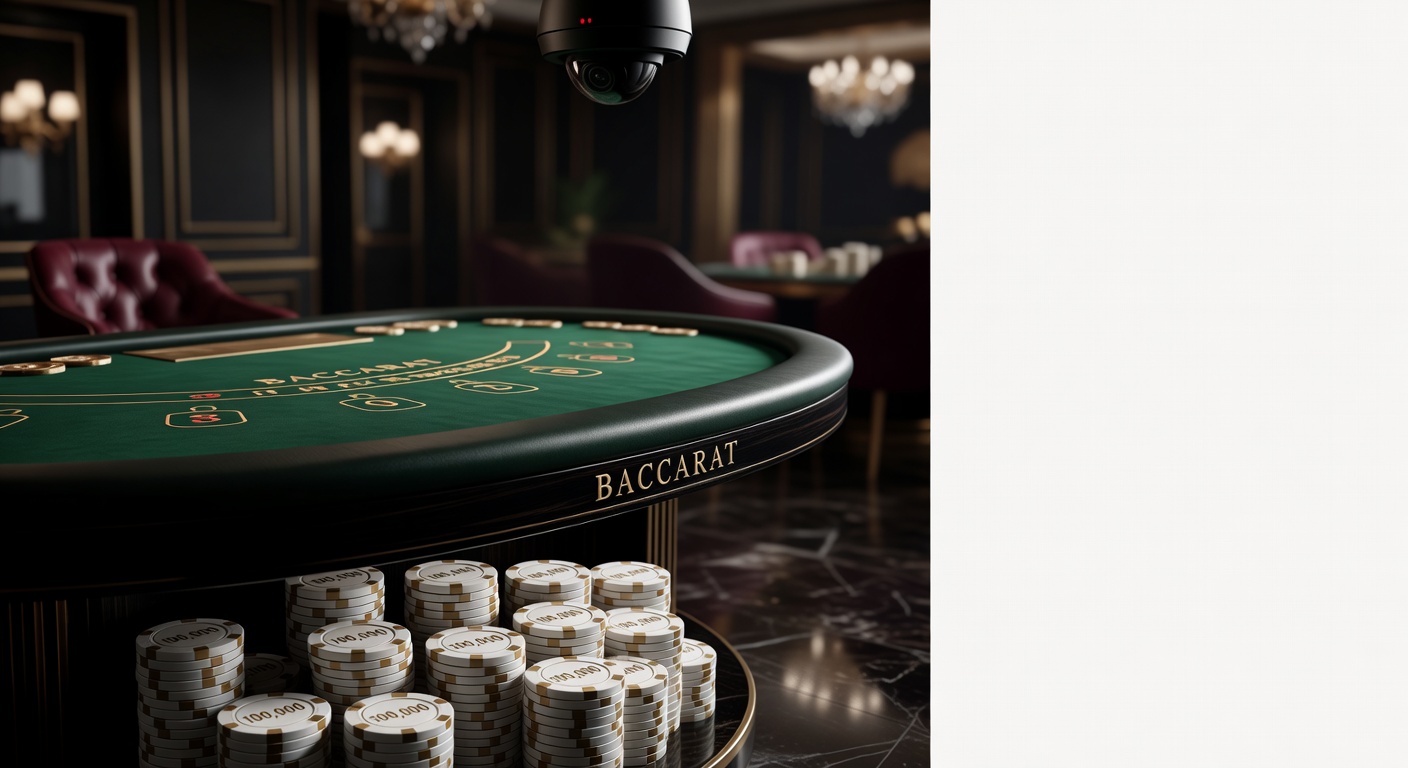
To understand the attention paid to whale baccarat players, one must begin with the economics of the game itself.
The arithmetic of volatility
Baccarat's house edge is famously narrow. On the banker bet, with a five percent commission, the house edge is approximately 1.06 percent. On the player bet, it is approximately 1.24 percent. These are the thinnest edges among the standard table games, thinner than blackjack played with basic strategy in most rule configurations. The tie bet carries a much larger edge of roughly 14.4 percent with the standard eight-to-one payout, but serious players rarely touch it.
Because the edge is narrow, the variance per hand is comparatively high relative to expected value. A player wagering 500,000 US dollars per hand and playing 60 hands per hour has an expected hourly loss of roughly 318,000 US dollars on the banker bet, but the standard deviation of that hour is several times larger. Casinos structure their baccarat operations around this reality. The game produces enormous swings in both directions, and the house's edge materializes only across very large volumes of action.
The implication is straightforward. A baccarat whale can put a casino's monthly, quarterly, or even annual results at risk in a way that a whale at another game cannot. MGM's publicly disclosed results in several quarters over the past two decades have been moved meaningfully by the win or loss of individual high-end Asian customers, a fact acknowledged in MGM Resorts International's own 10-Q and 10-K filings during the 2012 to 2015 period.
The history of advantage play at baccarat
The second reason for close surveillance is a specific, documented history. Baccarat is, at first glance, a game with no decisions. The player bets, the cards are dealt according to fixed rules, and the outcome is resolved. Advantage play should be impossible. In fact, several methods have produced sustained wins, and each has shaped current surveillance practice.
The most famous is edge sorting. Phil Ivey, playing alongside Cheung Yin Sun, exploited minute asymmetries in the patterns printed on the backs of playing cards at Crockfords in London in August 2012 and at the Borgata in Atlantic City in 2012. The combined winnings were approximately 7.8 million pounds at Crockfords and 9.6 million US dollars at the Borgata. Both casinos refused to pay or sued to recover the money, and both prevailed in court, Crockfords at the UK Supreme Court in October 2017 and the Borgata in United States federal court in October 2016. The cases established that edge sorting, in the jurisdictions involved, constituted a breach of the implied contract between player and casino.
Earlier examples include card steering, card counting by memorizing remaining high cards in a shoe, and in at least one case in the 1990s, a team that bribed dealers to use false shuffles. MIT alumnus John Chang was involved in baccarat teams in the 1990s, though the group is better known for its blackjack work.
What the surveillance actually watches
The monitoring of a whale baccarat table combines several technologies and human practices.
- Overhead cameras, now almost universally in high definition and often with real-time video analytics, record every card from the moment it leaves the shoe.
- Chip trays are weighed continuously in many modern casinos, so that the house has a running estimate of the player's position without relying on the dealer's count.
- RFID-enabled chips, introduced incrementally from the mid-2000s, allow the casino to track bet sizes with accuracy independent of the dealer's visual judgment.
- Card backs are inspected for consistency at the start of each shoe, and in several casinos the cards are rotated one hundred and eighty degrees on a random schedule specifically to defeat edge sorting.
- Shufflers, particularly the continuous shuffling machines, remove several classes of advantage play that depend on identifying patterns from shoe to shoe.
The human side is equally important. Pit managers at whale-level tables are often among the most experienced on the property. They watch both the cards but the player's behavior: requests regarding card rotation, specific dealer preferences, unusual attention to one end of the shoe, and patterns in bet sizing that do not match the stated system.
The commercial stakes
The third reason for the attention is simpler. The whale segment is the most commercially concentrated in the industry. In Macau, a single junket room operator's top client could generate tens of millions of dollars of theoretical loss per month during the 2011 to 2014 peak, and the Macau market as a whole depended on the high-roller segment for a majority of its gross gaming revenue. In Las Vegas, the Asian baccarat customer became, by the early 2010s, the single most important source of table-game revenue on the Strip.
When a small number of customers generate a large share of revenue, the downside of each individual's variance is magnified. Losing a whale to a competitor, through poor comp treatment or a dispute over a disallowed bet, has a direct and measurable impact on the property's results. The surveillance is therefore not merely defensive against advantage play; it is the foundation on which the comp program, the line of credit, and the private salon are built. The casino needs to know, to the dollar, how much theoretical revenue the player generates, because every discretionary benefit offered back to the player is priced against that figure.
The synthesis
Whale baccarat sits at the intersection of a thin edge, a high variance, a documented history of successful advantage play, and a concentrated commercial significance. Each of these conditions individually would justify elevated scrutiny. Together they make the whale baccarat table the most intensively monitored environment on most casino floors, more so than any blackjack pit and more so, in many cases, than the cash cage itself. The attention is not an accident. It is what the mathematics and the history of the game have produced.