
Shuffle Tracking: Is It Still Possible in Modern Casinos?
A blackjack technique from the analog era, a conversation with a retired card counter in a Reno coffee shop, and the slow painful decline of an advantage play that once made careers. Where shuffle tracking stands in 2026.
Arnold Snyder's name came up on the second cup of coffee at the Pneumatic Diner on West 2nd Street in Reno, on a morning so dry and bright that the light through the front window felt like an overhead lamp. The retired advantage player across from me, whom I will call Tom (not his real name, and he asked me not to use it because, he said, "some of my guys are still working"), had been talking about card counting for about forty minutes when I asked him, carefully, whether anyone he knew was still shuffle tracking.
He looked at me the way a man looks at someone asking if anyone still drives a Model T.
"Depends what you mean by still," he said.
Tom had been a shuffle tracker in the 1990s. He was, by his own account, part of a small team that worked the Strip and the Northern Nevada clubs between about 1992 and 2004. He stopped, not because he was caught (he was never caught at any casino, he told me twice for emphasis) but because the game itself had changed around him in ways that made the work unprofitable. The story of why is the story of shuffle tracking as a technique, and it is worth telling because it tells you a lot about how casinos respond to advantage play.
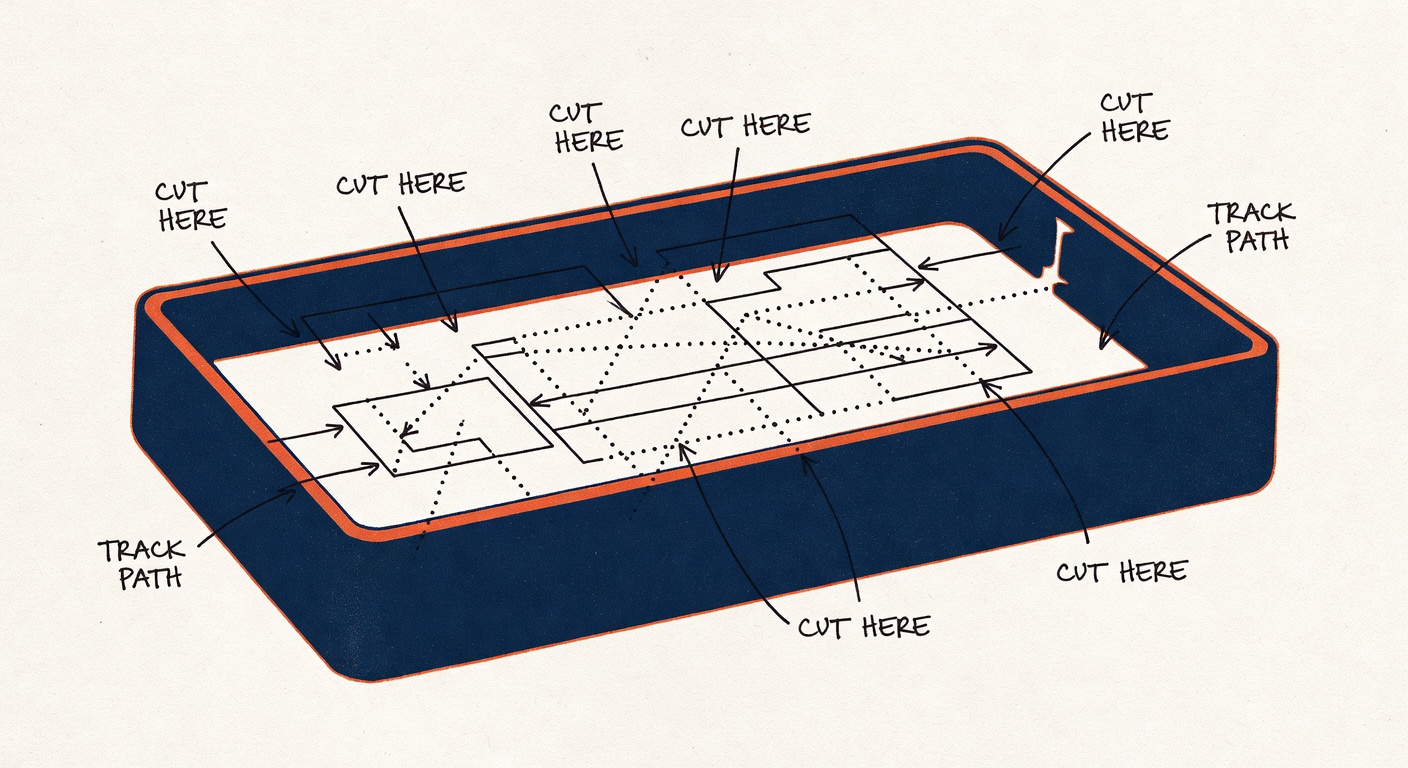
The premise of shuffle tracking is simple in description and brutal in execution. A card counter tracks the count of cards as they come out of a multi-deck shoe. At the end of the shoe, the dealer shuffles the cards, and a fresh shoe begins. In a simple hand shuffle (the kind that dealers used in most of the mid-20th century), the shuffle is a rough but finite process: the cards get interleaved and stripped, but the resulting deck is not a perfectly random permutation. Certain sequences and clumps of cards from the original shoe remain detectably together in the new shoe. A trained tracker, watching the shuffle carefully, can estimate where a known "slug" of high-value cards (tens and aces, the counter's friends) is likely to end up in the new shoe, and play more aggressively when that slug is being dealt.
Arnold Snyder, the author of The Shuffle Tracker's Cookbook and a handful of other seminal works on the technique, described the skill in the late 1980s and spent the next two decades refining it. Peter Griffin's Theory of Blackjack and later Stanford Wong's Professional Blackjack had introduced the mathematical framework. A small professional community of trackers operated quietly through the 1990s, some of them affiliated with the MIT Blackjack Team and its various descendant crews, most of them independents.
In the best conditions (a hand-shuffled six-deck shoe, a dealer with a visible and consistent shuffle technique, good penetration through the pack, and a tracker with hundreds of hours of practice), shuffle tracking could add a full percentage point to the player's edge on top of whatever the counting technique was already producing. At bet spreads appropriate to the game, this could turn a marginal advantage-play opportunity into a real business.
Then, across the 2000s and 2010s, the business dried up. The reasons were technological.
The automatic shuffler
The first kill switch was the automatic shuffling machine (ASM). Shuffle Master (now part of Scientific Games) began installing automated shufflers in casinos in the 1990s, first as aids to the dealer (speed up the shoe break) and then as full replacements. A modern ASM takes the used cards, performs a mechanical shuffle that is demonstrably close to a uniform random permutation, and returns the shoe for the next hand. Against an ASM, shuffle tracking is essentially impossible, because the mechanical process does not preserve the positional information a tracker needs.
By 2010, the majority of multi-deck blackjack tables in Nevada were running ASMs. By 2020, the holdouts were mostly high-limit rooms that preserved hand shuffles for atmospheric reasons.
The continuous shuffler
The second kill switch, which affected card counting and shuffle tracking alike, was the continuous shuffling machine (CSM). A CSM re-introduces the played cards into the shoe after each hand, so there is never a discrete end-of-shoe moment. You cannot track a shuffle that never finishes. You also cannot count, because the count resets continuously.
CSMs are now standard at many low and mid-limit tables in Nevada, Atlantic City, and most regional markets. They are not universal, but they are common enough that a tracker looking for hand-shuffled games has to search for them.
What's left
Tom, sipping coffee that had gone cold in his hand, listed what remained.
- A small number of high-limit tables in Vegas and Macau still use hand shuffles, specifically for the theatrical effect. These are the only tables where shuffle tracking remains technically possible.
- Some regional casinos in smaller markets (Kansas tribal properties, some Midwestern riverboats, scattered Canadian tables) still run hand-shuffled games at moderate stakes. The crews that still work, he said, travel.
- Carnival side bets on hand-shuffled games occasionally offer exploitable structure, but this is a narrow sub-skill.
The rest is gone. The Strip has almost no hand-shuffled six-deck games below the $500 minimum. The downtown Vegas properties are mostly CSM or ASM. Reno, which was once a fertile hunting ground, is now dominated by electronic tables and machine-shuffled shoes.
What this means for modern players
Let me be clear about something. Shuffle tracking was always a specialist's technique, not something a casual player could pick up over a weekend. It required hundreds of hours of practice with a video camera and stopwatch in a hotel room, team communication protocols, cover plays, bankroll management at professional-grade risk-of-ruin standards. It was never a technique for the hobbyist.
The question "is it still possible in modern casinos" is really two questions. Is it mathematically possible? Yes, at the small number of remaining hand-shuffled games, with the same practice burden as before. Is it economically possible? That is harder. The economics of a tracking operation depend on game availability, bet size, and operating costs. With the available games now concentrated in high-limit rooms, the entry cost is higher, the scrutiny is greater, and the tolerance for cover play is lower. The major surviving crews I have heard about operate in Macau rather than the US.
Tom described a cousin of the technique that has partly replaced it: tracking within a continuous shuffler's error margin. Some older CSMs have been documented to produce non-uniform permutations under certain loading conditions. This is not shuffle tracking in the traditional sense; it is machine exploitation, and it falls into the same legal and ethical category as hole carding or ace sequencing. The crews that do this work are tiny, mostly engineers, and almost entirely silent.
The departure
We walked out of the Pneumatic Diner around noon. The parking lot was half empty. Tom had driven down from Truckee for the interview. He was in his early sixties now, clean-shaven, gray hair cut short, the eyes of a man who had spent twenty years watching the tops of shoes with a concentration that most people reserve for operating a lathe.
I asked him, standing by his truck, whether he missed the work.
He thought about it for longer than I expected.
"I miss being good at something," he said, "that the other guys didn't understand. The tracking itself was boring. The being good at it was not."
He drove away. A man in a reflective vest was sweeping the parking lot. The sky over Reno was the same hard empty blue it had been all morning. I stood for a minute thinking about the tiny history I had just been handed, a generation of advantage players who learned a technique the casinos had since engineered out of existence, most of them now retired, a few still working the edge cases, the whole practice now mostly a ghost inside a physical game that has itself been largely replaced by digital versions where the concept of "shuffle" no longer means what it used to mean.
You can still shuffle track in 2026. You would be hunting a handful of games, in a handful of rooms, under a level of surveillance that the 1990s crews would find comical. The technique is not dead. Its ecosystem mostly is. Which, when you think about it, is a distinction without much of a difference.