
Red Flags When Choosing an Online Blackjack Site
Not every online blackjack site deserves the player's trust. A patient enumeration of the warning signs can save the prospective player from discovering the problems after a deposit rather than before.
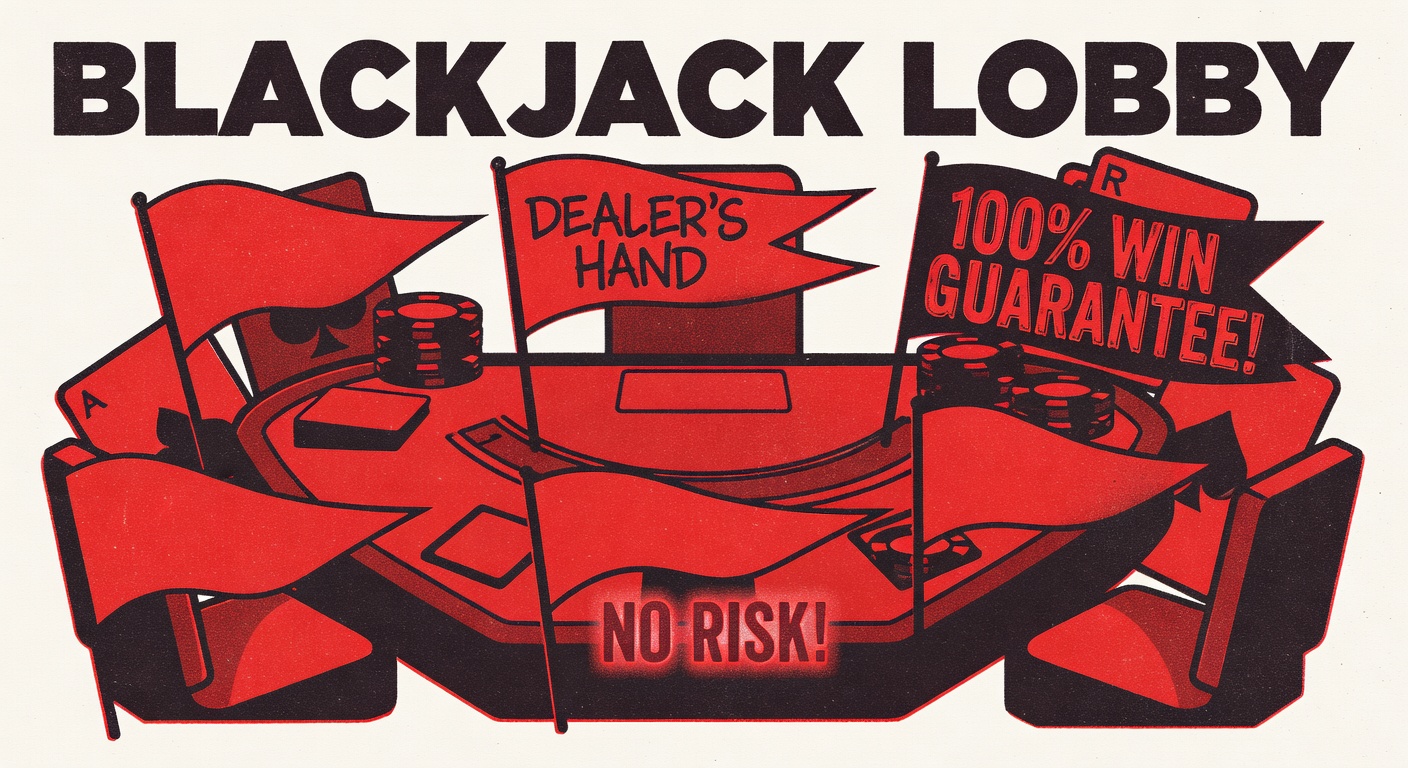
What should one look for before committing funds to an online blackjack site?
Let us proceed by questions, each addressing a specific warning sign. The reader who walks through the list carefully is unlikely to fall into the commoner traps.
Q: Is an unlisted or obscure license a concern?
Yes. A legitimate online blackjack site operates under a license from a recognized regulator. The United Kingdom Gambling Commission, the Malta Gaming Authority, the Gibraltar Gambling Commissioner, and several state-level regulators in the United States are the most demanding. A Curacao license is legitimate but carries weaker consumer protections. A license from a regulator the player has never heard of, or the complete absence of a license number in the site's footer, is a serious warning.
The license number can and should be verified on the regulator's own website. A site claiming a UKGC license that does not appear in the UKGC's public register is either mistaken or dishonest. In either case, the player should not deposit.
Q: What if the site refuses to show its game rules clearly?
A reputable blackjack site publishes, for each variant it offers, the specific rules. The number of decks, the dealer's soft-seventeen rule, the availability of doubling after splitting, the availability of surrender, and the payout on a blackjack, three to two or six to five, are all material. A site that hides these rules, or that makes them available only after registration, is a concern.
The reason is simple. The house edge of blackjack varies from approximately 0.3 percent under favorable rules to approximately 2 percent under unfavorable rules. A player who cannot verify the rules cannot verify what they are paying for.
Q: What is the significance of six-to-five blackjack payouts?
A payout of six to five on a natural blackjack, rather than the traditional three to two, adds approximately 1.4 percent to the house edge. This is a substantial change, converting an otherwise favorable game into one with a meaningfully negative expected value. Six-to-five payouts are common enough that they are not in themselves a red flag for dishonesty, but they are a red flag for the player seeking to minimize house edge. A site that offers only six-to-five blackjack is a site the player should either avoid or play only at the lowest stake acceptable.
Q: Are continuous shuffling machines a warning sign?
Not of dishonesty. Continuous shufflers are legitimate tools used to discourage card counting and speed the pace of play. They are, however, a warning sign for a player who is seeking the most favorable variant. A game played from a freshly-shuffled shoe after every hand offers no possibility of counting, which is a lost possibility even for a player who does not count actively, because the absence of counting-friendly conditions tends to correlate with other unfavorable rule choices.
Q: What about the reputation of the game provider?
The provider of the game software matters. Major recognized providers such as Evolution Gaming, NetEnt, Playtech, Microgaming, and Pragmatic Play are regulated and audited. Games from these providers have publicly available return-to-player figures, have passed certification by laboratories such as GLI and iTech Labs, and are operated under the provider's reputational stake.
A site offering blackjack from a provider the player has not heard of, particularly one that does not display certification seals or publish RTP figures, warrants scepticism. The game might be fair; the player has no way to verify it.
Q: What are the warning signs in payment handling?
Several signs suggest caution.
- Deposits accepted only through unusual channels, such as direct wire transfer to an obscure account or exclusive cryptocurrency deposits to a wallet the site does not verify through a reputable processor.
- Withdrawals with unusual delays, hidden minimum amounts, or arbitrary identity verification demands after a win but not after a deposit.
- Terms that permit the operator to withhold withdrawals indefinitely under vague conditions.
- Lack of standard payment partners such as Visa, Mastercard, or major e-wallets.
The payment relationship is where the player's funds actually live. A site that cannot maintain relationships with standard payment processors has failed a due diligence test conducted by those processors, and that failure is informative.
Q: What about the bonus terms?
Bonus terms are often the clearest test of an operator's intentions. A reputable operator will state wagering requirements, game contributions, maximum bets during bonus play, and expiry windows clearly, and will enforce them consistently.
Warning signs include.
- Wagering requirements above 50x, particularly on the bonus plus deposit rather than the bonus alone.
- Game contribution from blackjack of zero, or wording suggesting that blackjack play may void the bonus entirely.
- Maximum bet limits so low that clearing the bonus within the expiry window would be impractical at any reasonable pace.
- Clauses that allow the operator to void winnings under vaguely defined conditions, such as bonus abuse, without clear criteria.
Any one of these in isolation is a reason for caution. Several together are a reason to avoid the site.
Q: What about the customer support experience?
One can often learn a great deal from a pre-registration question. Contact customer support, by live chat or email, before depositing, and ask a specific question about, for example, the variant of blackjack offered or the withdrawal timing. A reputable operator will answer promptly, accurately, and in clear language. A site whose support is slow, evasive, or confused about its own product is a site whose operational quality is likely to be similarly weak.
Q: What about external reviews and player forums?
Independent review sites and player forums are useful sources, with caveats. Some review sites are affiliate-funded and favor the operators that pay them; some forums contain disputes that are genuinely informative and others that reflect individual unreasonable grievances.
The useful signal is the pattern. A site with consistent reports of slow withdrawals across many players is probably slow to withdraw. A site with a single aggrieved complaint in a sea of otherwise positive reports is harder to assess but generally less concerning.
Q: What are the signs that a site is actively fraudulent?
The most serious red flags are specific.
- The site operates without a verifiable license from any recognized authority.
- The site's terms permit confiscation of winnings under very broad and undefined conditions.
- Multiple player reports describe funds being deposited but withdrawals being repeatedly refused or delayed.
- The site's games come from unverified or unknown providers.
- The site uses contact addresses, company registrations, or payment channels that change frequently.
A site displaying several of these characteristics should not receive the player's deposit.
Q: What should the prospective player actually do?
Let us draw the examination to a practical close. Before depositing at any new online blackjack site, the player might.
- Verify the license on the regulator's own website.
- Read the published rules of the specific blackjack variants offered.
- Check the bonus terms carefully, with particular attention to game contribution and wagering requirements.
- Make a test interaction with customer support.
- Search for independent reviews and player reports.
- Start with a small deposit and complete at least one withdrawal before committing larger funds.
These steps require perhaps half an hour of attention. They will not eliminate all risk, but they will filter out the common failure modes and leave the player with a reasonable confidence that the site they have chosen will pay what it owes and operate the games as described.
The broader principle is one of patience. The player who resists the impulse to deposit immediately, and instead spends the time to verify the basic claims of the site, is acting with the quiet discipline that distinguishes the deliberate bettor from the hurried one. In gambling, as in most endeavors, hurry is usually expensive.