
How Bonus Abuse Detection Typically Works
An examination of the technical, behavioural, and operational systems that online casinos use to detect players exploiting promotional offers beyond their intended terms, and the quiet tension between legitimate optimisation and enforced compliance.
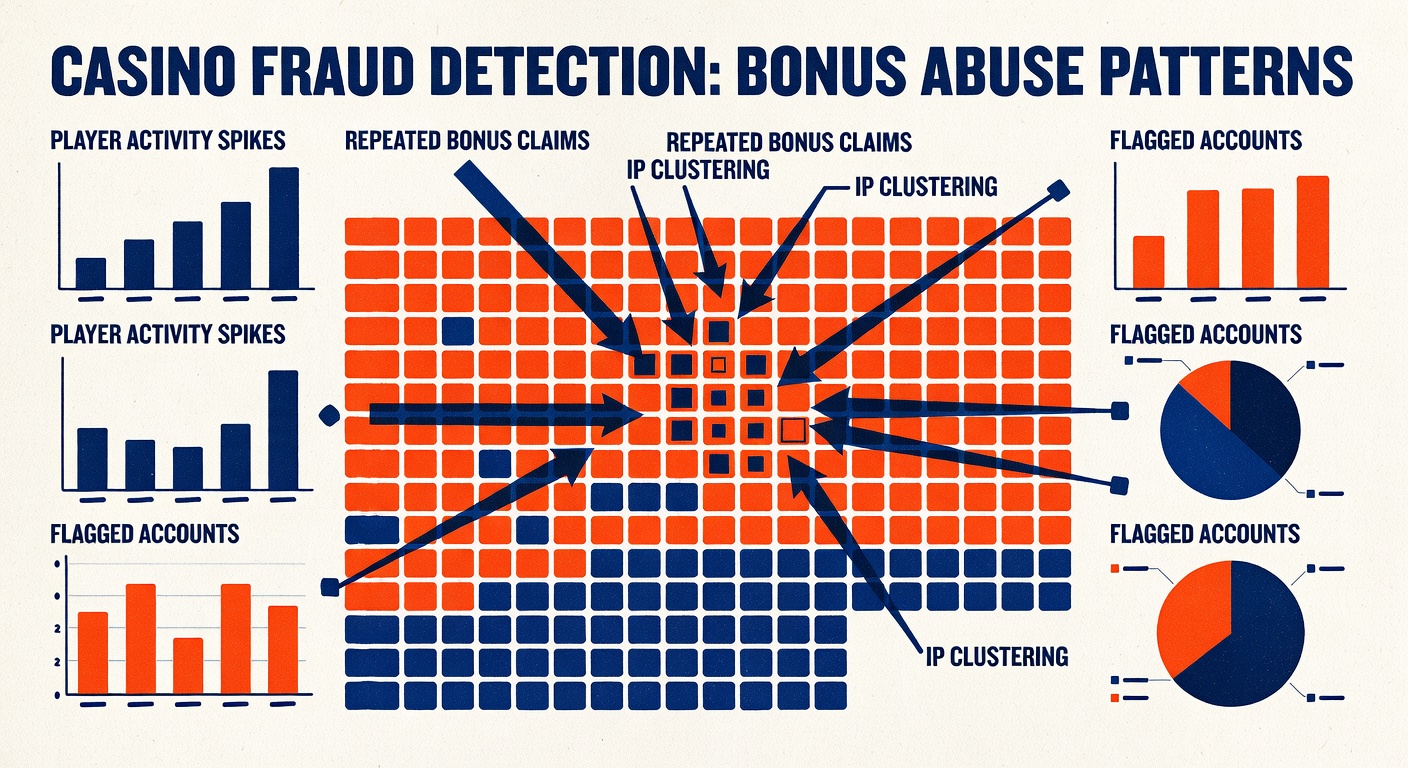
The online casino industry spends, by industry estimates, somewhere between 15 and 30 percent of its gross gaming revenue on player acquisition and retention bonuses.
This is a substantial sum, and it is distributed to players on the expectation that a calculable proportion of the bonus value will be reclaimed through wagering requirements, expected losses, and the ongoing engagement that the bonus produces. The commercial logic of the bonus depends on its being used within a particular behavioural envelope. When players consistently extract value from bonuses at rates exceeding the operator's model, the practice is classified, in the industry's internal terminology, as bonus abuse.
Bonus abuse detection, therefore, is not an occasional regulatory concern. It is a continuous commercial defence operation. The systems that perform it have evolved considerably over the past fifteen years and now operate at a level of sophistication that most players are unaware of.
This is a description of how the detection typically works.
The behavioural signature of bonus abuse
The starting premise of any detection system is that bonus abusers behave differently from ordinary players. The differences are not random; they are predictable consequences of the abuser's strategy.
A typical bonus abuser, often called a bonus hunter in the older literature, exhibits several distinctive behaviours:
- Deposits exactly the bonus-qualifying minimum, rather than a larger or smaller amount.
- Plays only the games that contribute maximally to the wagering requirement.
- Plays at or just below the maximum permitted bet size during wagering.
- Wagers approximately the exact amount required to clear the bonus, with no further play afterward.
- Requests withdrawal immediately upon clearing the wagering requirement.
- Does not return to the casino after the withdrawal.
- Registers multiple accounts across operators in rapid succession.
Each of these behaviours, taken individually, is innocuous. In combination, they form a statistical signature that detection systems are trained to recognise.
The data collected
Online casinos collect, in the ordinary course of business, a substantial volume of behavioural and technical data on every registered account. The data that feeds bonus abuse detection typically includes:
Technical data:
- Device fingerprint, including browser version, screen resolution, installed fonts, and operating system.
- IP address at registration, deposit, wagering, and withdrawal.
- Geolocation data derived from the IP.
- VPN and proxy detection flags.
- Browser cookie and local storage identifiers.
Account data:
- Registration email and phone number, checked against disposable-email services and against operator-internal blocklists.
- Payment method details, including card BIN ranges, e-wallet identifiers, and crypto wallet addresses.
- Identity verification documents, where KYC has been performed.
Behavioural data:
- Session duration, game selection, and betting patterns.
- Time between registration and first deposit.
- Time between deposit and wagering commencement.
- Withdrawal request timing relative to wagering completion.
- Post-withdrawal return behaviour.
The data is consolidated into a per-account behavioural profile, which is compared against templates of known abuse patterns.
The scoring model
The typical detection system operates as a scoring model that produces, for each account, a bonus abuse risk score. The score is a weighted combination of feature signals, where the weights have been fitted, usually through supervised machine learning, on a training set of previously flagged accounts.
The specific features that drive the score vary by operator, but a representative set might include:
- Device overlap with previously flagged accounts.
- Payment method overlap with previously flagged accounts.
- Deposit amount equal to bonus-qualifying minimum.
- Game selection concentrated in high-contribution titles.
- Bet-size variance abnormally low (suggesting mechanical wagering rather than recreational play).
- Time-to-withdrawal-request short after wagering completion.
The score is typically re-calculated continuously as new data arrives. An account may be flagged for review on the basis of its registration data alone, or may pass through registration unflagged only to be flagged on its first withdrawal attempt.
The device fingerprint
Device fingerprinting is one of the more technically sophisticated elements of the detection infrastructure. The operator's client-side code, embedded in the casino website or app, collects a wide range of device attributes.
A modern device fingerprint can identify the same device across multiple registrations with, depending on the collection granularity, somewhere between 90 and 99 percent accuracy. This is a significant matching rate, and it substantially limits the viability of the multi-account strategies that were commonly used by bonus hunters in the 2010s.
Players attempting to evade fingerprinting typically use virtual machines, browser sandboxes, or anti-detect browsers like Multilogin, Kameleo, or GoLogin, which generate varied fingerprints on command. Detection systems have, in turn, evolved to identify the telltale signatures of these anti-detection tools. The arms race is ongoing.
The payment link analysis
Casinos correlate accounts through the payment methods associated with them. Two accounts that share a deposit card, a bank account, or a wallet identifier are linked. Linked accounts are typically treated as a single household for bonus eligibility purposes, meaning that only one of them may claim any given promotional offer.
The sophistication of payment link analysis has advanced considerably since the rise of cryptocurrency deposits. Crypto wallet analysis platforms like Chainalysis and TRM Labs enable operators to trace deposit wallets to known aggregation points, to previously flagged accounts, and to jurisdictions subject to sanction or high-risk classification. An operator with a crypto abuse detection integration can identify that a deposit from an apparently fresh wallet is in fact derived from an address associated with a previously closed account.
The network-level analysis
At the network level, operators detect:
- VPN and proxy usage, through the standard commercial databases (MaxMind, IP2Proxy, IPQualityScore).
- Tor exits, which are universally blocked on registration by most licensed operators.
- Datacentre IP ranges, which are treated as suspicious.
- Geolocation inconsistency between the IP and the declared country of residence.
- Unusual latency patterns consistent with remote-access proxies.
An account registered from what appears to be a residential IP but which later accesses from a datacentre IP, or vice versa, is flagged for review.
The downstream responses
Once a bonus abuse score exceeds the operator's threshold, several responses are possible.
- Enhanced review. The account is flagged for manual review before any withdrawal is processed. KYC documents are scrutinised more closely; the player may be asked to provide proof of funds or additional identification.
- Bonus forfeiture. If the terms and conditions permit, the bonus funds and any associated winnings may be voided. The original deposit is typically returned.
- Account closure. In cases of clear or repeated abuse, the account is closed with any remaining balance returned. The player may be added to an operator-wide or industry-wide blocklist.
- Behavioural restrictions. The player may be permitted to continue using the account but with bonuses no longer available to them. This is a relatively common outcome, allowing the operator to retain the revenue from ongoing play while preventing further bonus extraction.
The legitimate player problem
The detection systems are not perfect, and false positives are a recurring problem. A legitimate recreational player who happens to exhibit several of the bonus-abuse signals, perhaps because he deposits the minimum for cash flow reasons and prefers slots with high wagering contribution, may find himself flagged and subject to enhanced review.
The typical operator's response is to resolve these cases through manual review, with experienced analysts examining the full account history and making a judgement about whether the behaviour is abusive or merely coincidental. The process adds friction to the legitimate player's experience and produces, in some proportion of cases, a frustrated customer who takes his business elsewhere. The operator's calculation is that the fraud savings exceed the lost revenue from misclassified legitimate players.
Whether that calculation is correct is, at each operator, a live question. The operators who tune their detection systems too aggressively lose legitimate revenue. The operators who tune them too loosely lose margin to actual abusers. Finding the correct balance is a continuous optimisation problem.
The regulatory dimension
The terms and conditions under which bonuses are offered must, in most regulated jurisdictions, be clearly disclosed. When an operator voids a bonus or closes an account on the basis of detected abuse, the regulator may subsequently review the decision if the player complains.
The UK Gambling Commission and the Malta Gaming Authority have both addressed bonus abuse disputes in published guidance. The general regulatory position is that operators may apply bonus terms as written, provided the terms are clear and the evidence of abuse is reasonable. Operators that void bonuses on the basis of ambiguous or pretextual grounds have, in several published cases, been required to pay the voided amounts.
The regulatory oversight imposes a discipline on the detection systems. An operator cannot simply flag any winning player as a bonus abuser and void the winnings; the detection must be supportable under subsequent regulatory review.
The synthesis
Bonus abuse detection is, in the modern online casino, a full and continuously evolving defence system. The technical sophistication of device fingerprinting, payment link analysis, and behavioural scoring has advanced to a point where traditional bonus-hunting strategies are substantially less viable than they were a decade ago.
For the honest player, the systems are invisible. He registers, deposits, plays as he wishes, and withdraws without difficulty. The detection happens in the background and rarely surfaces into his experience.
For the player who attempts to game the bonus system at scale, the detection is a real and increasingly effective constraint. The economics of systematic bonus hunting have deteriorated. The practice persists, and will continue to persist, but at smaller scale and with narrower margins than in its heyday.
The bonus is a marketing instrument priced for a particular behavioural envelope. Players who stay within the envelope receive the bonus. Players who step outside it are identified, and the bonus is withheld.
The equilibrium is not static. The anti-detection tools improve, the detection systems improve in response, and the operational balance between fraud prevention and customer experience continues to shift. What remains constant is that the casino is watching, systematically and at scale, and the player who believes otherwise is mistaken.