
The History of Slot Machines: From Liberty Bell to Megaways
Forty years of opening cabinets. Here is the whole arc, San Francisco 1895 to Gibraltar 2016, in the order it actually happened.
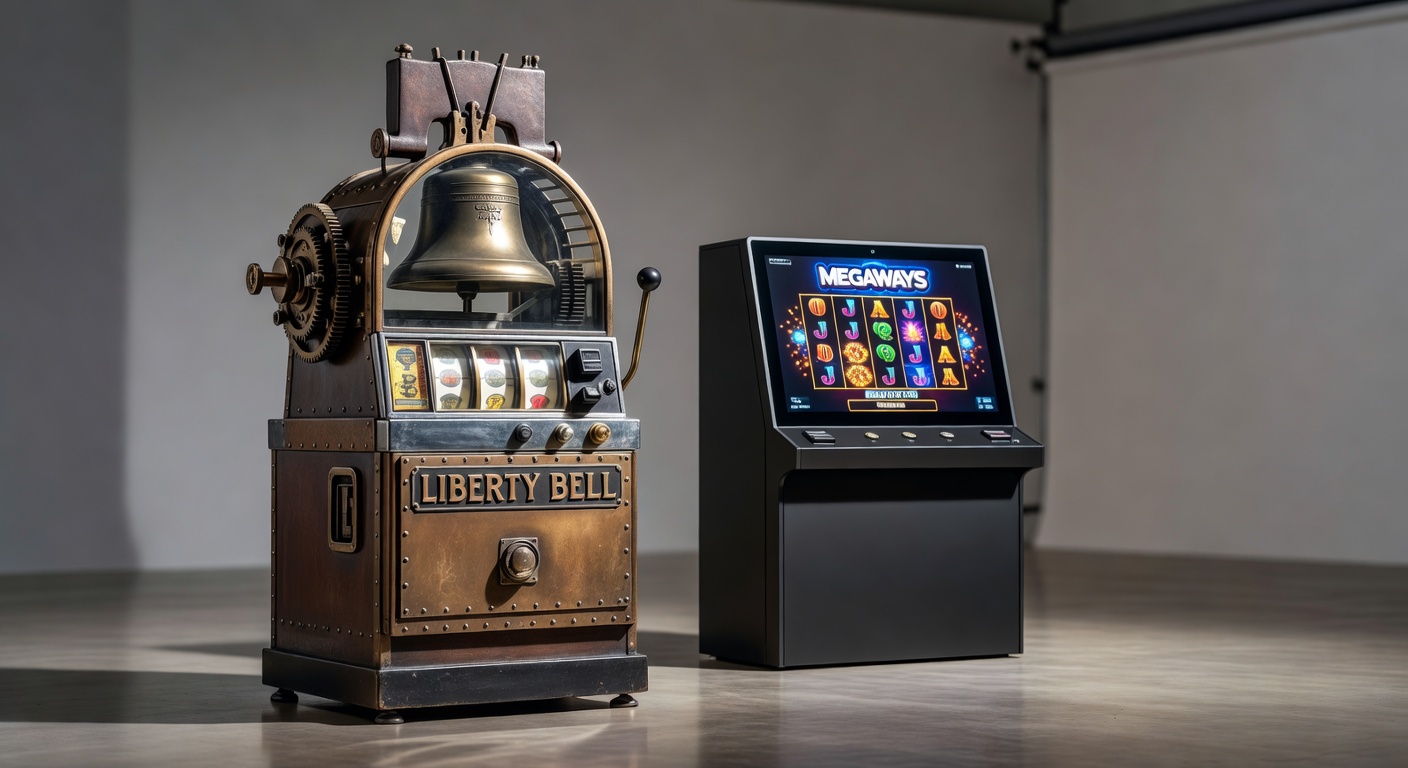
The Liberty Bell is still the ancestor of every machine I have serviced.
Charles Fey built it in a small shop at 406 Market Street in San Francisco around 1895. Three reels, ten symbols each, automatic coin payout. One thousand possible combinations. That is the entire idea of the slot machine. Every cabinet I opened in forty years was a variation on Fey's three-reel skeleton. Here is how it got from there to the 117,649-way Megaways engine running on your phone.
1895 to 1907: The Liberty Bell and its clones
Fey never patented the Liberty Bell, which is why copies spread faster than the originals. Herbert Mills in Chicago released the Operator Bell in 1907, swapping some of Fey's symbols for fruit icons. The cherry, lemon, orange, and bar all come from this era. Payouts were often in gum or drinks rather than coins, to skirt local gambling bans. The mechanical principle was unchanged: three reels on a shared shaft, stop positions determined by a notched disc, payout triggered by a mechanical sensing arm.
1933 to 1949: Prohibition and the Mills escalators
The end of Prohibition in 1933 opened the legal market, and Mills Novelty Company dominated it. The Mills Hi-Top and later the Golden Falls used escalator coin entry, which gave the machine a more theatrical feel, and introduced the modern hopper payout. The Fey-style internal mechanism remained, but the exterior went from saloon furniture to stylized cabinetry. The 1940s also saw Jennings and Pace become viable competitors, and the first electric lighting on slot fronts began appearing by 1946.
1964: Bally Money Honey and electromechanical escapement
This is the machine that broke the all-mechanical tradition. Bally's Money Honey, released in 1964, used an electrically powered reel stop mechanism while retaining a mechanical display. The significant change: a 500-coin hopper that could pay larger jackpots automatically, without an attendant. Bally engineer Raymond Maloney's company had been around since 1932 making pinball, and the shift into slots redirected the whole industry. By 1970, electromechanical cabinets had displaced the purely mechanical Mills and Jennings product on most casino floors.
1976: Fortune Coin and the video reel
The Fortune Coin Company in Las Vegas, founded by Walt Fraley, put a 19-inch Sony television behind a modified Bally cabinet in 1976. The reels were no longer physical. They were video images drawn by a computer. The Nevada Gaming Commission was initially skeptical, but the machine was approved for trial at the Las Vegas Hilton. IGT acquired Fortune Coin in 1978 and inherited the video reel patent. The path to every screen-based slot I ever serviced starts here.
1984 to 1988: The PRNG becomes the heart of the machine
Inge Telnaes, a Norwegian-American engineer, patented US patent 4,448,419 in 1984 for a method of generating slot outcomes using a pseudo-random number generator with virtual reel mapping. The patent, held by IGT, allowed the physical or video reel to display a symbol that corresponded to a weighted pool. A single stop on a physical reel could be mapped to many positions in the virtual reel, meaning near-misses could be engineered. This is the single most important invention in modern slot design. It let manufacturers advertise a top jackpot of 1 million dollars on a machine whose actual probability of hitting it was one in tens of millions.
1986: Megabucks and the progressive jackpot
IGT launched Megabucks in Nevada in March 1986, the first wide-area progressive. Machines across multiple casinos fed a single jackpot pool over a satellite link. The opening jackpot was 1 million dollars. Suzanne Henley won 4.9 million on the first hit. The model scaled rapidly, and by 1990 Megabucks pots exceeded 10 million. In 2003, a 25-year-old software engineer won 39.7 million on a Megabucks machine at the Excalibur, still the largest slot jackpot ever paid in a land-based casino.
1996: WMS Jackpot Party and the five-reel video age
Williams Manufacturing had made pinball since the 1940s, rebranded as WMS Gaming in 1994, and launched Reel 'Em In in 1996 followed by Jackpot Party later that year. The second-screen bonus round, which paused the base game to trigger an interactive feature, pulled players away from the traditional three-reel cabinet. Bally and IGT responded within two years with their own bonus-round product. By 2000, the five-reel video bonus slot was the industry default.
1994 to 2004: Microgaming and the first online slots
Microgaming launched its first casino software in 1994. The early online slots were three-reel, single-line replicas of the land-based product, running on dial-up connections. The Gaming Club, one of the first online casinos, went live in 1994 with Microgaming product. NetEnt followed in 1996. By 2004, Playtech had entered the market, and the online slot had become a distinct category with five reels, multi-line betting, and bonus features designed for the screen.
2012: Starburst and the mainstream online boom
NetEnt released Starburst in January 2012. It is a simple slot by any technical measure: five reels, ten lines, medium variance, a win-both-ways mechanic and a single expanding wild. It became the most-played online slot in the world for a decade. Its importance is not technical. It is marketing. Starburst demonstrated that online slots could be brand-able, recognizable, and evergreen. It shaped every slot release strategy from 2012 onward.
2016: Big Time Gaming's Megaways
BTG, based in Sydney and founded by Nik Robinson and Ian Schmidt, filed the Megaways patent in 2015 and released Dragon Born in 2015 as the first title. Bonanza followed in 2016 and became the breakout hit. The mechanic allocates a variable number of symbols per reel, typically two to seven, generating up to 117,649 ways to win per spin. BTG licensed the engine to other studios, and by 2019 there were over 100 Megaways titles across Blueprint, Red Tiger, iSoftBet, and others. The mechanic was the biggest structural shift in slot design since Telnaes patented virtual reels in 1984.
2020 to present: Bonus buys and mobile-first design
Nolimit City, Hacksaw Gaming, and Push Gaming now dominate new releases. The defining features of the current era are bonus buys (pay 100x the bet to enter the feature directly), cluster-pays mechanics (replacing paylines entirely), and max-win caps at 50,000x or higher. Games are designed for vertical phone screens and for streamer clip content first, casino floor second. The Liberty Bell's three reels are still in there, under all of it, but Charles Fey would not recognize the cabinet.