
Bobby Baldwin: From WSOP Champion to Vegas Casino Boss
A twenty-eight-year-old Oklahoman with a reputation for reading poker faces, walking across the Horseshoe casino floor with eleven players left in the 1978 Main Event. The story of how that kid became the man who built the Bellagio.
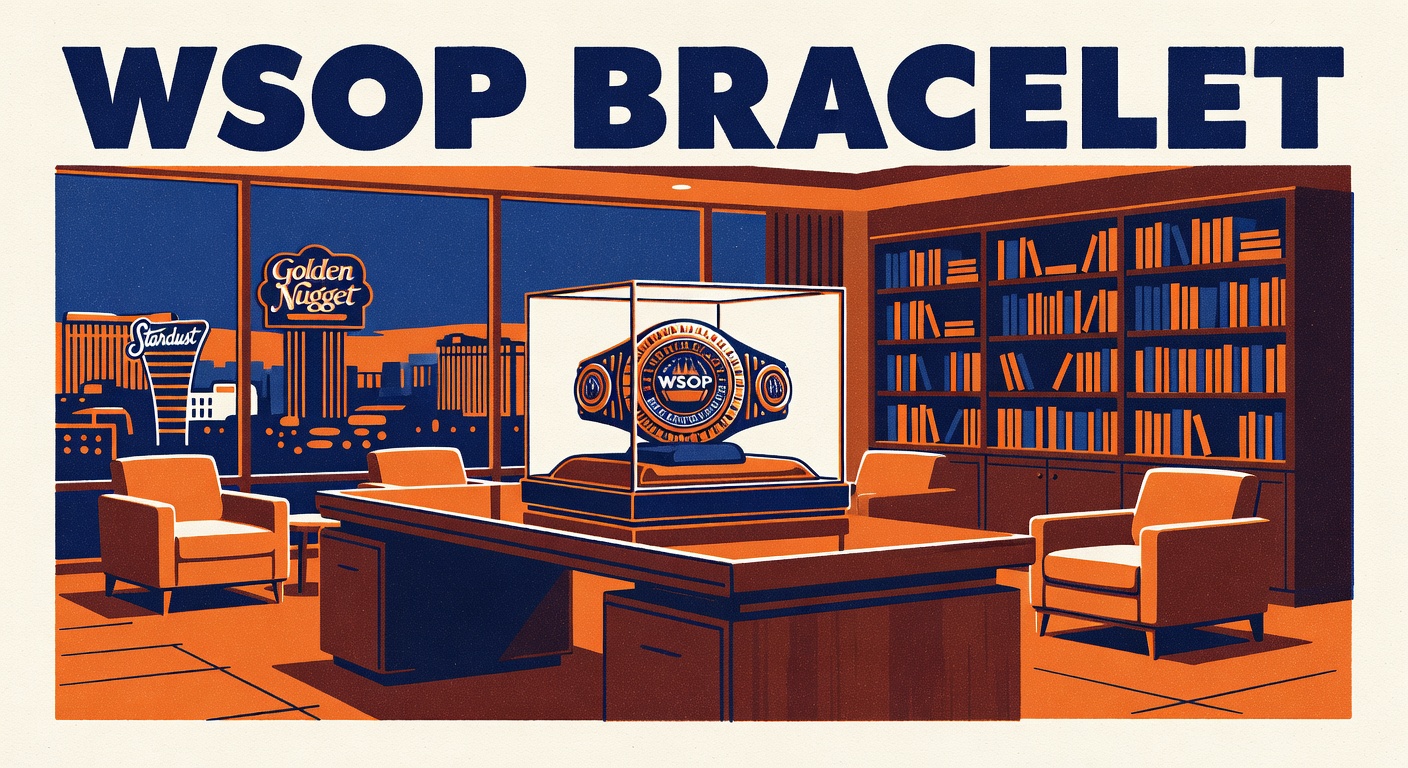
You could still smoke inside the Binion's Horseshoe in May of 1978, and most of the people at the final table did. Bobby Baldwin did not. He sat in seat four, twenty-eight years old, collar buttoned, hair combed, a glass of orange juice rather than whiskey at his elbow. What set him apart from the men around him, eleven of them at the start of the day, was not that he was the youngest. It was that he had already, by the quiet reckoning of the cash-game community in that room, been identified as one of the best readers of a live hand in the country.
He won the bracelet that Thursday afternoon. Heads-up against a Salt Lake City restaurateur named Crandall Addington, on a hand where Addington moved in on a paired board and Baldwin, holding a bigger pair than Addington had represented, called in about four seconds. The prize was two hundred ten thousand dollars. The photograph that went out over the wires showed Baldwin standing behind a low stack of bills on the felt, unsmiling, hand on the chips.
The story of Bobby Baldwin, to the people who watched him, was never really the bracelet. The bracelet was a credential, a proof-of-work that let the rest of the city take him seriously. The story was what came next, and what he did with the quieter skill that the poker table had taught him. He could read rooms. He could read the people in them. He could see, faster than most, how a structure would behave under pressure. Those are the skills that build casinos, not the skills that win bracelets, and Baldwin transitioned from one to the other in a way that almost no one of his generation managed.
He had grown up in Tulsa, the son of a Methodist minister. He started playing pool halls in his teens, then moved into cash poker games at the Mayo Hotel. By the mid-1970s, he was a fixture in the high-stakes cash circuit that ran between Dallas, Houston, and Las Vegas, a closed circuit of maybe thirty players who all knew each other by reputation and often by face. Doyle Brunson. Amarillo Slim. Sailor Roberts. Jack Strauss. The rooms were smoky. The stakes were enormous relative to the era. Most of these men, in one way or another, eventually became figures in the public poker imagination. Baldwin, deliberately, did not.
What the scene was really about
He was given the nickname the Owl, partly because of the round glasses he wore in that period, partly because of a reputation for long stretches of watchful silence at the table. He played fewer hands than most of his peers. He was slower to bluff. He accumulated chips the way a certain kind of fisherman catches fish, by waiting longer than anyone else could bear to wait.
After the 1978 win, he added three more bracelets in the following four years. He played in every Main Event through the early 1980s. He was, by any serious metric, one of the top ten players in the country.
What changed the shape of his life was a conversation that took place, according to people who were there at the time, in the card room at the Dunes Hotel in 1983. The Dunes was struggling. Ownership was in flux. Baldwin, through a relationship with the owners, was invited to take on an operational role. He accepted. By 1984, he was the general manager of the Dunes. By 1987, he was running the Golden Nugget downtown for Steve Wynn. Wynn, who had taken Baldwin's measure over a series of increasingly substantive conversations, made a decision that surprised many of the veterans of the industry. He promoted the young poker champion into a senior casino operations role.
Baldwin ran the Mirage, after it opened in 1989, as its president. He oversaw the construction and opening of the Bellagio, which went up on the site of the old Dunes and opened in October 1998 at a reported cost of about one point six billion dollars, then the most expensive hotel complex ever built. He was president and CEO of the Bellagio through its opening years. He later became president of Mirage Resorts, then CEO of CityCenter, the multi-property development that MGM opened on the Strip in 2009 during one of the worst years the American casino industry has ever had. That project, capitalized at roughly eight point five billion dollars, nearly broke MGM during the financial crisis. Baldwin was the man responsible for opening it.
The turn in the road
The quiet skill that the poker table taught him was, by the accounts of the people who worked with him, the thing that let him handle rooms full of architects, bankers, union negotiators, and celebrity chefs. He listened more than he spoke. He waited for other people to show their hand first. He was, colleagues said, difficult to surprise.
He left operational roles at MGM in 2013, after nearly three decades in senior casino management. He returned, in the mid-2010s, to poker, playing occasionally in high-stakes cash and mixed-game formats at the Bellagio's private Bobby's Room, the high-limit cash room named for him in 2005. The room itself has become something of a legend in the poker world, a small space off the main poker room where stakes start at four hundred-eight hundred limit and occasionally climb into the mid six figures in blind levels for particular sessions.
What you learn, watching Baldwin's career, is that the transition from the felt to the boardroom is rarer than the poker world's own mythology suggests. Many great players have tried it. Most have failed, or stayed at the margins. Baldwin was one of a small number, perhaps only two or three of his era, who made the jump all the way through to the executive suite of a major casino company. The reasons, by his colleagues' telling, were a combination of discipline, temperament, and a particular way of reading risk that did not translate through most of his contemporaries.
The card room at the Dunes where he was recruited is gone. The Dunes itself was imploded on October 27th, 1993, a demolition staged for the benefit of cameras attending the grand opening of the adjacent Treasure Island. The site is now the Bellagio. The man who won the WSOP in 1978 oversaw the opening of the property that stands on the ground where he first was offered the job that ended his full-time poker career. That is, in its own way, the kind of narrative arc that the poker community likes to tell itself stories about. The people who watched it happen in real time describe it more simply. He paid attention. He waited. And when the hand came, he was ready for it.