
Howard Hughes' Bizarre Takeover of the Desert Inn and Vegas
On Thanksgiving night 1966 a man in a wheelchair wrapped in a blanket was lifted into the ninth-floor penthouse of the Desert Inn. He would not leave it for four years. This is what he did while he was up there.
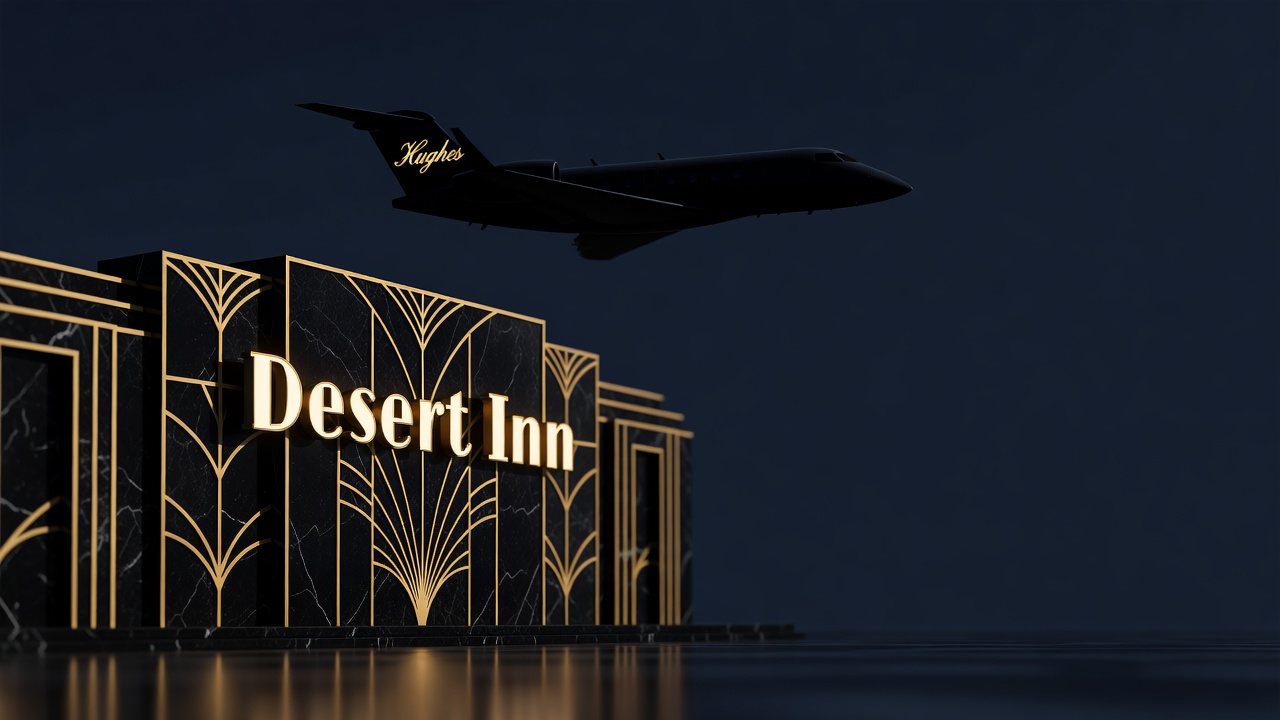
The Desert Inn sat on the Vegas Strip from 1950 until 2000. On the night of November 27, 1966, a private train pulled into a rail siding at the back of the property and a man was unloaded from one of the cars. The man was 61 years old. He weighed barely a hundred pounds. His fingernails had not been cut in months. He was wrapped in a blanket and placed in a wheelchair. Four aides lifted the wheelchair into a waiting elevator and took it to the ninth-floor penthouse, which had been rented for ten days. The man's name was Howard Hughes.
He checked in quietly. He did not gamble. He was a recluse already by 1966, though the general public still thought of him as the aviator, the movie producer, the dapper industrialist of the 1940s. The reality was a man in advanced mental deterioration, addicted to codeine, afraid of germs to the point of paralysis, spending his days naked in a hotel suite while aides handled everything outside the walls. The Desert Inn management did not know the condition he was in. They knew he was a rich eccentric and they gave him the suite. After the initial ten days, they asked him to leave. He did not want to leave. He sent an offer instead. He would buy the hotel.
I came across the Hughes story in the literature of recovery, oddly. A therapist gave me Michael Drosnin's book Citizen Hughes in 2021, two years after I had stopped gambling. She told me it was a case study in what happens to addiction when money is no longer a constraint. Most addicts stop when the money runs out. Hughes never ran out. He had come out of the TWA sale with enormous cash. By the time he arrived at the Desert Inn, he had more than five hundred million dollars sitting liquid.
He bought the Desert Inn for 13.2 million. He bought the Sands. He bought the Frontier, the Castaways, the Landmark, and the Silver Slipper. He bought the North Las Vegas airport. He bought a television station, KLAS-TV, because he could not sleep and he wanted late-night movies played on a schedule he controlled. When he could not sleep at three in the morning and the station had gone off the air, he would call the station manager and have the broadcast restarted with a film he had chosen.
What the scene was really about
This is not a metaphor. He owned it, so he used it.
He wrote memos from the penthouse. The memos are in Drosnin's book, page after page of them, in the handwriting of a man whose attention was all detail and no system. He told his top lieutenant, Robert Maheu, to buy specific properties the next morning. He told Maheu to get rid of cocktail waitresses whose outfits he disliked on the screen in his suite. He told Maheu that black entertainers should not be allowed to perform at his hotels because he found their presence uncomfortable; to Maheu's credit, the instruction was ignored. He told Maheu to block atmospheric nuclear tests at the Nevada Test Site because the vibrations reached the penthouse, which cost Hughes nothing but delay and cost the federal government weeks of argument.
He did not leave the suite for four years.
The aides, a rotating group of six Mormons Hughes called 'the Mormons' because he trusted Mormons to be clean and non-drinking, brought his food, changed his sheets, and took down his handwritten orders. Hughes sat in bed naked watching movies, injecting codeine, and occasionally placing multi-million-dollar real estate decisions through dictation. The Mormons never went to the gambling floor. The gambling floor, by this point, belonged to Hughes anyway. He owned half of it.
By 1970 Hughes was used into roughly 300 million dollars of Vegas property. He had transformed the Strip from a mob-run operation into a corporate-run one, in part on his own merit and in part because his arrival made the ownership of casinos by publicly traded corporations politically respectable for the first time. The 1969 Corporate Gaming Act in Nevada was written partly to accommodate his structure. After Hughes, the Strip stopped being a collection of independently owned casinos. It became a set of real estate assets owned by holding companies. Bally's, Hilton, MGM, and the rest followed the path he had blasted.
The turn in the road
On Thanksgiving night 1970, exactly four years after he had arrived, Howard Hughes was removed from the Desert Inn penthouse on a stretcher, through a rear staircase, and driven to an airport where he was flown to Nicaragua. He weighed less when he left than when he arrived. He never returned to Las Vegas. He died six years later on a plane over Texas, en route to a Houston hospital, so malnourished that the attending physician initially did not recognize him.
I think about the four years often. Hughes had, in those four years, more influence over the city of Las Vegas than any single person before or since. And he was, essentially, not there. He was a man in a room, with a pen and a television. The city shaped itself around the shape of his preferences without him ever walking its streets. When I read that, the therapist asked me what I saw in it.
I said that I saw someone who had built a wall of money around a compulsion and then could not get out.
She said that was most of them. Most addicts are not Hughes. Most of them run out of money long before the wall finishes. But Hughes, she said, showed what the compulsion looks like when resources are removed as a limiting factor. He did not gamble at his own tables. He did not need to. He had collapsed into a different version of the same impulse, a compulsion to control, to isolate, to accumulate, to watch the reels of his own hotels spin from a ninth-floor window he never looked out of.
The Desert Inn was demolished in 2001. The Wynn is there now. When I visited my friend in Riga, I was shown a painting of the old Desert Inn in a bar attached to the hotel where I stayed. The painting showed the old neon sign, lit up. I thought of the penthouse, nine floors up, where the light had not been on for those four years. The bar owner told me the bar was themed after classic Vegas. He did not mention Hughes. Nobody there would have known.