
How to Enable Responsible Gambling Tools on Mobile
Four in the morning. A small screen in a dark bedroom. The tools are already in the app. Most players never find them. A calm walk through how to enable the ones that matter, before a bad session becomes a worse week.
It is four in the morning. The bedroom is dark. The phone screen is very bright. Somewhere in the apartment, a dog is snoring. A player sits at the edge of the bed, thumb hovering over a live blackjack table. Her balance is five hundred below where she started. She has already redeposited twice. She knows she should stop. She also knows that the exact mechanism for making it impossible to continue is, somewhere, in this same app. She has never looked for it.
This is the common shape of the moment at which responsible gambling tools matter most. The tools are in the app. The user has not enabled them. By the time she wants them, the window for enabling them with a clear head has largely closed.
Every regulated online casino and sportsbook offers a set of responsible gambling tools, because regulators require it. The tools vary slightly across jurisdictions, but the core set is consistent. The user who enables them in advance, during a calm session at the beginning of an account relationship, has a substantially different experience from the user who does not.
Here is how to find and enable them, on most regulated mobile apps in the United Kingdom, Europe, North American regulated states, and Australia.
First, open the account section. This is usually the icon in the upper right corner of the mobile app, labeled with a user silhouette or the word Account. Tap it. The menu that opens will typically include options for profile, banking, history, bonuses, and, somewhere in that list, a section titled Responsible Gambling, Safer Gambling, Account Controls, or My Limits. The naming varies. The location is consistent.
What the scene was really about
Inside that section, you will find several categories of controls.
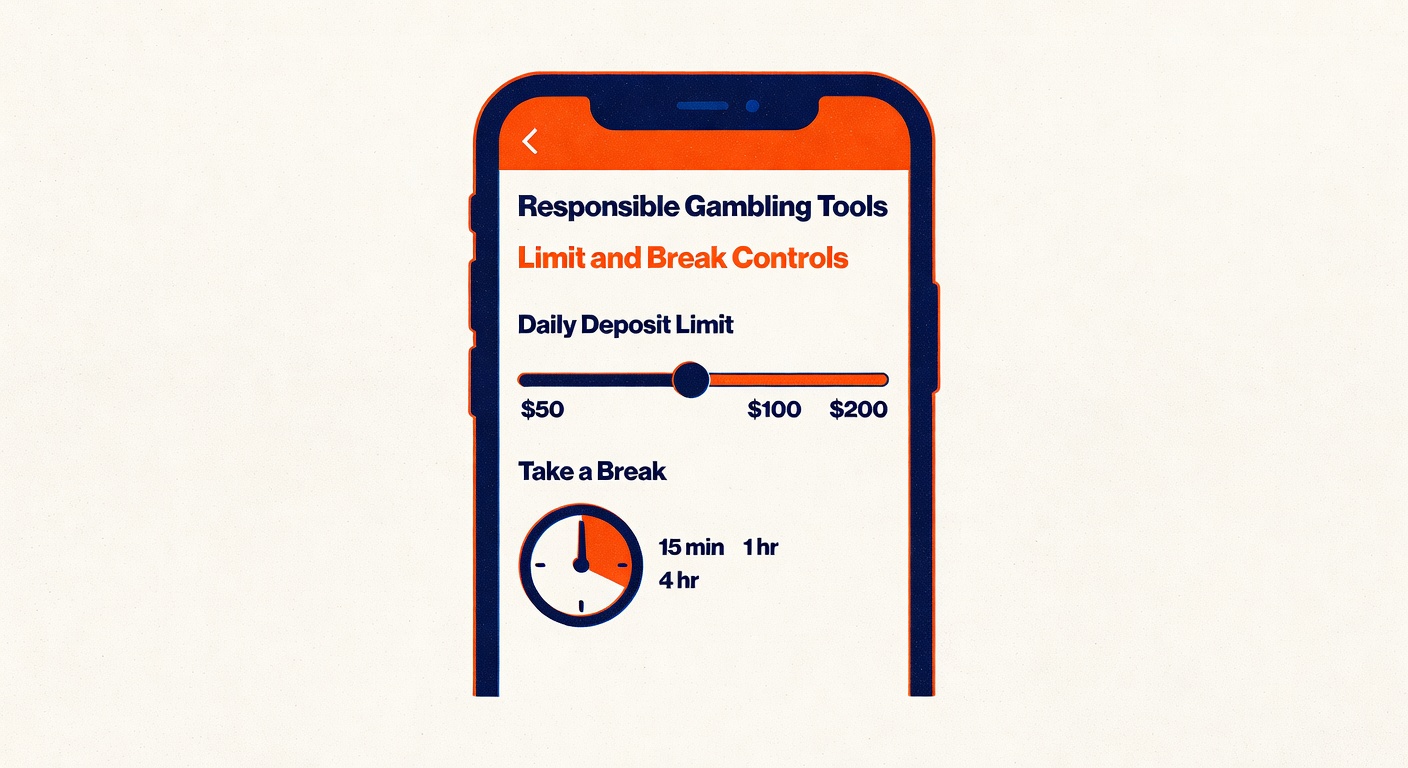
Deposit limits are the most important single tool. A deposit limit caps the total you can deposit into the account over a defined period. Most operators offer daily, weekly, and monthly limits. Setting a monthly deposit limit equal to what you can comfortably afford to lose in that period is the single most effective action you can take to keep your play within safe bounds. Most regulated operators implement deposit limits asymmetrically. A reduction in the limit takes effect immediately. An increase to the limit is subject to a cooling-off period, typically 24 hours or seven days, during which you cannot deposit above the old limit. This asymmetry is deliberate and useful. It prevents an impulsive late-night decision to raise the ceiling during a losing session.
Wager limits cap the total amount you can bet over a defined period, regardless of whether those bets win or lose. This is a broader tool than the deposit limit, because a player who wins money and then re-bets those winnings can still exceed a safe session length without hitting the deposit limit. Wager limits are less commonly used but available at most UK-licensed operators and at some European operators.
Loss limits cap the net loss over a defined period. Once the limit is reached, the account is suspended from further play until the period resets. This is a sharper tool than a deposit limit, because it keeps the focus on the outcome rather than on the inputs.
Time limits, also called session limits, close the session after a defined period of continuous play. Common settings are thirty minutes, one hour, or two hours. When the limit is reached, the app either logs you out or displays a mandatory break-reminder screen. This is a tool most useful for users who recognize that long sessions are a risk factor for them.
The turn in the road
Reality checks are pop-up notifications that appear at defined intervals, usually every thirty minutes or every hour, showing time elapsed, net win or loss for the session, and an option to continue or end the session. These are mandatory at most regulated operators, but the interval can usually be adjusted in settings.
Time-outs, or cool-offs, are short-term self-exclusions. You select a period, typically 24 hours, 48 hours, one week, or thirty days. During that period, you cannot log in to play or deposit. The account remains active for purposes of account queries and withdrawals. Once the period elapses, play resumes automatically. This is the right tool when you feel that a single session or a single week has gone wrong and you want to step away without closing the account entirely.
Self-exclusion is the strongest tool. Periods available typically range from six months to five years, and some jurisdictions offer indefinite exclusion. During a self-exclusion, the account is closed for play and deposit. Many regulated markets, including the United Kingdom and the United States, operate cross-operator self-exclusion registries. In the UK, registering with GAMSTOP blocks access to every licensed operator in the country. In the United States, each state operates its own self-exclusion list that binds all licensed operators in that state. Self-exclusion is not trivially reversible. The choice, once made, is designed to hold.
A few practical notes apply to all of this. Responsible gambling tools available at offshore, unregulated operators are typically absent or nominal. Self-exclusion at one operator does not reach another operator in a different licensing jurisdiction. If you have a gambling problem, the most effective path in most jurisdictions is the cross-operator registry, not operator-by-operator settings. If the operator is offshore, the self-exclusion will not be enforced against other sites, and the account itself may remain reachable through a different login or device.
For the woman at the edge of the bed at four in the morning, the useful version of this guidance was the version she should have read at her first deposit, not her twenty-third. The tools are most effective as a commitment device set in a calm moment, binding a future self who may not be as calm. That is the shape of the problem. That is also the shape of the solution. The tools exist. The cooling-off periods exist. The registries exist. The app itself will tell you where they are, if you look for them before you need them.