
Geo-Restriction Basics: Why Casinos Block Certain Countries
A woman in Stockholm opens a casino site her cousin recommended and gets a message telling her she cannot play. Why does that happen, and what does it tell us? Here is the story.
Elin was at her kitchen table in Sodermalm on a Tuesday evening in February.
The snow was falling lightly outside, and her cat was sleeping on the sill. Her cousin Marcus, who lived in Malmo, had messaged her earlier in the day about a casino he had been playing at, recommending a slot called Book of Shadows. Elin had heard of Book of Shadows. She had played it years ago at Casino Cosmopol in Stockholm, in the days when Cosmopol still had a slots floor.
She opened the laptop, found the link Marcus had sent, and tried to register.
A box appeared: "We are sorry, our service is not available in your region."
She tried refreshing. The box appeared again.
She tried registering with an email address, skipping the country dropdown. The box appeared again, now identifying her IP address as Swedish.
She closed the tab and messaged Marcus. He said: Try a VPN. She said: That seems complicated. He said: Yes. Then: I live in Copenhagen for tax reasons but I play on a Danish licence so that is where my account is registered. Marcus's life was complicated in exactly the ways that Elin's life was not.
She put her phone down.
Here is why the box appeared.
Sweden licensed its online gambling market in January 2019, under the Swedish Gambling Act. Every operator offering gambling services to Swedish residents must hold a licence from Spelinspektionen, the Swedish gambling authority. The licence carries obligations: participation in the Spelpaus self-exclusion register, welcome bonus limits of one per player per lifetime at that operator, deposit limit requirements for online casino, advertising restrictions, responsible gambling tools.
What the scene was really about
Many offshore operators do not hold Swedish licences. They do not want to comply with Swedish advertising rules, Swedish deposit limits, or Swedish participation in Spelpaus. The Swedish law penalties for operating without a licence while targeting Swedish residents are significant: regulatory fines, reputational damage, and potential loss of operations in other European markets where the operator does hold licences.
The cleanest defensive posture for a non-licensed offshore operator is to geo-restrict Swedish traffic entirely. The box Elin saw was this posture in action.
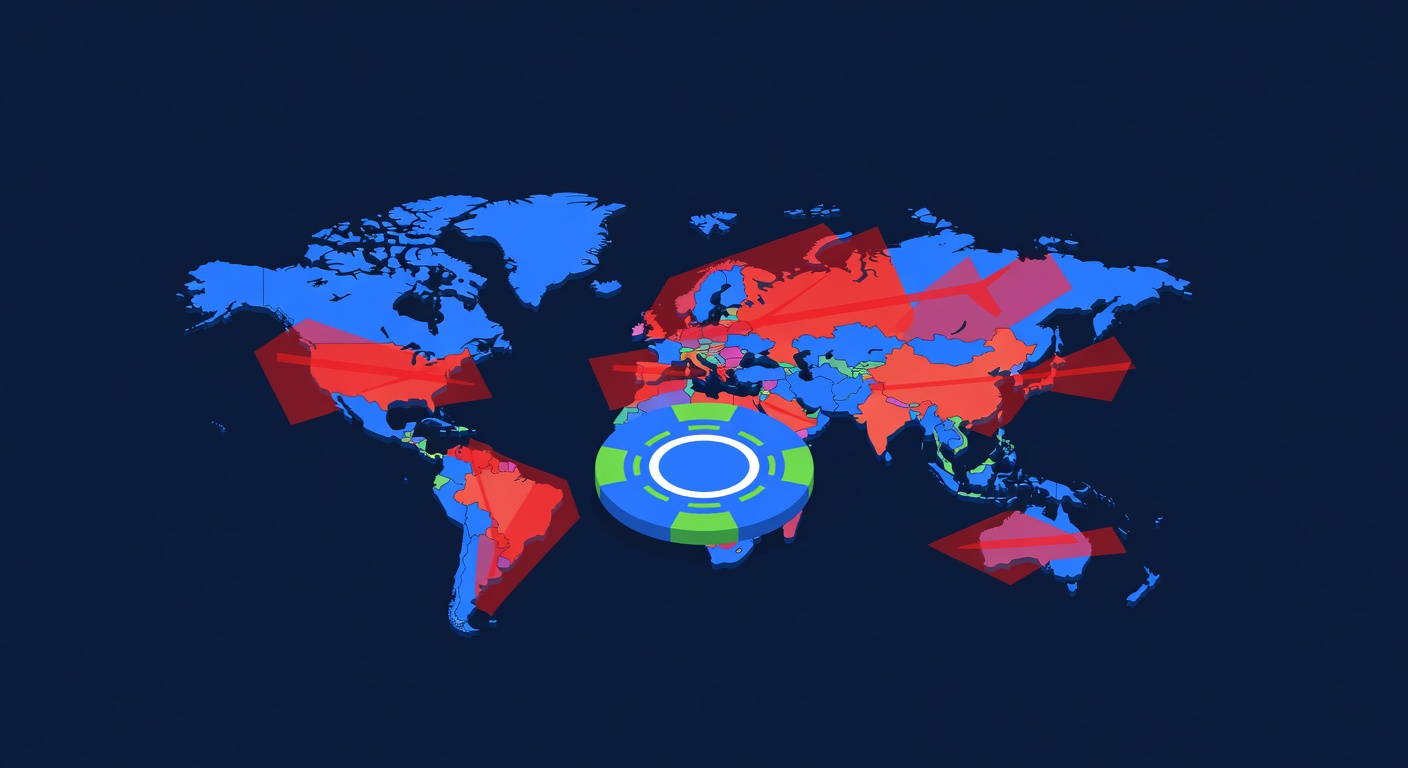
Geo-restriction is implemented through several layers. The first is IP-based geolocation, which uses commercial services (MaxMind, IP2Location) to look up the geographic origin of the connecting IP address. This catches most casual traffic. The second layer is device fingerprinting, which uses browser characteristics (language, time zone, screen resolution) to corroborate or flag contradictions with the IP. The third is payment instrument analysis, which checks whether deposit methods are consistent with the claimed country. The fourth is behavioral analysis, which flags patterns typical of VPN users (geographically inconsistent login times, access from IP ranges known to be VPN endpoints).
A determined user with a VPN, a foreign payment method, and enough patience can sometimes slip through the early layers. The later layers, particularly during KYC verification at withdrawal, usually catch circumvention attempts. A player who slips through the register but is caught at withdrawal loses both their winnings and their deposit.
There are many reasons beyond Sweden's specific licensing regime for geo-restrictions.
The United Kingdom has a comparable regime through the UK Gambling Commission. Italy, France, Germany, Spain, Portugal, Belgium, Denmark, and the Netherlands all have locally licensed markets with obligations that push non-licensed operators to geo-restrict.
The United States has a patchwork of state-level regulation. A casino licensed in New Jersey can accept NJ residents but not Pennsylvania residents. The state-level restriction is enforced with geo-fencing that is often more sophisticated than country-level restriction, because the population of states is close enough geographically that mobile location services (not just IP) are used.
Some countries prohibit online gambling entirely (Qatar, Brunei, North Korea). Operators geo-restrict these countries to avoid legal exposure and to keep payment rails clean.
Some restrictions come not from government regulation but from payment processor requirements. Visa and Mastercard apply country-level risk ratings to gambling merchants, and an operator whose risk profile worsens (due to chargeback rates or regulatory scrutiny) may be required by its acquiring bank to exclude certain countries as a condition of continued card processing.
Some restrictions come from licensing agreements for specific games. Game studios license their content with territorial restrictions. A slot licensed only for European markets will not be available to players in Latin America even if the operator itself serves both regions. The operator geo-restricts not the whole site but specific games within it.
The turn in the road
Some restrictions come from operator choice without any external pressure. An operator focused on, say, a Scandinavian market may choose to exclude African or South American residents simply because it does not want to localize its customer service, its payment rails, or its marketing for those markets. The cost of serving a geography exceeds the revenue it would generate.
Elin considered all of this, though she did not know the specific structure. She simply knew that the message had appeared and that her cousin lived in a different country.
She thought about trying a VPN. She even opened a browser tab and looked at the marketing page for a consumer VPN service. The monthly fee was modest. The setup was described as three clicks.
She thought about what would happen if she tried.
She would register with a VPN-assigned IP. She would use her Swedish bank card or a Skrill account. The account might verify at first, she might play and win, and then at withdrawal, the operator's verification team would ask for a utility bill to prove her address. Her utility bill would show Stockholm. Her bank statements would show SEK transactions. The verification would fail. Her winnings would be confiscated. Her deposit might or might not be returned, depending on the operator's terms.
The risk was asymmetric. If it worked, she would have access to a casino she was not supposed to have access to. If it failed, she would lose money. The upside was convenience. The downside was loss. The math did not favor the attempt.
She closed the laptop.
She walked to the kitchen, made a cup of tea, and sat on the sofa with the cat. She opened a Swedish-licensed casino app on her phone, one she knew was above-board, and played a single 20-spin session on Starburst. She lost 60 kronor. She smiled at the cat and went to bed.
That was the answer. Not the one Marcus would have given her. But the one that matched the rules she was living under, the country she was living in, and the complication she did not want to take on.
The geo-restriction message is a small moment at a laptop. It sits on top of a structure of law, payment processing, licensing, and commercial calculation that stretches from Stockholm to Malta to Curacao to New York. The message looks arbitrary. It is not arbitrary. It is the visible tip of a whole system that has decided, for reasons good and bad, which players it is willing to serve.
The players who understand the system can choose whether to fight it or work within it. Elin chose to work within it. The message had told her something true about the operator on the other end. She listened to what it was saying and kept her evening simple. That is what the message is for, at its best. A quiet, accurate signal that this is not your operator. Go find one that is.