
Cold Storage vs Hot Wallets for Gambling Bankrolls
If you keep a gambling bankroll in crypto, the cold-vs-hot wallet question is load-bearing. Most casual crypto gamblers have it backwards. Here is the thesis, with less hedging than most security writing on this topic.
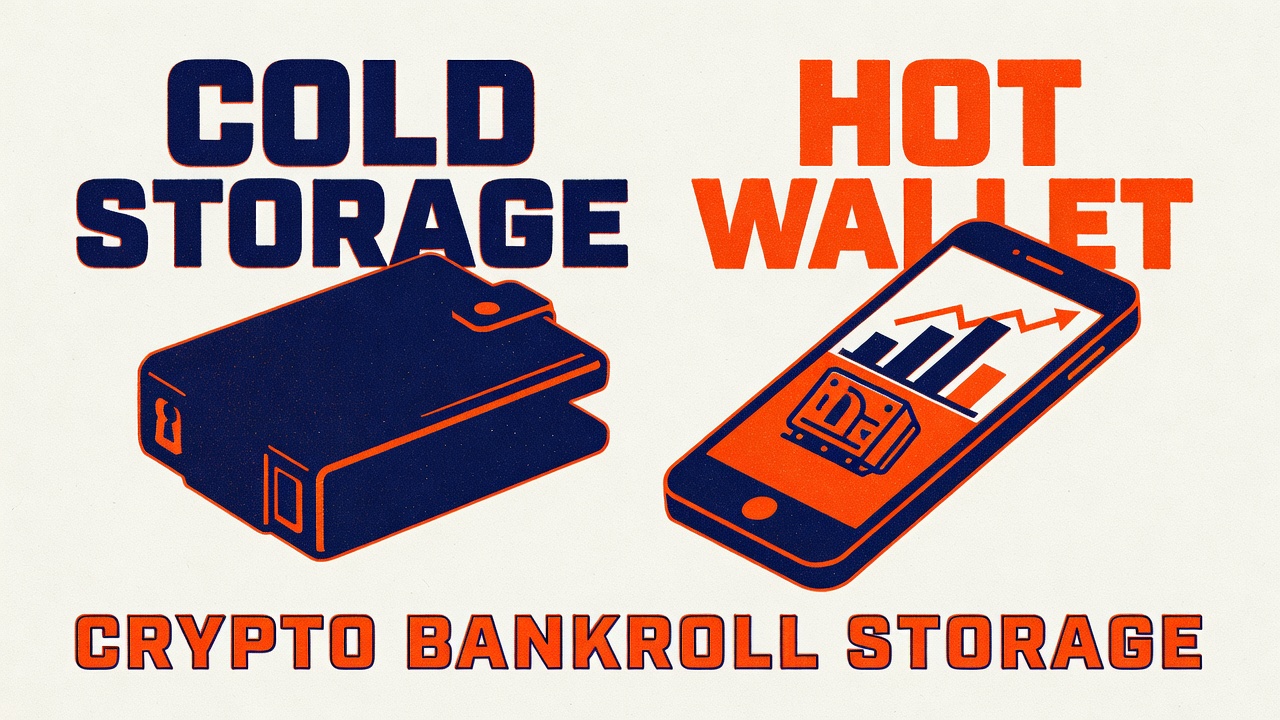
Thesis: if you have a crypto gambling bankroll worth more than a few hundred dollars, cold storage is mandatory for the bulk of it, and any "just keep it on the exchange" setup is the retail investor equivalent of leaving your car keys in the ignition at a Waffle House.
The convenience argument for hot wallets is real. It is also not worth the risk profile for most people.
The Actual Risk Model
A gambling bankroll is a pool of funds specifically meant to be depleted through play. The natural impulse is to keep it liquid: on an exchange, on the casino, or in a hot wallet on your phone. The logic is "I am going to spend it anyway, so security is a lower priority."
This misunderstands where the risk lives. The risk is not that you slowly lose the bankroll to gambling. That is expected. The risk is that a single security incident (phishing, SIM swap, exchange hack, malware, compromised casino) takes the entire bankroll at once, instead of the 4 to 10 percent per month you were budgeting for the casino to take.
You are not protecting against yourself. You are protecting against an external event that converts a planned slow burn into a sudden zero.
The Amounts Matter
If your gambling bankroll is $200 and you are topping it up from income every month, cold storage is overkill. Keep it on the exchange, play it down, reload. The theft risk is bounded at $200.
If your gambling bankroll is $5,000 and represents meaningful savings, cold storage for the bulk with a small hot wallet float is the right setup. Keep $500 on the casino, $500 in a hot wallet on the phone, and $4,000 on a hardware wallet that gets touched once a quarter.
If your bankroll is $50,000, you should be using a multi-sig setup and probably consulting someone who thinks about this professionally. At that scale, the DIY threshold has been crossed.
The Specific Failure Modes
Exchange hacks: Mt. Gox lost $450M in 2014. QuadrigaCX lost around $170M in 2019. FTX collapsed in 2022 with roughly $8B in customer funds unaccounted for. These are tail events, but they happen with enough frequency that treating exchange balances as unconditionally safe is empirically unsupported.
Casino takeovers: less well-documented publicly, but operators do occasionally get hacked, go bankrupt, or simply steal deposits. The historical record on Curacao-licensed sites is not great. The record on better-licensed sites is better but not perfect. Casino balances are less safe than bank deposits and should be treated accordingly.
Hot wallet compromise: malware targeting hot wallets is a mature industry. Clipboard hijackers that replace destination addresses. Fake browser extensions that siphon private keys. SIM swap attacks that compromise 2FA flows. Any of these can drain a hot wallet in seconds.
Cold storage attacks: technically possible, but the attacker has to either physically acquire your device or social-engineer your seed phrase. Both are much harder than any of the hot-wallet attack vectors.
The Counter-Argument
The pushback is that cold storage is inconvenient. You cannot instantly top up your casino balance. You have to plug in a Ledger, type a PIN, sign a transaction, wait for confirmations.
For the gambling use case specifically, this inconvenience is a feature, not a bug. The cold-storage friction acts as a circuit breaker on impulsive reloads. You wanted to top up your casino balance at 2 AM after a losing session? The hardware wallet setup makes you stop and think.
If your gambling habit is healthy, you will do the top-up the next day when you have thought about it. If your gambling habit is not healthy, the friction is doing you a favor.
The Hot Wallet Float
You still want a small hot wallet float for routine play. The rule I use: the float should be about one month of planned gambling spend, and it should never be more than 15 percent of your total gambling bankroll.
Reload the float from cold storage on a schedule, not on demand. Monthly is fine. Weekly is too often (it trains you to route around the friction). Never is obviously not viable.
The operational rhythm is: cold storage holds the bulk, hot wallet holds the float, casino holds the current session. Three tiers of liquidity with different security postures.
Multi-Sig for Larger Bankrolls
If your bankroll is large enough that a single seed phrase compromise would hurt meaningfully, multi-sig is the move. Two-of-three or three-of-five setups using devices from different manufacturers make it much harder for any single failure to drain the full balance.
Casa, Unchained, and similar services offer managed multi-sig if DIY feels risky. These services add complexity and cost, but they also add insurance-like risk reduction. The threshold at which managed multi-sig is worth the cost is debatable; I would put it around $25,000 in gambling bankroll.
The Concession
Most gambling bankrolls are small. Most readers of this do not need multi-sig. Most readers do not even need cold storage.
But "most" is not everyone, and the upside of being cautious is large (preserved bankroll) while the downside is small (some operational friction). For anyone serious enough to be reading a crypto gambling post to the end, the default should be cold storage with a small float.
Your gambling bankroll can survive a bad month at the casino. It cannot survive a bad moment at an exchange.
That is the actual risk model. Act accordingly.