
Wild Bill Hickok and the Dead Man's Hand Explained
The Dead Man's Hand is probably the most referenced poker hand in American cultural history. Most of what you have heard about it is shaky. Here is what the evidence actually supports.
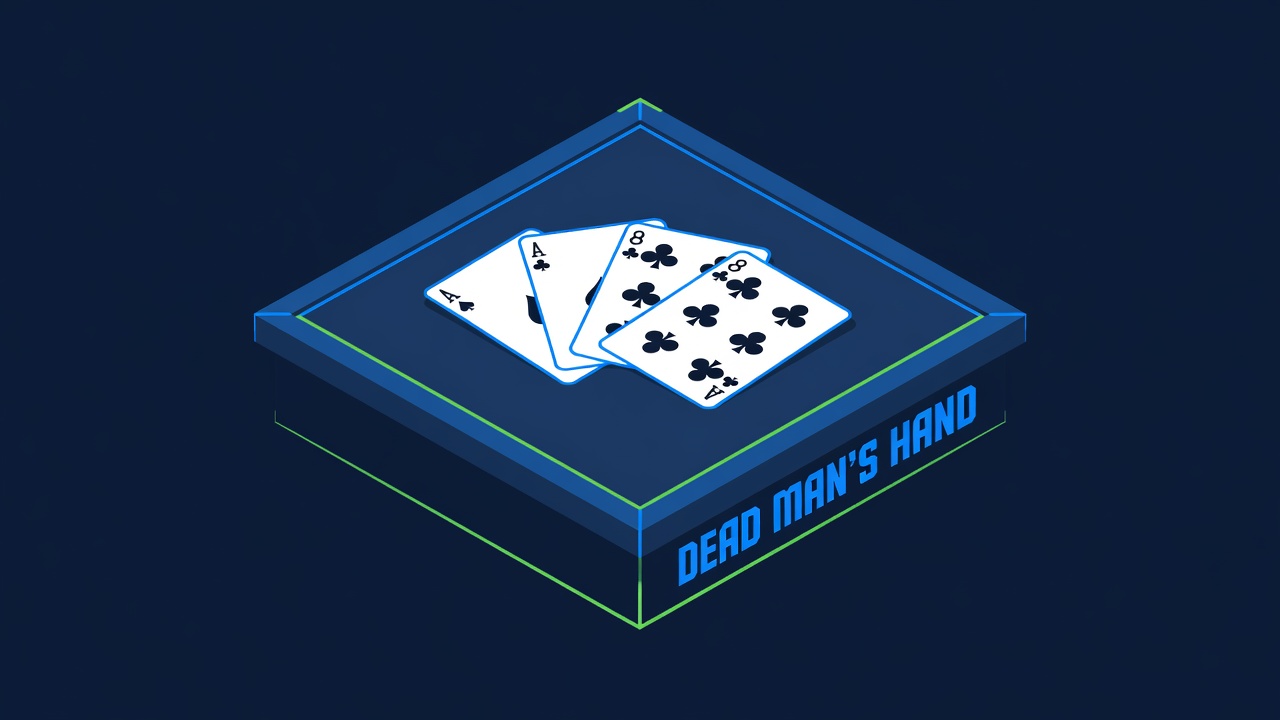
The Dead Man's Hand: aces and eights. The hand Wild Bill Hickok was allegedly holding when Jack McCall shot him in the back of the head on August 2, 1876 at Nuttal and Mann's Saloon in Deadwood, Dakota Territory.
The cultural weight of this hand is enormous. The historical evidence is thinner than you would expect.
Let me go through the claims.
Claim 1: Hickok Was Holding Aces and Eights
The claim: When Hickok was shot, he was holding two black aces and two black eights, with a mystery fifth card.
Reality: The aces-and-eights attribution comes from Frank J. Wilstach's 1926 biography of Hickok, published 50 years after the event. Wilstach's source was Ellis T. "Doc" Peirce, a barber and undertaker in Deadwood who claimed to have been there. Peirce was talking to Wilstach decades after the fact. There are no contemporaneous 1876 accounts that specify the cards. The aces-and-eights story solidified in the 1920s, which is when it entered the historical record, not when it entered history.
Claim 2: The Fifth Card Is a Mystery
The claim: The fifth card in Hickok's hand is unknown and may have been the queen of hearts or the jack of diamonds.
Reality: Multiple later accounts give different fifth cards: the queen of clubs, the queen of diamonds, the jack of diamonds, or a hand of only four cards with a drawn card unrevealed. The "mystery fifth card" framing is partly romantic, partly reflective of the fact that no one actually knows. Wilstach's account does not commit to a specific fifth card. The mystery is structural: the event was described by secondhand sources decades later, so the data does not exist.
Claim 3: Hickok Was Shot Because He Refused to Sit With His Back to the Door
The claim: Hickok was an experienced gunfighter who always sat with his back to the wall. That night he accepted a seat with his back to the door, and it cost him his life.
Reality: This part is well-documented in contemporary accounts. Charles Rich, who was at the game, reportedly refused to trade seats with Hickok when he asked. The vulnerable seat was specifically the one with a clear line of sight from the door. McCall walked in, walked up behind Hickok, and fired at close range. Whether the seating was fatalistic destiny or just a crowded saloon on a busy night is a question for storytellers, not historians.
Claim 4: McCall's Motive Was Revenge for a Brother
The claim: Jack McCall killed Hickok to avenge a brother Hickok had killed earlier.
Reality: McCall told multiple different stories during his two trials. The first trial (held by a miner's court in Deadwood) acquitted him on grounds that reflected the frontier's ambivalence about Hickok. The second trial, held later in a federal court after authorities determined the first proceeding had no jurisdiction, convicted him and he was hanged in 1877. McCall never reliably articulated a motive. "Revenge for a brother" appears to have been invented post-hoc. Most historians believe McCall was either paid by associates of Hickok's enemies or acting on some combination of grudge, drunkenness, and opportunism.
Claim 5: The Dead Man's Hand Is Always Unlucky
The claim: Holding aces and eights in a poker game is bad luck, based on Hickok's death.
Reality: Two pair (aces and eights) is a perfectly good hand in five-card draw or five-card stud poker. The probability of being dealt two pair is roughly 4.75 percent. The probability of winning with two pair aces and eights against a random hand is high enough that it is a value hand, not a trap. The bad luck reputation is cultural, not statistical. If you actually play poker with the Dead Man's Hand, you are fine. You are just not betting it with your back to the door.
Claim 6: The Event Happened in Calamity Jane's Presence
The claim: Calamity Jane was Hickok's lover and was at the saloon when he was killed.
Reality: Calamity Jane claimed a romantic connection with Hickok that most serious historians do not accept. She was in Deadwood during that period, but there is no credible account of her being present at the shooting. Her later autobiography contains multiple factual errors and appears to have been partly fabricated for publication sales. The Hickok-Jane romance is a cultural artifact, not a historical fact.
Claim 7: Hickok Was a Well-Known Poker Player
The claim: Hickok was famous as a poker player before his death.
Reality: Hickok was famous as a gunfighter, lawman, and scout. He gambled recreationally, often heavily, but he was not considered a particularly skilled poker player. By 1876, his gambling was partly a symptom of his failing eyesight (which may have had a venereal origin, per contemporary medical speculation) making his primary profession of gunfighter harder to sustain. He was a lawman who played cards in his last years, not a poker professional.
Claim 8: The Dead Man's Hand Still Has Cultural Power
The claim: The Dead Man's Hand has become the single most iconic poker hand in American culture.
Reality: Probably true, though "iconic" is hard to quantify. The hand appears in countless westerns, video games (Red Dead Redemption references it), tattoo designs, and poker apparel. Whatever its historical accuracy, it now has independent cultural weight. Which is a reasonable case study in how a probably-apocryphal detail from a 50-year-after-the-fact biography can become a stable cultural object. Peirce may have been right. He may have been embellishing. Either way, he won the long-run attention market.