
Why Short Sessions Feel Luckier: The Illusion of Hot Streaks
The short session, so often endorsed as a virtue of disciplined play, also carries a quieter psychological payoff: the shape of a brief run of results looks rather more like a streak than a longer run does. The statistics are unflattering. The feeling is durable.
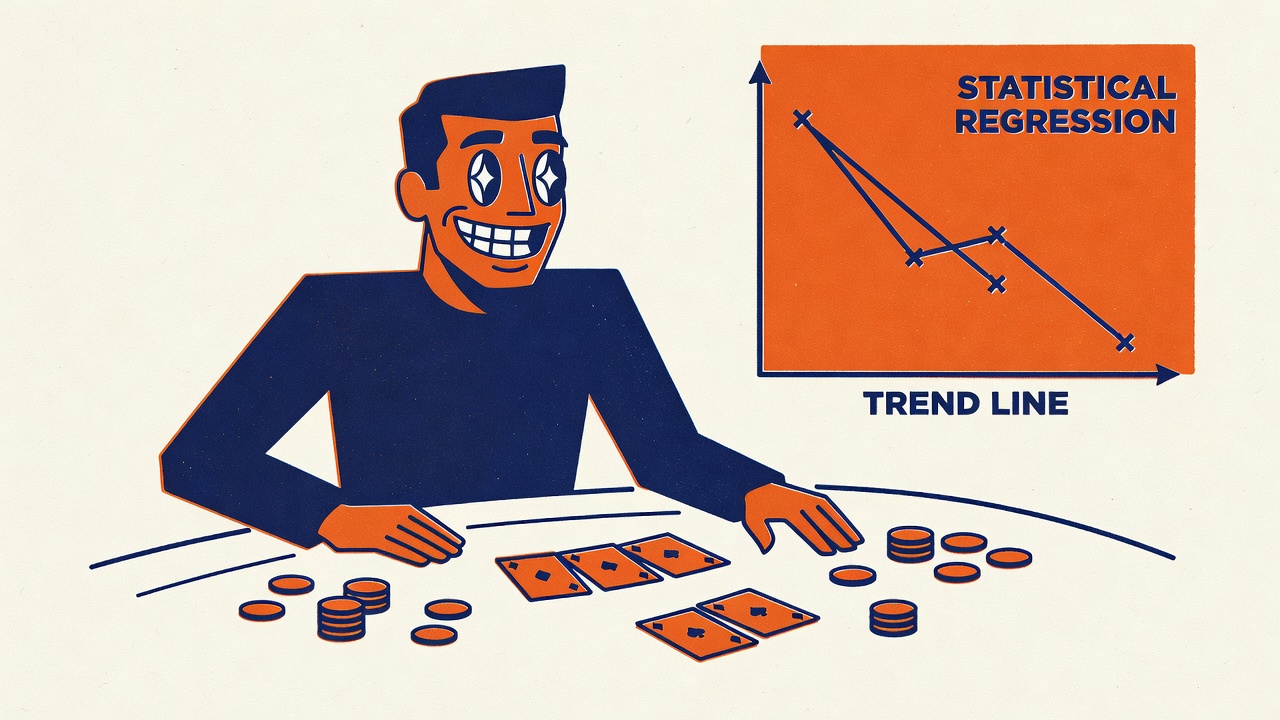
There is, among gamblers, a widely shared and rather obstinate intuition that certain sessions simply feel luckier than others.
The player's recollection, a fortnight after the event, will typically select a handful of vivid moments: a fortunate turn card, two roulette numbers in quick succession, a slot bonus that hit twice in an hour. These moments are then assembled into a narrative of hot-handedness, a belief that the night in question was blessed with some favourable dispensation that the longer nights lacked. The intuition is rarely challenged. It is rarely examined. And it persists not because it is true in any rigorous sense, but because the statistical properties of short sessions positively conspire to produce it.
What follows is an attempt to examine why.
The shape of randomness over short runs
Consider a hundred coin flips. The distribution of outcomes is, roughly, a bell curve centred on fifty heads. The standard deviation is five. Most outcomes fall between forty-five and fifty-five heads. This is the arithmetic that every A-level statistics student has been introduced to, if rarely retained into adulthood.
Now consider ten coin flips. The distribution is still centred on five heads, but the standard deviation, proportionally, is much larger. The outcome of seven heads in ten flips is unremarkable. It occurs in a little over one in ten experiments. The outcome of sixty heads in a hundred flips is, by contrast, extraordinary, occurring in less than three in a thousand.
The short run is noisy. The long run is smoother. This is, in effect, the law of large numbers restated. Any gambler's intuition about streaks is formed against the texture of the short run, not the long one, and the short run naturally contains more apparent anomalies per minute of play.
Selection effects in recollection
A further mechanism is at work beyond the pure mathematics. The gambler does not treat all sessions equally when forming an impression of which nights were lucky. Sessions that were uneventful, that drifted gently downwards toward an unremarkable loss, leave little trace in memory. Sessions that were punctuated by several vivid wins, even if the cumulative result was also a loss, leave a strong impression.
This is the availability heuristic, introduced into cognitive psychology by Amos Tversky and Daniel Kahneman in 1973. The mind does not reconstruct a base rate of outcomes. It reaches for salient examples. Salient examples from gambling sessions are disproportionately the ones containing exciting wins, and exciting wins are more likely to occur in short, high-variance runs than in long, regression-to-the-mean runs.
A session that felt lucky, then, is not necessarily a session in which the player won more money. It is a session in which the player's memory contains vivid positive moments. Short sessions offer more such moments per unit of betting turnover, because their results are more volatile and produce more extreme local outcomes. The arithmetic of variance delivers the illusion.
The narrative demand
Human beings tell stories. A night out at a casino, or an hour at an online slot, or a Saturday afternoon on the sportsbook, becomes a story that is retold in the pub or recalled alone on the train home. The story requires structure. A beginning, a middle, a turning point, an ending. Flat, middling sessions fail to produce the structural beats the story requires. Volatile sessions succeed.
The player who tells the story of the wonderful night at the baccarat table in Monte Carlo is drawing on a genuine memory. The statistical reality is that the wonderful nights were, on average, offset by uneventful or quietly poor ones that the same player no longer bothers to recall. The narrative archive is a biased sample, skewed toward high-variance outcomes, and short sessions are the primary source of high-variance outcomes.
The hot-hand fallacy, and its modest reinstatement
Thomas Gilovich, Robert Vallone, and Amos Tversky published their celebrated paper on the hot-hand fallacy in 1985, examining whether NBA players genuinely got hot and concluding, from the data available, that they did not. Consecutive successes in basketball shooting were, the authors argued, no more common than would be expected from each shot being an independent event of fixed probability.
The paper was influential and, for two decades or so, was taken as settled. In 2015, Joshua Miller and Adam Sanjurjo showed that the 1985 analysis had contained a subtle statistical error, and that the hot hand in basketball, once properly adjusted for, did produce a small but real effect. The correction modestly rehabilitated the concept. The correction does not, however, extend to games of pure chance. Roulette wheels and slot machines are not athletes. They do not get tired or warmed up or psychologically settled. Their successive outcomes are genuinely independent.
An online slot that has paid twice in twenty spins is not, in any meaningful sense, hot. The twenty-first spin is an independent event. But it is likely that the player, flush from the recent wins, is feeling hot, and will describe the session to others as such. The feeling and the reality are, on this point, decoupled.
The practical consequences
If the foregoing is right, it follows that the subjective experience of luck is a poor guide to the expected value of any given session. This has practical consequences for anyone who gambles, whether for recreation or for a living.
First, the sense that one is on a run should not influence bet sizing. A sensible gambler sizes bets on the basis of edge, bankroll, and game variance, not on the feeling that the wheel is cooperating. The feeling is, almost invariably, a selective recollection of the last three minutes rather than a reliable prediction of the next three.
Second, the sense that a session is going badly and that one is owed a recovery is, equally, a cognitive artefact. The roulette wheel is not keeping accounts. A player who has lost eight times in a row has not purchased a higher probability of winning on the ninth spin. The independence of trials, which is the foundation of every casino game's house edge, is not reversible by exasperation.
Third, the very structure of short sessions, with their greater volatility and their more frequent apparent anomalies, is what keeps many casual gamblers engaged. A player who lost quietly and evenly over three hours would rarely return. A player who won briefly and heavily in the first half-hour, gave it all back over the second, and then squeaked a small rally at the end, has had an experience that the mind will remember as eventful. The operator understands this. Session design, free spin triggers, and near-miss features are all tuned to exploit the psychology that the arithmetic makes possible.
The longer view
Over a sufficiently long run of play, the edge of the game dominates the variance. This is not a matter of opinion. It is the central result of the theory of gambling, as developed in the eighteenth century by Abraham de Moivre and refined ever since. A player with a negative expectation, playing long enough, will lose at a rate approaching the house edge per unit wagered. A player with a positive expectation, playing long enough, will win at a rate approaching the player edge per unit wagered. Short-term luck is the noise. Long-term edge is the signal.
The interesting question is why so few gamblers internalise this. Part of the answer, one suspects, lies in the fact that the human emotional apparatus did not evolve to integrate probability distributions over thousands of independent trials. It evolved to extract information from small samples under conditions of survival pressure. The evolutionary niche produced a creature rather good at finding patterns and rather poor at recognising when patterns are absent.
The casino, in its modern form, is a product of industrial-scale statistics. The gambler, in his ancient psychology, is not. The mismatch is what the industry sells, and what the player pays for.
A temperate conclusion
The illusion of hot streaks is not a failure of intelligence. It is a feature of the mind operating on short, volatile data sets. Understanding it does not, unfortunately, dispel it. A player who has read everything there is to read on the gambler's fallacy will still, at the table, feel that the wheel is running hot or cold, and will still, if unchecked, let that feeling influence his bets.
The remedy is not to argue with the feeling. The feeling will win most arguments. The remedy is to build structures around the feeling: pre-committed bet sizing, fixed session lengths, bankroll separate from daily finances, and a healthy scepticism toward one's own retrospective assessments of whether a given evening was lucky or unlucky.
The short session feels luckier because the short session is noisier. The noise is, among other things, where the casino's art of entertainment lives.
Recognising that much is, perhaps, the most one can reasonably ask of a gambler before the next spin. What the gambler does with the recognition is, as ever, his own affair.