
Why Chasing Losses at the Roulette Table Backfires
A road-worn chronology of how doubling-up systems rose, failed, and kept failing. From 18th-century Paris to 20th-century Monte Carlo to 21st-century online casinos, the house edge has outlasted every chaser.
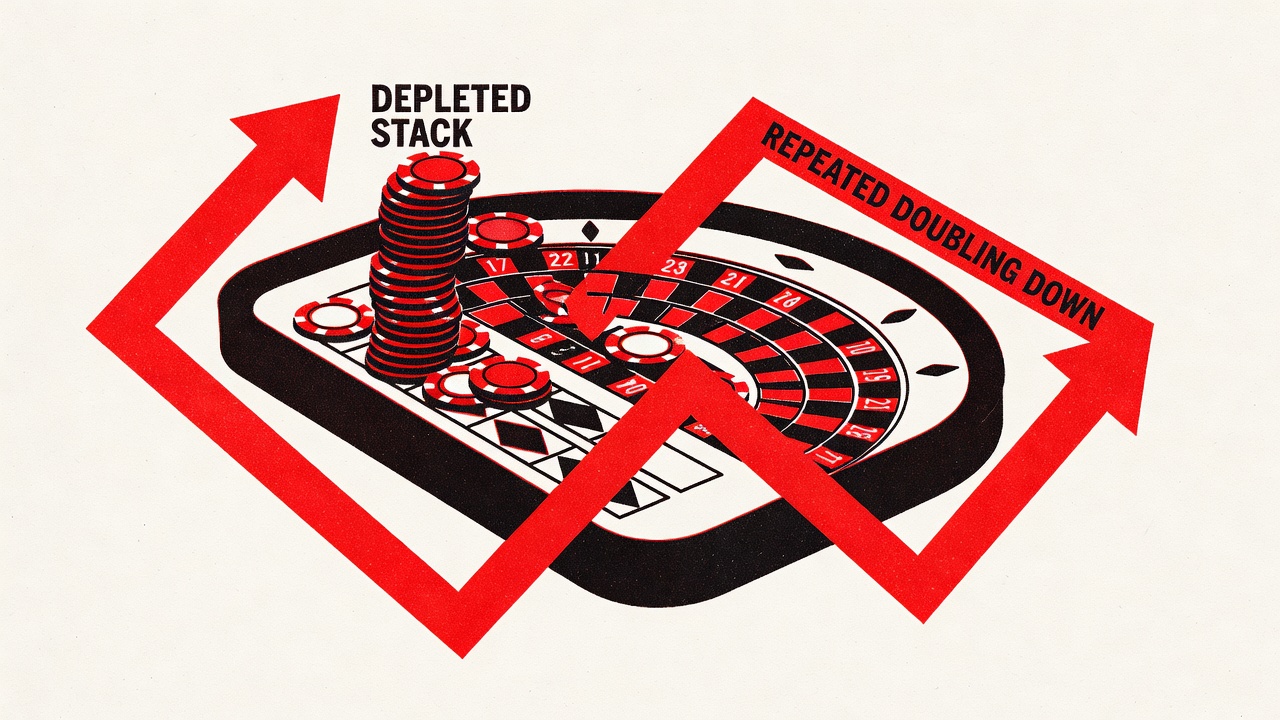
A chaser has a plan. The wheel has a mean.
The mean wins every time, eventually. What follows is the history of that collision, told in order, without romance.
1720s: The wheel arrives
Blaise Pascal's single-zero roulette wheel, originally conceived as a perpetual motion experiment in the 1650s, became a gambling device in Paris in the early 18th century. By the 1720s, wheels appeared in Parisian salons. The zero gave the house its edge. From that point forward, any system that assumed a fifty-fifty outcome on red or black was mathematically doomed.
1754: The Martingale appears in print
The Martingale system, double your bet after every loss, is usually credited to the French mathematician and gambler Charles de Moivre's associates in the mid-18th century. The first clear printed description appears in French gambling literature around 1754. The idea is simple. A losing run ends eventually. When it ends, you recover all losses plus one unit.
It does not work. Three reasons, even back then. Bankrolls are finite. Table limits exist. The zero exists. If you lose ten spins in a row at an even-money bet, your eleventh wager is 1,024 times your starting unit. Most players and most tables cannot accommodate the double beyond five or six steps.
1796: The first documented Martingale ruin
Giacomo Casanova, in his memoirs covering his time in Venice in 1796, describes using the Martingale at the Ridotto gaming house. He doubled up successfully for short sequences. He lost everything on a longer run. He wrote that the Martingale "infallibly ruins those who adopt it," a line that has been true for 230 years and counting.
1863: The Monte Carlo Casino opens its current building
François Blanc's Monte Carlo Casino opened its permanent building in 1863 and rapidly became the European centre of roulette. By the 1880s, system sellers were advertising Martingale variants, D'Alembert progressions, and Fibonacci sequences in Paris and London newspapers. The casino published table limits explicitly to prevent the doubling-up spiral. A single-zero wheel with a table limit of 100 times the minimum, for example, caps a Martingale at roughly six or seven doublings before the player runs into the ceiling.
18 August 1913: The Monte Carlo run on black
On that evening, the wheel at Monte Carlo landed on black 26 times in a row. Gamblers lost millions of francs betting on red, convinced that red was overdue. The event entered the literature as the canonical example of the gambler's fallacy. Each spin is independent. The wheel has no memory. The chaser believes it does.
1913-1914: The first statistical papers on gambler's ruin
The mathematician Karl Pearson published work in 1894 on the distribution of runs in roulette data from Monte Carlo, and his findings were picked up more broadly by probability theorists in the years after. The theory of gambler's ruin, that a player with finite bankroll against a house with effectively infinite bankroll will be ruined with probability one given enough time, was already well established by 1914. Every chasing system is a special case of gambler's ruin.
1934: The D'Alembert resurfaces
Jean le Rond d'Alembert, the 18th-century French mathematician, is often credited with a progression system that increases the bet by one unit after a loss and decreases by one after a win. The real d'Alembert believed that a coin that had come up heads several times was more likely to come up tails next, a direct statement of the gambler's fallacy. The system bearing his name got fresh attention in 1934 when an anonymous system seller in London marketed it to postwar gamblers. The math remained unchanged. It does not beat the zero.
1960s-70s: Labouchere, Oscar's Grind, and the system boom
The 1960s and 1970s saw a flood of printed system books in the American market. Allan Wilson's The Casino Gambler's Guide, published in 1965, reviewed most of them rigorously and found every one of them losing. Oscar's Grind, Labouchere cancellation, reverse Martingale, Paroli, 1-3-2-6. All of them are progressions that shuffle bet sizes around a losing expected value. None of them changes the edge per spin.
The persistent myth is that a betting system can overcome a negative expectation. It cannot. A weighted average of negative-EV bets is still negative EV. The progression only changes the shape of the loss distribution.
1990s-2000s: Online casinos industrialise the chase
When online casinos launched in the mid-1990s, the ability to spin fast made Martingale sessions brief and often catastrophic. A player could lose a bankroll in ten minutes that would have taken an hour in a live casino. Chasing in an online environment is faster, more automated, and less interrupted by the physical breaks of a live session. The result is a shorter arc to the same ending.
2010s: The psychology finally gets funded
Researchers at the University of Nottingham, notably Mark Griffiths, and others at the Responsible Gambling Council of Canada, studied loss chasing as a specific behaviour distinct from general gambling. Their finding is consistent across studies. Chasers are not bad at arithmetic. They are good at arithmetic under calm conditions and bad at it under loss. The chase is a response to the emotional state of being behind, not a reasoned bet. Progressive increases after losses are common even among players who, asked in the abstract, know the bets are independent.
The present: the chase still works as a trap
Online roulette in 2024 has the same zero it did in 1720. The house edge on a single-zero wheel is 2.7 percent. On a double-zero wheel, 5.26 percent. Those numbers are permanent features of the game. A chaser's expected loss grows linearly with the total amount wagered. Doubling up accelerates the amount wagered. Accelerating the amount wagered accelerates the expected loss.
A chasing system is a mechanism for losing faster. It does nothing else.
The table limit and the bankroll are the two walls. The house edge is the gravity. Every chaser since 1754 has walked into those walls at high speed. The walls have not moved. Neither has the gravity. Neither, in nearly three hundred years of trying, has the result.