
Why Bet Size Matters More Than Spin Count in Slot Sessions
In a fixed-RTP slot, your expected loss per session is a linear function of total wager, not spin count. This is why switching from $2 spins to $0.50 spins has roughly 4x more impact on expected loss than halving your session length.
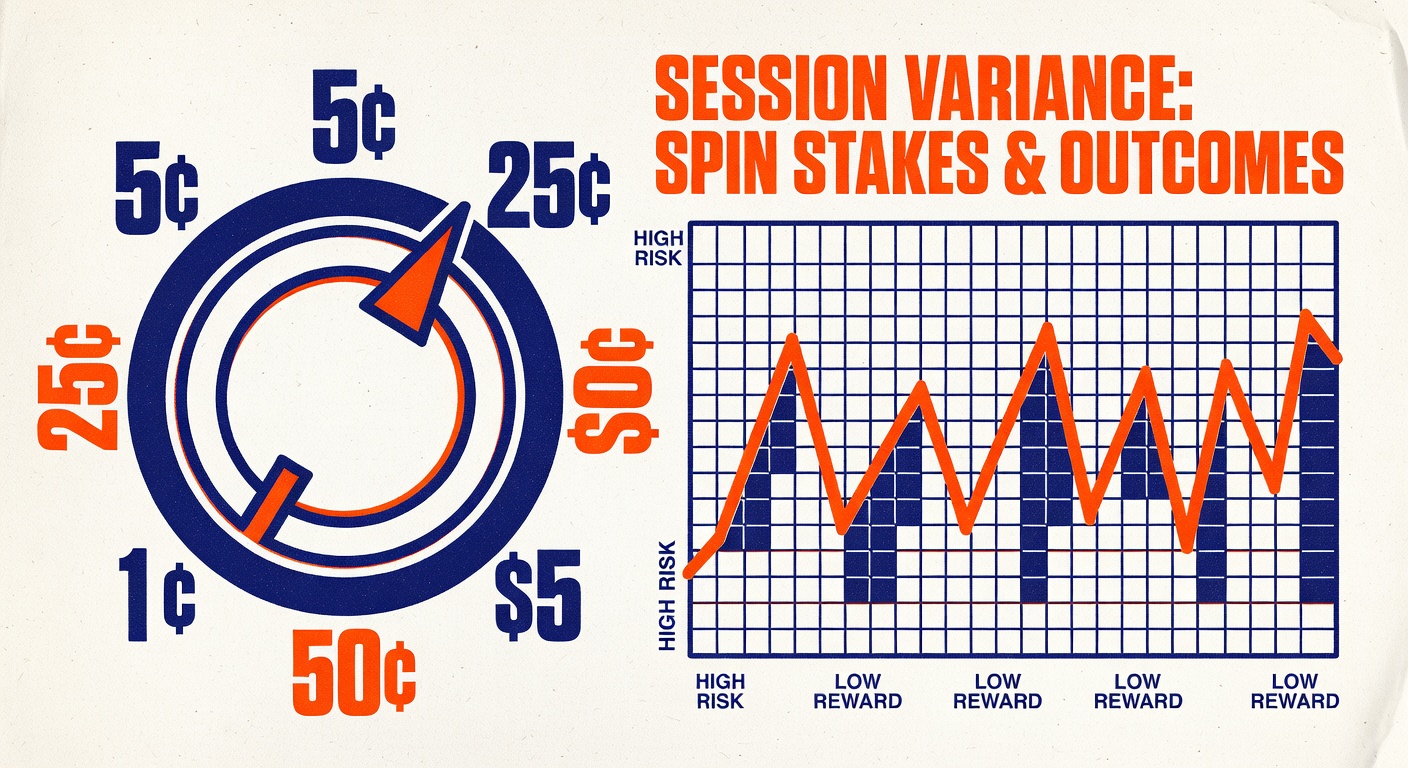
In a fixed-RTP slot, your expected loss is a linear function of total money wagered, not time played.
That one sentence reorders most of what players think about slot sessions. The 500-spin warning-sign number you sometimes hear is the wrong unit. Total wager is the right unit. Let me show the math, because it changes what "responsible session management" actually means.
The first-principles setup
Every slot has a theoretical return to player (RTP), certified by a testing lab across a very large sample. A 96% RTP slot returns 96 cents per dollar wagered in expectation. The house edge, 4% in that case, applies to every dollar of wager.
That means expected loss is simply:
Expected loss = (total wagered) x (house edge)
It is independent of how you split the wagers up. 100 spins at $2 each and 400 spins at $0.50 each both result in $200 total wagered, and therefore both have the same expected loss of $8 on a 96% RTP slot.
Where the confusion enters
Players often hear advice like "limit your session to 300 spins." Taken alone, this is misleading. 300 spins at $10 per spin costs you an expected $120 on a 96% RTP slot. 300 spins at $0.20 per spin costs you an expected $2.40. Same spin count, vastly different expected loss.
The spin count is a proxy for session length, which matters for entertainment budgeting. But for bankroll math, wager is the variable that matters.
A concrete comparison
Let's compare two 60-minute slot sessions with the same bankroll of $200.
| Dimension | Session A: $2 spins | Session B: $0.50 spins |
|---|---|---|
| Spins per hour | ~600 | ~600 (same speed) |
| Total wager per hour | $1,200 | $300 |
| Expected loss (96% RTP) | $48 | $12 |
| Expected loss (92% RTP) | $96 | $24 |
| Probability of busting the bankroll | much higher | much lower |
The spin count is identical. The session length is identical. The expected loss is four times larger in Session A because the bet size is four times larger. This is the actual driver.
Why variance compounds the point
Bet size also amplifies variance. A bigger per-spin wager creates a wider distribution of possible outcomes. You're more likely to hit a feature and be up big, and more likely to run cold and bust the bankroll before any feature triggers.
For bankroll survival over a session, the rule of thumb is:
- target total wager = 20 to 30 percent of bankroll per hour of play
- per-spin bet size should let you absorb 150 to 200 losing spins before busting
At a $200 bankroll, that's a bet size of roughly $1 per spin. Going to $2 per spin halves your expected session length before bankroll failure.
The volatility interaction
On a high-volatility slot, dry streaks are longer. If the bonus trigger is 1 in 400 spins on average, you might play 200 spins without any meaningful win. During those 200 spins, your bankroll drifts downward.
At $0.50 per spin, 200 dry spins cost you $100 wagered and about $4 in expected loss. You're still in the game.
At $2 per spin, 200 dry spins cost you $400 wagered and about $16 in expected loss, but more importantly, at a $200 bankroll you've already gone bust on bad variance well before the bonus triggers.
Volatility means bet sizing needs to be inversely proportional to volatility if you want to see the bonus round. Bigger bet on higher-variance slot is a fast way to miss the one thing that pays out.
Why operators prefer bigger spins
This is the commercial backdrop. Operators earn a fixed percentage of total wagered. They are mechanically indifferent between 100 small spins and 1 huge one, as long as total wagered is the same. But from a customer lifetime value standpoint, they slightly prefer the player who wagers more per unit time, because retention is easier when the session feels "meaningful."
The UX on modern slots reflects this. Default bet sizes are often set higher than sensible bankroll management would suggest. Auto-spin buttons nudge toward "keep going." Max bet buttons are prominent.
The single biggest leak in casual slot play isn't game choice or strategy. It's accepting the default bet size without doing any math about the underlying bankroll.
The practical rule
A simple heuristic: cap per-spin bet at 0.5 percent of your intended session bankroll. At a $200 bankroll, that's $1 per spin. At $1,000, it's $5 per spin.
This keeps the bankroll alive long enough to realize volatility, and it keeps expected hourly loss in a range where the session is entertainment, not a crisis.
The spin count is a proxy. The wager is the measurement. Track the wager, not the clicks.