
The Origins of Roulette: Who Really Invented the Wheel?
The Pascal story is repeated everywhere. The evidence is thinner than the legend. A look at the paper trail for who actually built the first roulette wheel, drawing on 17th-century French records and 19th-century gambling texts.
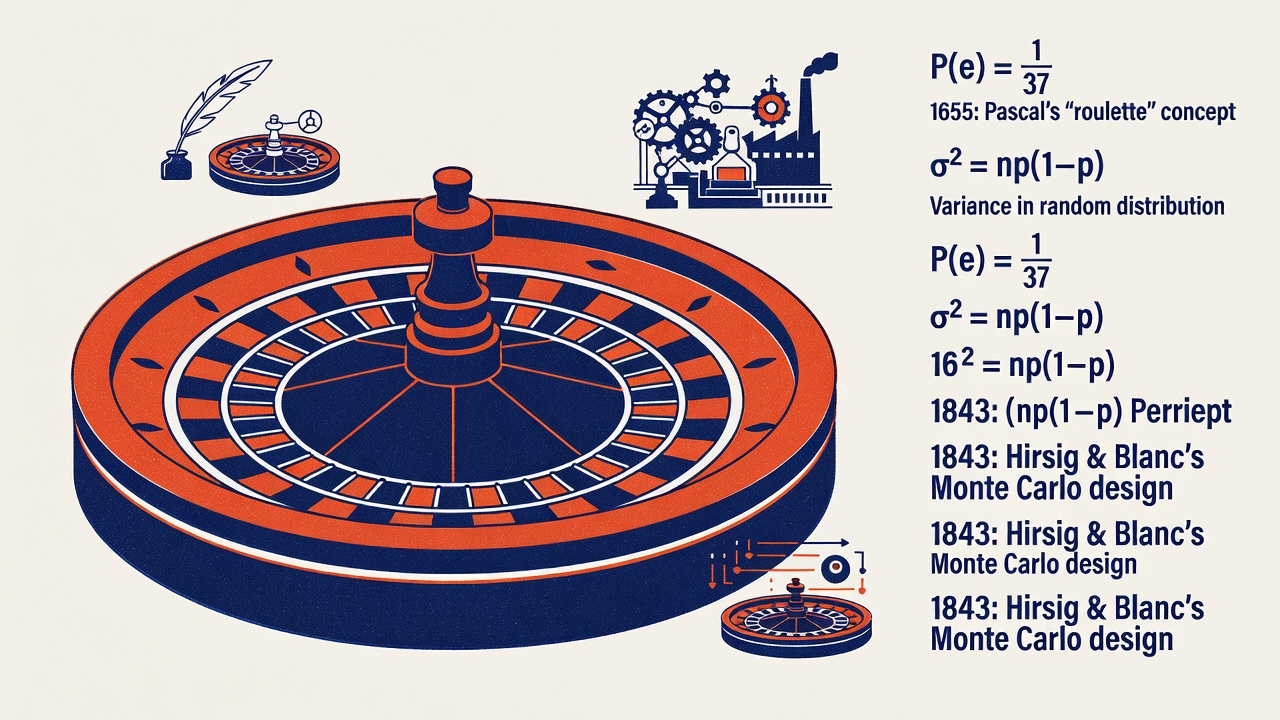
The claim, repeated in casino marketing copy for decades, is that Blaise Pascal invented roulette in 1655 while working on a perpetual motion machine. The claim is not quite right. The evidence points in a messier direction.
The Pascal claim and what actually survives
Pascal was born in 1623 and died in 1662. His surviving papers, collected in the Oeuvres de Blaise Pascal edited by Leon Brunschvicg between 1908 and 1914, contain no description of a gambling wheel. His mathematical correspondence with Pierre de Fermat in 1654 laid the foundation for probability theory. That same correspondence contains no mention of a spinning device for betting.
The first documented link between Pascal and roulette appears in the 19th century, specifically in the writings of French historian Louis Figuier and in gambling guides published in Paris in the 1860s. These sources, writing nearly 200 years after Pascal's death, assert the perpetual motion origin story without citing primary evidence. That chain of citation is the weakest possible basis for a biographical claim.
The most defensible statement is that Pascal's probability work was part of the intellectual climate in which wheel-based games developed in Paris. He did not invent roulette in any way that the surviving record supports.
Earlier wheel games that predate Pascal
Several wheel-based games existed in Europe before 1655.
Roly-poly, sometimes spelled Roulet, was played in English public houses in the early 17th century and was eventually banned by the Act for Suppressing Immoralities of 1745. The game used a spinning wheel with numbered pockets. The 1745 Act lists Roulet by name.
Hoca was an Italian wheel game popular in the court of Cardinal Mazarin in the 1650s. It had thirty numbered pockets and was played with bets on single numbers or on sections of the wheel. Mazarin, a chief minister of France, introduced Hoca at court and profited from it. Louis XIV banned it in 1665.
E.O., short for Even-Odd, was an English wheel game that emerged around 1720 and drew the attention of parliamentary committees worried about aristocratic gambling. E.O. wheels had 40 slots, twenty marked E and twenty marked O, with two house slots that gave the operator a fixed edge.
Each of these games predates or parallels the supposed Pascal invention. None of them is exactly modern roulette. But the lineage is a lineage of variants, not a single moment of creation.
The first game that looks like modern roulette
The earliest description of a game with the specific features of modern roulette, a wheel with pockets numbered 1 through 36 plus zero and double zero, red and black alternation, and bets placed on a numbered layout, appears in a French text from 1796. The text, La Roulette, ou Le Jour, is a novel by Jaques Lablee set in the Palais Royal in Paris. Lablee describes the game being played on a wheel with single and double zero, with the house winning on both.
That single reference, published in Paris in 1801, pushes the documented existence of near-modern roulette to the late 1790s. It does not name an inventor. The Palais Royal had hosted organized gambling since the 1780s, when the Duke of Orleans opened his gardens to licensed houses; those houses paid a fee to the Duke and operated openly.
The single zero wheel and the Blanc brothers
The wheel most players know today, with a single zero rather than double zero, is credited to Francois Blanc and his brother Louis Blanc. The Blancs operated a casino in Bad Homburg in the German state of Hesse beginning in 1843. Francois Blanc removed the double zero pocket in order to offer a lower house edge than the Paris casinos, which ran double zero wheels. The move drew players away from competing German spas. By 1860, Bad Homburg was the most profitable casino in Europe.
When Prussia outlawed gambling in the late 1860s, Francois Blanc moved his operation to Monaco at the invitation of Prince Charles III. The Monte Carlo Casino opened under Blanc's direction in 1863. The single zero wheel became the standard for European roulette and remains so today.
The legend that the Blanc brothers sold their souls to the devil for roulette secrets, repeated in 19th-century French pamphlets, derives from the fact that the numbers on a roulette wheel sum to 666. That sum is arithmetic, not demonology.
The American double zero and its path to Louisiana
Double zero roulette traveled with French colonists to Louisiana in the late 18th and early 19th centuries. By the 1820s, riverboat gambling on the Mississippi featured double zero wheels, often with a third pocket marked with an American eagle that gave the house an even higher edge. Hoyle's Games, in editions published from the 1860s onward, describes the three-pocket variant and warns players that the edge could exceed 12 percent.
That variant died out. The standard American wheel settled at 38 pockets, 0 through 36 plus 00, producing a house edge of 5.26 percent on most bets. The European single zero wheel produces a house edge of 2.70 percent. That difference, not national pride, explains why advantage players prefer European wheels.
What the paper trail actually supports
The shortest accurate answer to the question of who invented roulette is that no single person did. Pascal contributed probability theory, not a wheel. Hoca and E.O. provided structural templates. Paris gambling houses in the 1790s produced the first game recognizable as roulette. Francois Blanc standardized the single zero wheel in Bad Homburg in the 1840s and carried it to Monte Carlo. American operators kept the double zero.
For marketing purposes, a casino prefers a single name and a single origin story. For historical purposes, the sources are clear that the truth is a sequence of modifications over two centuries, with Blanc doing the most decisive work to shape the wheel as players know it now.