
The Most Common Mistakes New Poker Players Make
The mistakes new poker players make are not the ones they think they make. The big leaks are structural and mental, not technical. Here is the thesis, delivered with the minimum charity those mistakes deserve.
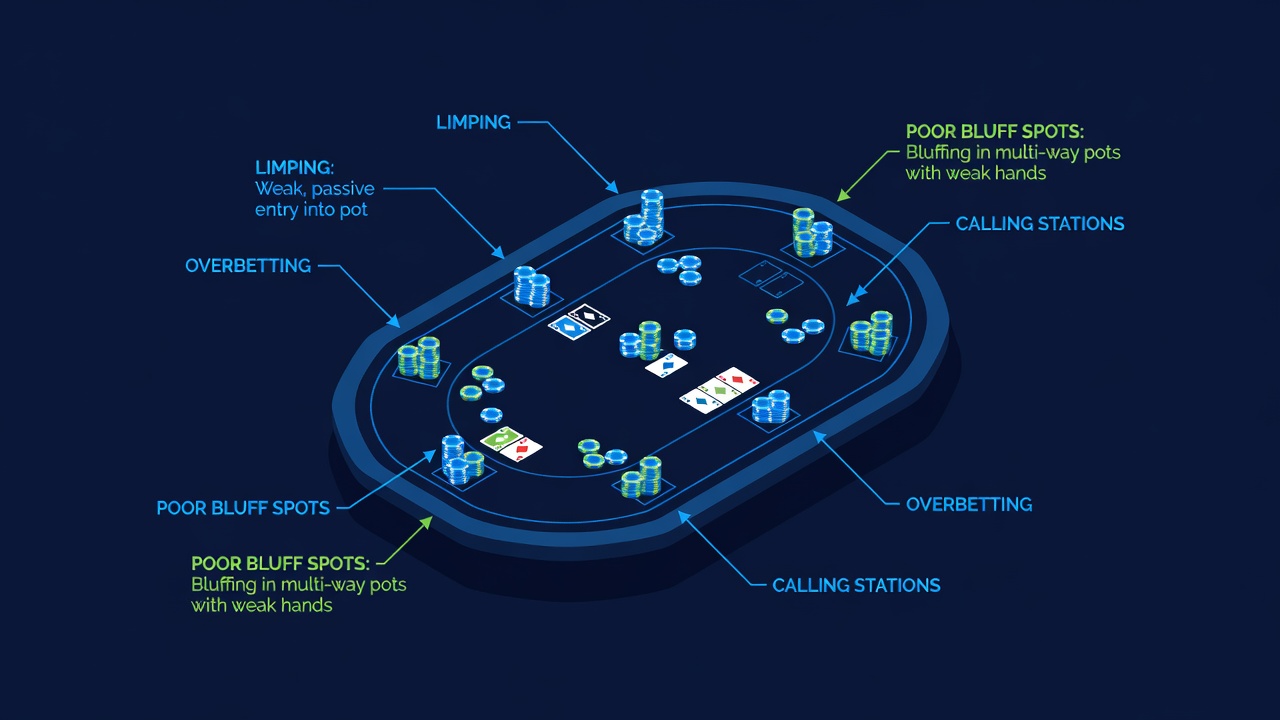
Thesis: the worst mistakes new poker players make are not tactical errors. They are structural decisions about bankroll, game selection, and emotional management that preordain losing outcomes regardless of how well the technical game is played.
Teaching pre-flop ranges to a player who has not internalized these structural issues is like teaching a trader to read charts while they are using their rent money for margin. The micro-skill does not matter if the macro-setup is broken.
Here are the specific mistakes, ranked by cost.
Mistake 1: Playing at a Stake Their Bankroll Does Not Support
The standard recommendation for cash games is 20 to 30 buy-ins for your stake. So for 1/2 no-limit with a $200 buy-in, you want a bankroll of $4,000 to $6,000.
New players routinely show up to 1/2 with $300 and the belief that this is sufficient. It is not. The variance in no-limit cash games is brutal enough that a 30 percent win rate edge can still result in multiple consecutive buy-in losses. A player with three buy-ins at their stake will go broke a meaningful percentage of the time even if they play optimally.
The mistake is not the stake choice. It is the refusal to move down after early losses. Tilt plus stubbornness plus an undersized bankroll is the fastest known way to zero.
Mistake 2: Playing in Bad Games to Prove Themselves
New players often pick the toughest table available because they think beating tough opponents is the goal. It is not.
The goal is making money. Making money is easier against bad opponents. There is no scoreboard that rewards beating a table of regulars when you could have been at the table next to it with three tourists and a drunk businessman.
Game selection is the single highest-EV skill in poker and it is explicitly not taught in most beginner material, because it is unglamorous. Serious players spend hours scouting tables before sitting. New players sit at the first empty seat.
Mistake 3: Believing in Their Own Reads Too Early
A new player who wins a hand by making a contested read instantly concludes they have a talent for reads. The next session, they make another read, which is wrong, and they lose the pot. Then another read. Also wrong.
The problem is that the signal-to-noise ratio in poker reads is low for everyone, and especially low for new players who have not built up an empirical database of what specific bet sizings mean at specific stakes. Reads based on gut feel are usually wrong more than half the time in the first year of play.
The antidote is playing a GTO-leaning baseline and only deviating when you have specific evidence of an opponent's tendency. The new player who trusts their reads before they are calibrated is handing money to opponents who know this pattern.
Mistake 4: Treating Tournaments and Cash as the Same Game
Tournaments and cash games have the same rules and completely different correct strategies. Stack-to-blind ratios, ICM pressure, bubble dynamics, and payout structure transform cash game fundamentals into different equations.
New players often learn cash game strategy and assume it translates to tournaments. It does not. The player who calls three-bets with pocket pairs for set value in cash game play is making a mistake when they do it at a 15-big-blind stack in a tournament, because the implied odds are gone and the ICM pressure is huge.
The reverse is also true. Tournament grinders who jump into cash games often overfold because they are used to playing risk-averse with tournament life.
Mistake 5: Not Taking Notes
After a session, the new player remembers the hands that felt dramatic. They do not remember the hands that felt routine. The routine hands contained the information that would have helped them figure out which players at the table were exploitable.
Writing notes on every opponent, every session, is high-friction and feels nerdy. It is also the main tool professionals use to turn hours of play into a structured database of exploits. A new player who skips note-taking is throwing away the compounded value of their session time.
Mistake 6: Tilting and Not Quitting
Tilt is not a character flaw. It is a predictable response to specific triggers (bad beats, cooler hands, long losing streaks). Professional players acknowledge that tilt will happen, and they build protocols to manage it (quit sessions early when tilted, take forced breaks, reduce stakes temporarily).
New players almost never do this. When they tilt, they play longer and play worse, because the impulse is to "win it back." The mathematical impact of this is immense: a decent player tilted for two hours can lose more than they made in the previous ten hours of good play.
The tilt management mistake is the single biggest mental-game leak at every stakes level, and it is worst among new players.
Mistake 7: Dismissing Study
Poker is a solved-math game for most common situations. Solver output is publicly available. GTO fundamentals can be learned in a few months of focused study.
New players often treat study as optional or boring and trust that play volume will teach them. Volume alone teaches bad habits. A player who plays 10,000 hands without studying the theory will have internalized some approximation of correct play, with systematic errors they cannot see from inside their own perspective.
An hour of study per ten hours of play is a reasonable starting ratio. Most new players do an hour of study per hundred hours of play. The asymmetry in improvement is predictable.
Mistake 8: Believing Their Results Reflect Their Skill
Variance in poker is enormous. A week of results is noise. A month is mostly noise. A year starts to mean something. Ten thousand hands is not enough to distinguish a slightly winning player from a slightly losing one.
New players assume a winning week means they are winners. Assume a losing week means they need to adjust. The correct frame is that neither week told you much, and you should wait for more data before drawing conclusions. Short-term results should not drive strategic adjustments.
Most new poker players lose not because the game is too hard, but because they set themselves up to lose before the first hand is dealt. The bankroll, the game selection, the emotional management: get these wrong and the rest does not matter.