
The History of Online Poker: From IRC to Moneymaker
Before PokerStars, before the bad beat jackpots, before the Moneymaker effect, there were a handful of grad students on IRC in the mid-1990s typing "bet 10" at each other. This is the story of how a command-line hobby became a global casino.
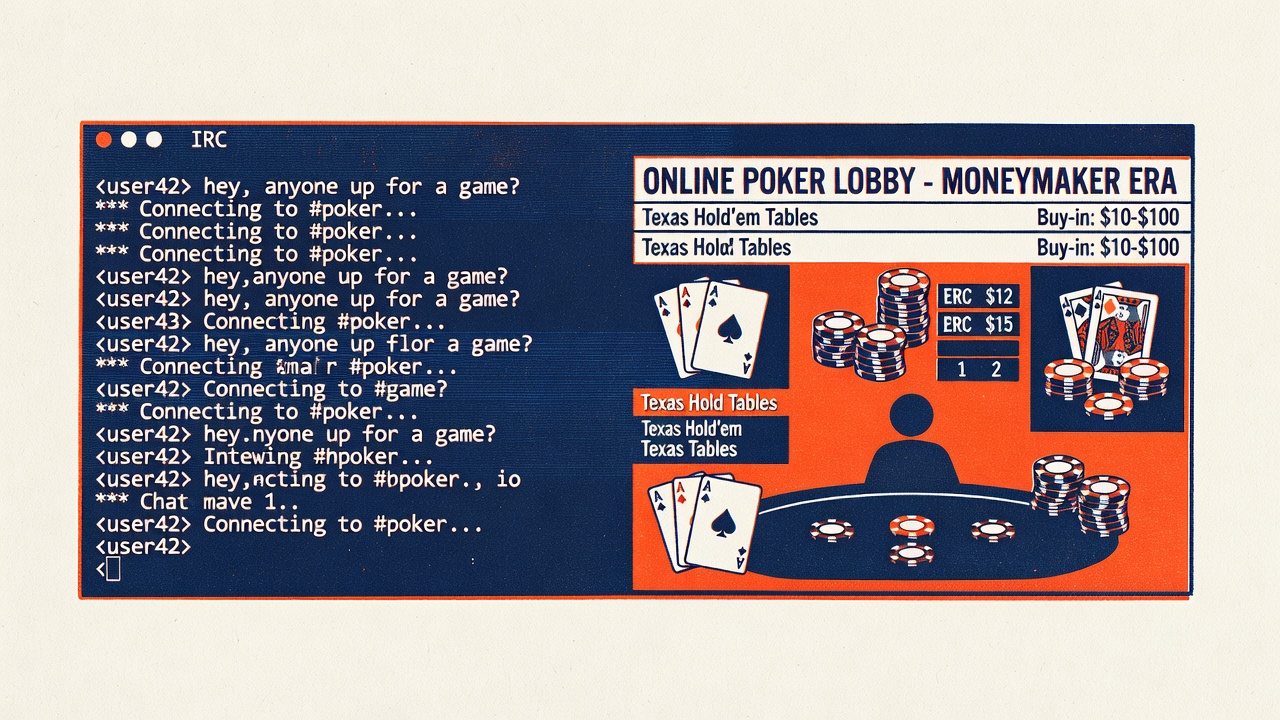
The room that mattered was called #holdem on an Internet Relay Chat network called EFnet, sometime in early 1995, and the computer where I first saw it open was in a dorm in Ithaca, New York, on a beige CRT monitor, operated by a skinny graduate student who did not really want me there but tolerated me because I had brought pizza. He was playing poker against strangers all over the world with play chips. There were no animations. There were no cards on the screen in the way you would understand cards on a screen. There was a bot named IRCBot that dealt text, tracked the pot, listed the hole cards privately to each player, and displayed the action in lines of green ASCII against a black terminal window. The pizza was getting cold. The graduate student was up forty thousand play chips and what I remember most clearly, twenty-nine years later, is the way his hands moved on the keyboard. Short, precise, unhurried. He typed "raise 200" without looking down. He had typed it thousands of times before.
That was the beginning, as near as it has a beginning. Greg Reynolds, Todd Mummert, and a few other coders had set up the IRCBot system around 1994, built in Perl, and within a year there was a small ecosystem of players orbiting it, some of whom would later become very famous. Chris Ferguson played there. Paul Phillips played there. Wes Hayward, known by a thousand online handles, played there. The games were for play money, but the players took them seriously, because they had discovered something that did not yet have a name: the idea that you could log thousands of hands of poker in the time it used to take to play fifty, and that the variance compressed and the learning curve got very steep.
By 1998 the first real-money sites began to appear. Planet Poker, run by a man named Randy Blumer out of Costa Rica, was the first, going live in January of that year. A player named Mike Caro (the same Mike Caro who had written Book of Tells a decade earlier) consulted on it. The software was primitive. Hands sometimes froze. The graphics were flat and the chips looked like stickers on a beige felt. But the thing worked. You could, for the first time, fund an account with a credit card and play Texas Hold'em against a human across the Pacific at two in the morning.
What the scene was really about
Paradise Poker came next, in 1999, based in Costa Rica as well, and it was a noticeable improvement: better graphics, nicer tables, avatars that did not look quite like clip art. Paradise was where the first real professional players appeared, where a grinder in Sweden could play a grinder in Melbourne at three different stakes simultaneously, where multi-tabling became a thing anyone had heard of. The old Vegas and Atlantic City pros watched from a distance, many of them skeptical, a few of them amused. David Sklansky, ever the theoretician, was intrigued. Doyle Brunson was dismissive. Phil Hellmuth shouted at anyone who would listen. The old world had not caught up yet.
The event that changed everything was a kid from Tennessee with a last name that sounded like a metaphor.
In the spring of 2003, a twenty-seven-year-old accountant named Chris Moneymaker, sitting in a house he shared with his pregnant wife, satellited into the World Series of Poker Main Event through a $39 online qualifier on PokerStars. He flew to Las Vegas, played for nine days at the Horseshoe downtown against professionals including Sam Farha and Phil Ivey, and on a final hand at the table of a televised final with Farha, he shoved with absolutely nothing (seven-three offsuit, a bluff that has been dissected for two decades) and ended up winning the whole event for $2.5 million. The ESPN broadcast, repackaged with narration by Lon McEachern and Norman Chad, looped on cable for the next year. Every accountant in North America watched it. Every college kid watched it. The dorm rooms filled with poker software.
What followed, between 2003 and 2006, is still called the poker boom, and it was the largest expansion of an individual gambling product in the history of the internet. PokerStars went from a niche site with a few thousand concurrent players to a flagship with hundreds of thousands. Party Poker, run out of Gibraltar, became briefly the largest poker site in the world and went public on the London Stock Exchange in 2005 at a valuation that would have seemed absurd three years earlier. Full Tilt launched with a stable of celebrity pros. Absolute Poker and UltimateBet appeared. The televised tours multiplied: the World Poker Tour, the European Poker Tour, the Asia-Pacific Poker Tour. The rake was enormous. The money was real. The math of the ecosystem, briefly, worked for almost everyone who touched it.
The turn in the road
The crash, when it came, was structural rather than cultural. The UIGEA (Unlawful Internet Gambling Enforcement Act) in October 2006 killed the American banking rails. Party Poker pulled out of the US market overnight, losing most of its value. PokerStars and Full Tilt stayed, using workarounds, and took a massive market-share windfall. Then, on April 15, 2011, the US Department of Justice unsealed indictments and seized the .com domains of the three largest sites still serving American players. It became known as Black Friday. Full Tilt turned out to have been running a Ponzi-shaped set of accounts and could not pay its US players for years. PokerStars paid everyone back, absorbed Full Tilt in a deal brokered by the DOJ, and kept going.
I sat on a balcony in Barcelona in 2012 with a player I will not name, a man who had run a $100 deposit into a six-figure bankroll between 2004 and 2010, and who had watched a large portion of it disappear in the Black Friday freeze. He smoked with a particular distracted intensity. He had the thousand-yard stare of someone who had seen an era end. He said, and I quote approximately because I was drinking too, "the thing nobody tells you about a boom is that everybody forgets the IRC. Everybody forgets Planet Poker. Everybody thinks it started with Moneymaker because the TV said it did. But the real thing was already built by 2001. Moneymaker just turned the lights on."
I have thought about that line for twelve years. He was right, almost. The lights had been on already; Moneymaker simply made the rest of the neighborhood notice. The game that began as green ASCII on a terminal had, in under a decade, become a televised global product with tens of billions in annual handle, and then, in another decade, had contracted, fragmented by regulation, ring-fenced by jurisdiction, and now, as I write this in 2026, lives on in a patchwork of regulated markets where the old dream of a single worldwide poker economy survives mostly as nostalgia.
The graduate student in Ithaca, for the record, became a software engineer at a large tech company and stopped playing poker entirely around 2009. I lost touch. The pizza is still cold, in my memory. The screen is still green on black. That is the piece of the history that does not make the documentaries, and it is the piece that mattered most. Poker on the internet started as a game people played because it was new. Everything after was commerce.