
The History of Card Counting: From Thorp to Today
Card counting history gets told as a hero's journey, Thorp through the MIT team to modern advantage play. My take: counting was mostly killed by the industry before it was killed by the math, and the romance narrative has aged badly.
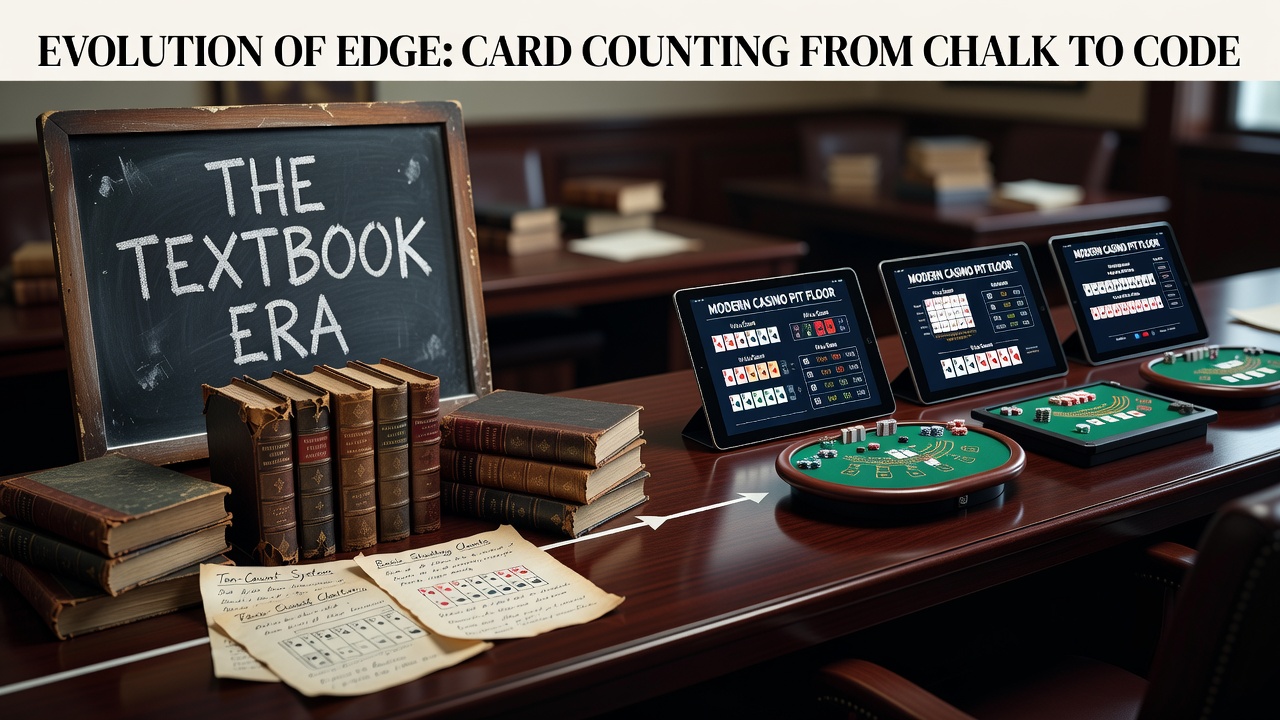
Card counting is the original advantage play, the thing every table game EV calculation starts from, and the activity that built the mythology of "beating the casino."
Thesis: the golden age of card counting was roughly 1962 to 2005, it was smaller than the mythology suggests even at its peak, and the industry response (countermeasures, game redesigns, surveillance tech) killed it before the math did.
Thorp Was Right and Early
Edward Thorp's "Beat the Dealer" was published in 1962. Thorp proved via actual probability calculations and computer simulation that blackjack could be beaten with optimal strategy plus card counting under common single-deck rules of the time.
The math was correct. The practical edge on the best games of that era was approximately 1 to 2 percent, which is genuinely beatable if you can bet in size. Thorp's own trips to Las Vegas confirmed the edge practically.
This part is the foundation. The history that gets dramatized afterward rests on Thorp's demonstration.
The MIT Team Was Smaller Than You Think
The Kevin Lewis book and Ben Mezrich's fictionalized "Bringing Down the House" turned the MIT blackjack team into a cultural story. The 2008 film "21" packaged it for a wider audience.
The real team operated from approximately 1979 to the early 2000s, across several generations. Peak cash bankroll was in the low millions. Peak active player count was probably 30 to 50 people in any given era. Total lifetime profits are reportedly in the tens of millions cumulative over two decades.
That is a successful small hedge fund, not a mythology-generating enterprise. The media coverage inflated it into something it was not. If you compare the MIT team's lifetime returns to the S&P 500 over the same period on the same capital, the team's returns are respectable but not exceptional. The interesting part was the social organization, not the money.
Countermeasures Killed the Edge
By 2005, the industry had systematically destroyed the structural conditions card counting needs:
- Single-deck games are now almost extinct except in specific promotional settings.
- Six-deck and eight-deck shoes with continuous shuffle machines have minimal penetration.
- 6-to-5 blackjack payouts (versus traditional 3-to-2) add roughly 1.4 percent to the house edge, wiping out the counter's advantage on those games.
- Surveillance software identifies bet-spreading patterns.
- Casinos share information on known counters via databases like the Griffin list (formerly) and its successors.
The counters did not lose a mathematical battle. They lost an operational one.
What Replaced Counting
Advantage play has become more specialized and less romantic. Modern APs focus on:
- Hole carding (reading the dealer's hole card when the dealer is sloppy)
- Edge sorting (Phil Ivey's technique, discussed in more detail elsewhere)
- Shuffle tracking (following groupings of high cards through imperfect shuffles)
- Progressive side bet thresholds (jackpot-level bets that tip positive only under specific conditions)
- Video poker full-pay games (rare, requires skill and patience)
Each of these is narrower, requires more specialized skill, and generates smaller edges than counting at its peak. The industry is better at defending against generic attacks. The surviving attacks are the specialized ones that require operator error.
The Concession
The obvious counter to my thesis is that card counting still works in specific venues. There are still games with good rules somewhere (Macau, rare promotional tables in Vegas, occasional smaller casinos). Skilled counters still make money.
Fair enough. The edges exist. They are just narrower, rarer, and require more travel, more game selection, and more social engineering to access than in the 1970s. The "just learn Hi-Lo and win" narrative is not viable in 2024 and has not been for at least fifteen years. Counters who work today are running a business that looks more like a specialized trading operation than a weekend hobby.
What the Counter's History Teaches
If you are interested in how edges get arbitraged away, card counting is a cleaner case study than most financial-market equivalents. The sequence:
- A mathematician identifies an edge (Thorp, 1962).
- Early practitioners exploit it (1962 to 1980).
- The edge gets publicized via books and later media (1970s to 2000s).
- Competition among practitioners slightly reduces per-person returns.
- The industry responds with structural changes that shrink the edge mathematically (1980s to 2000s).
- Surveillance and AML infrastructure further reduce the edge operationally.
- The edge becomes unexploitable except in specialized sub-strategies.
That arc, compressed into a sentence: any well-known profitable strategy in a regulated market has a half-life. The half-life of card counting was about 40 years. The half-life of most trading edges is shorter.
The Modern Counter
The honest advice for someone interested in card counting in 2024: do not. The ROI per hour is worse than almost any skilled labor, the cognitive load is high, and the risk of banning or trespass is real. The interesting work is in the math and the history, not in the practical execution.
Thorp agrees. His later career moved to options trading and then to hedge fund management, where the edges were bigger and the counter-party was not physically throwing him out.
The card counter's story is now the story of how efficient markets become. It is worth studying. It is not worth reenacting.