
The 1919 Black Sox Scandal: Baseball's Biggest Fix
A comparison of the two standard readings of the Black Sox scandal, set against the actual grand jury testimony and the subsequent court outcomes. The scandal was worse than the movie version and messier than the official record.
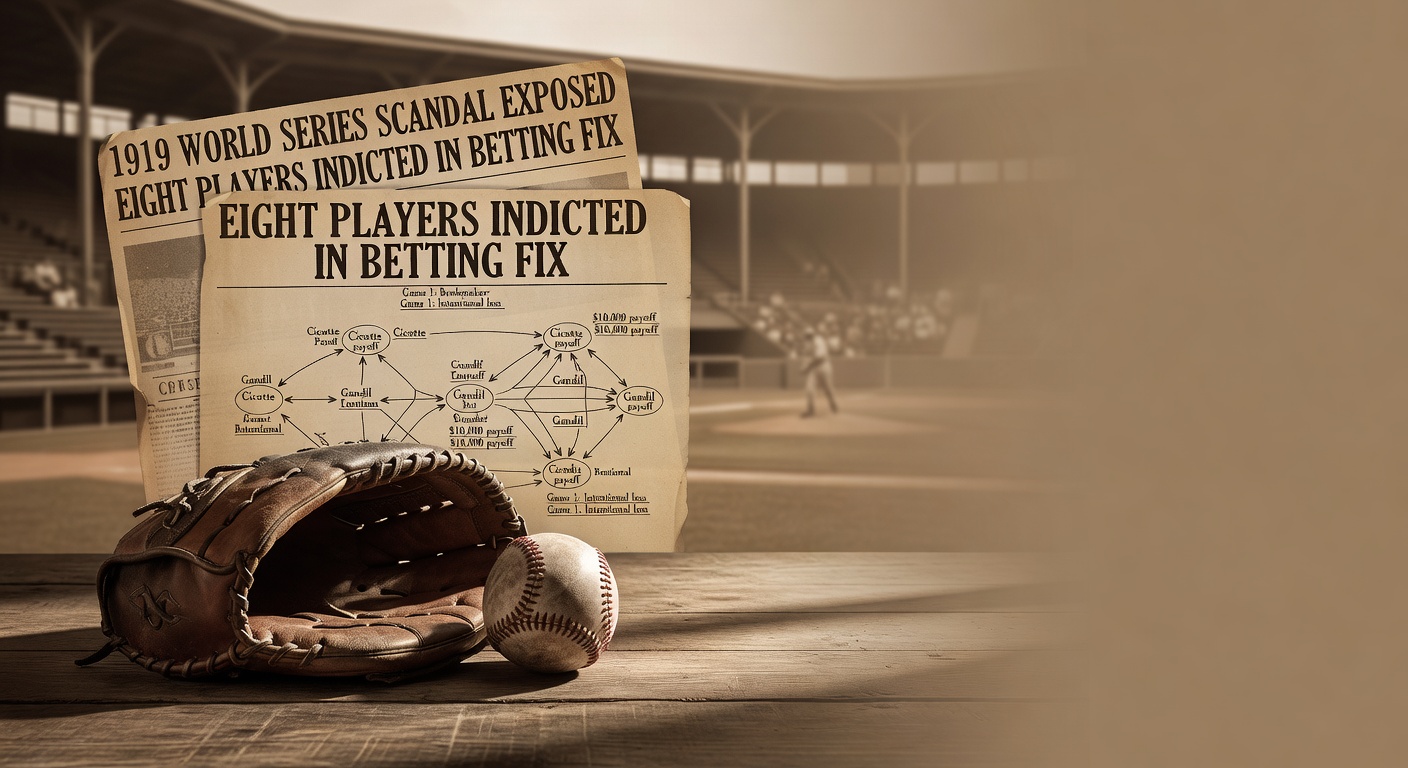
The 1919 Chicago White Sox lost the World Series to the Cincinnati Reds. Eight Chicago players were later accused of deliberately losing the series in exchange for payment from gamblers. The scandal produced a grand jury investigation, a criminal trial, and a lifetime ban from baseball issued by Commissioner Kenesaw Mountain Landis. Two broad readings of the scandal have persisted. The comparison between them, set against the documentary record, is worth making.
The two narratives
Narrative one, the sympathetic reading, frames the Black Sox as victims of an exploitative owner. Charles Comiskey paid his players poorly, often below the market rate set by other major league teams. Resentful players accepted money from gamblers as revenge against a miserly employer. Shoeless Joe Jackson, in this version, batted .375 in the series and played his best ball while allegedly fixing it, which is contradictory enough to cast doubt on his involvement.
Narrative two, the conspiratorial reading, frames the scandal as a fully-formed criminal operation involving gamblers Arnold Rothstein, Abe Attell, and Sport Sullivan, with the players as knowing participants. The fix was arranged before the series began. Payments were promised, partially delivered, and ultimately short-changed. The players threw specific games at specific points, including the pivotal Game One loss in Cincinnati on October 1, 1919.
The two readings are not mutually exclusive, but they emphasize different elements.
The documentary record
The grand jury testimony, transcribed in September 1920 in Chicago, is the foundational source. Players including Eddie Cicotte and Shoeless Joe Jackson provided confessions to the grand jury. The confessions were later reported by the newspapers to have been signed, though the actual signed documents were subsequently reported missing from the court's files before the criminal trial began in 1921.
The players were acquitted at the criminal trial in August 1921. The acquittal came despite the earlier confessions, partly because the signed confessions could not be produced in court and partly because the prosecution struggled to establish the specific criminal intent under Illinois law of the time. The legal outcome was not exoneration on the facts; it was acquittal on the evidentiary record available in the courtroom.
Commissioner Landis banned all eight players for life the day after the acquittal. His statement, often quoted in Black Sox literature, explicitly rejected the legal outcome as determining their eligibility to play baseball.
The comparison table
| Dimension | Sympathetic reading | Conspiratorial reading |
|---|---|---|
| Motivation | Underpaid players seeking revenge | Organized crime buying a series |
| Organization | Informal, reactive | Premeditated, rehearsed |
| Key figures | The players themselves | Rothstein, Attell, Sullivan, and the players |
| Money paid | Partial, often short | Partial, but significant amounts changed hands |
| Joe Jackson's role | Innocent or coerced | Knowing participant |
| Verdict explanation | Acquittal reflects innocence | Acquittal reflects evidence gaps |
| Landis's ban | Overreach by owner-aligned commissioner | Appropriate response to clear misconduct |
Both readings have textual support in the testimony. Both readings have gaps. The sympathetic reading struggles to account for the fact that eight players accepted payments and that detailed confessions specified who did what. The conspiratorial reading struggles to account for the specific game-by-game performance records, some of which do not fit a simple fix pattern.
Shoeless Joe Jackson, the specific case
Jackson batted .375 in the series with twelve hits, including the only home run. His fielding record was clean. His outfield play was reportedly strong. These statistics are frequently cited by defenders to argue that Jackson could not have been fixing the series.
The counter-evidence sits in Jackson's own grand jury testimony and in his acceptance of 5000 dollars from the fix money, which he did not return. Jackson's testimony, as transcribed in the record, acknowledged receiving the payment. He disputed that he had altered his play but admitted knowledge of the fix.
The case for Jackson as a victim rests partly on the argument that his playing statistics are inconsistent with deliberate underperformance. The case for Jackson as a knowing participant rests on his own testimony and the payment he kept. Baseball's Hall of Fame has not admitted him, notwithstanding periodic reinstatement campaigns.
Arnold Rothstein, the alleged banker
Rothstein was a New York gambler and racketeer widely credited in accounts of the scandal as the financier behind the fix. The case against Rothstein specifically rests on testimony from Abe Attell and from witnesses who observed meetings between the gamblers and the players.
Rothstein was not indicted in the criminal case. His own testimony, given reluctantly and likely incomplete, disclaimed direct involvement while acknowledging knowledge of the plot. The characterization of Rothstein as the mastermind is the standard narrative in sources including Eliot Asinof's 1963 book Eight Men Out and the subsequent John Sayles film.
Rothstein was murdered in 1928 in a dispute over a high-stakes poker game in New York. His death came before any full testimony about his baseball dealings could be extracted. The historical record on his precise role remains incomplete.
The financial scale
The total amount paid to the eight players is commonly reported at around 100,000 dollars. The figures per player varied. Eddie Cicotte reportedly received 10,000 dollars before Game One, money that was delivered in cash to his hotel room. Jackson received 5000 dollars at a later stage. Others received smaller amounts.
The aggregate figure should be compared to the players' official salaries. Cicotte earned roughly 6000 dollars per season in 1919; Jackson earned 6000 dollars. The bribe amounts, for the players who received significant sums, approached or exceeded a full year's salary. The financial incentive was real.
Comiskey's salaries were below market rate for top players in the era. Babe Ruth, who was soon to join the Yankees, would earn substantially more. The pay disparity supplies the economic backdrop for the sympathetic reading.
The landscape of the fix
The scandal did not occur in a vacuum. Gambling on baseball games was widespread in 1919. The American and National Leagues had long experienced allegations of game fixing, with numerous suspected incidents in the preceding decades. The 1919 World Series was the largest and most consequential fix in the historical record, but it was part of a pattern.
The scandal's exposure and the lifetime bans were, in part, a statement that the sport could no longer tolerate the pattern. Commissioner Landis was appointed specifically to clean up the game's integrity, and his actions on the Black Sox were the opening move of a broader cleanup that involved other players and other incidents throughout the 1920s.
The recommendation, if one is warranted
For a reader trying to hold the facts, the compact frame is this: the Black Sox scandal was a real criminal conspiracy in which eight players accepted money from gamblers to lose the series. The players were acquitted on evidentiary grounds. The commissioner banned them anyway, not as a legal judgment but as a professional one. Some players played worse than others. Some accepted more money than others. All eight participated to varying degrees.
The sympathetic reading has truth to it: Comiskey was exploitative, the players had legitimate grievances, and the legal process was flawed. The conspiratorial reading also has truth: the fix was organized, the gamblers were serious, and the damage to the sport was enormous.
Neither reading alone is complete. The most defensible summary combines both: underpaid players, exploitable by organized gamblers, participated in a fix that had both criminal character and economic motivations. Joe Jackson's case is the hardest to classify cleanly because the evidence for and against his active participation is genuinely mixed. The other seven players' cases are clearer.
For a comparison piece that asks which narrative to believe, the answer is that both narratives are partly right, and the full story is messier than either one allows.