
Poker's Wild West Origins: Riverboats, Saloons, and Gunslingers
The popular image of poker's frontier origins carries both truth and embellishment. A patient examination reveals how the game traveled from New Orleans north along the Mississippi and west to the mining camps, and what that journey shaped in the modern game.
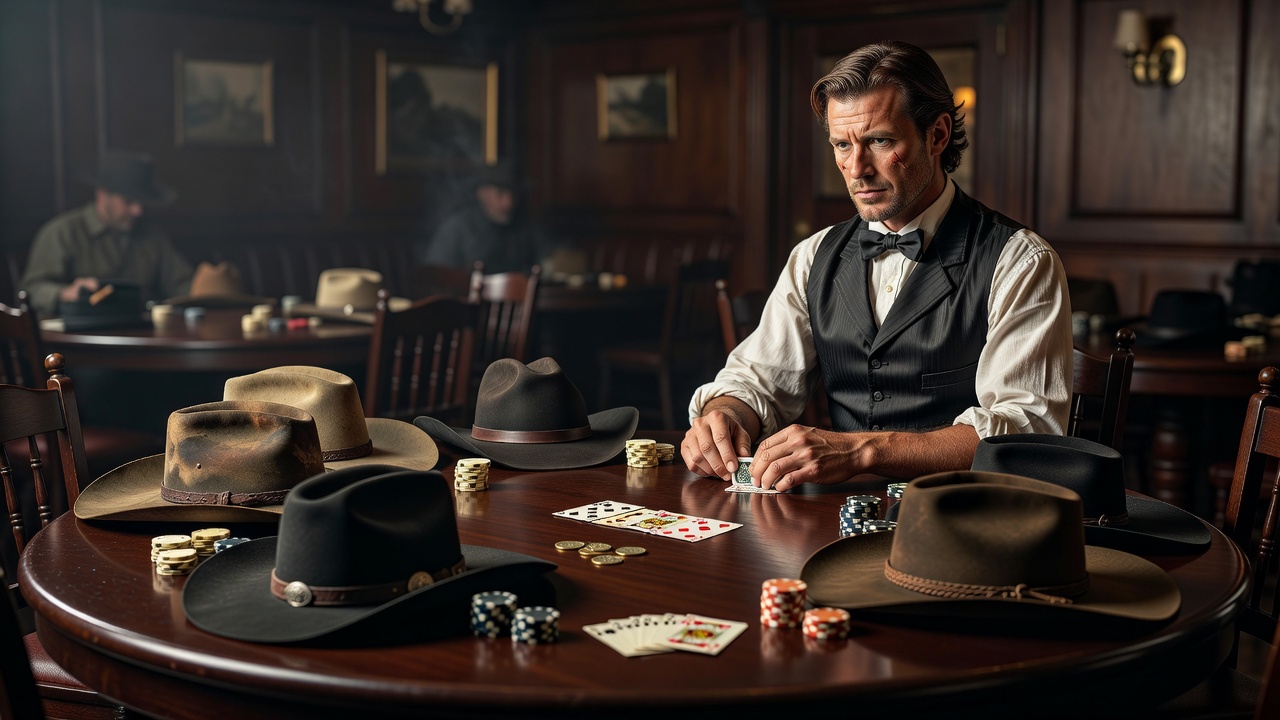
What is the truth of poker's early American history, as distinct from its myth?
Let us consider the question with care, because the game's origin story has been repeated in ways that have smoothed its rougher edges. The patient reader may find the actual history more instructive than the legend.
Q: Where did poker originate?
The game of poker in its recognizable modern form emerged in New Orleans in the early nineteenth century. It drew on older European games, particularly the French game of poque and the German game of pochspiel, both of which featured bluffing and betting rounds. New Orleans, as a French-influenced port city with a diverse population of traders, sailors, and travelers, provided the conditions for these antecedent games to cross-pollinate into something new. The earliest clear references to poker played with a twenty-card deck date to roughly 1810 to 1820, though the game evolved quickly.
Q: How did poker spread from New Orleans?
The Mississippi River was the principal route. Riverboats carrying cotton, timber, and passengers moved between New Orleans and St. Louis and up the Ohio River toward the interior. Professional gamblers, a recognized occupational category by the 1830s, worked these boats, traveling with the commerce and playing against merchants and planters whose business required them to carry cash. By 1837, the game was well established on the major riverboats.
The fifty-two-card deck replaced the twenty-card deck during this period, allowing for the four-of-a-kind hand and the flush, among other refinements. The draw variant was added, permitting players to exchange cards and produce a second betting round. The rules stabilized into something a modern player could recognize, though five-card stud and draw dominated rather than the hold'em variants that would appear much later.
Q: What role did the Civil War play?
The war of 1861 to 1865 scattered riverboat gamblers along with everyone else. The professional class of poker players dispersed across the country, particularly toward the western territories, where gold and silver strikes were producing a new kind of cash economy. Former soldiers, for whom the army years had taught a rough version of the game, carried poker with them.
By the late 1860s poker was established in the saloons of Kansas cattle towns, the mining camps of Colorado and Nevada, and the boomtowns of California. The game migrated with the frontier.
Q: How accurate is the gunslinger image of frontier poker?
Here the historian must separate myth from fact. Frontier towns of the 1870s and 1880s were indeed violent by modern standards, but the specific trope of shootouts over poker games, familiar from twentieth-century film and fiction, was less common than the legend suggests. Most poker disputes were resolved by argument, by the intervention of the house, or by the social mechanisms of a small community in which reputations mattered.
That said, specific famous incidents did occur. The death of James Butler Hickok, known as Wild Bill, in Deadwood, Dakota Territory, on August 2, 1876, is perhaps the most documented. Hickok was shot from behind by Jack McCall while playing five-card draw at Nuttal and Mann's saloon. The hand he held, two pairs of aces and eights, became known in folklore as the dead man's hand. The story is true in its basic facts, though many of its details, including the question of what the fifth card was, have varied across retellings.
Q: Who were the other notable frontier players?
Several names from the period have entered the historical record.
- Doc Holliday, John Henry Holliday, born 1851 in Georgia and died 1887 in Colorado, was a trained dentist who moved west for his health and supplemented his practice with professional gambling. His poker career ran through Texas, Kansas, and the Arizona Territory, and he was present at the 1881 gunfight near the O.K. Corral.
- Poker Alice, Alice Ivers, born 1851 in Devon, England, emigrated to the United States as a child and became one of the best-known female professional gamblers of the West. She worked in Colorado, New Mexico, and South Dakota from the 1870s through the early twentieth century.
- Luke Short, born 1854 in Mississippi, ran gambling operations in Dodge City and Fort Worth and was a well-known professional whose career connected to that of his friend Wyatt Earp.
These figures were both gamblers. Most combined gambling with other trades, law enforcement, business ownership, or gunmanship, in the combinations typical of the frontier economy.
Q: What role did the saloon itself play?
The frontier saloon was not simply a place to drink. It was the commercial and social center of many small towns, hosting poker games, political meetings, commodity trading, and informal banking. The poker game in the corner was one thread in a denser fabric of activity. Professional dealers, often employed by the saloon, ran the regular games; traveling players moved between saloons looking for opportunity.
One might observe that this structure continued, in modified form, into the early twentieth century and in some respects informs the current casino. The card room as a space where multiple kinds of social and economic activity intersect has a long lineage.
Q: How did frontier poker become modern poker?
The transition occurred through the late nineteenth and early twentieth centuries in a series of stages.
- The closure of the frontier, generally dated to 1890 by the Census Bureau, meant that the conditions that had produced frontier poker no longer existed. The game moved to cities.
- The emergence of legal card rooms in California, under state laws that distinguished card games like poker from banked games like blackjack, preserved a legal space for the game.
- The growth of Las Vegas after 1931 provided a new home for high-stakes play.
- The World Series of Poker, founded by Benny Binion at the Horseshoe Casino in 1970, codified the tournament structure that would, decades later, carry the game to global television audiences.
Each stage inherited something from the frontier era and altered it. The social texture of the saloon game survives most recognizably in live cardrooms; the professional-player-against-recreational-player dynamic that defined riverboat poker survives everywhere.
Q: What can we take from this history?
One might observe that the modern poker player, sitting at a table in a regulated cardroom or at an online table, is part of a lineage that extends back through the saloons, the riverboats, and the French and German games of earlier centuries. The game is not a modern invention but a long-evolving cultural form.
The frontier chapter is perhaps over-romanticized in popular imagination, but it is not a fabrication. The game did travel west with the expansion of the country, did take root in the rough economies of the mining and cattle towns, and did produce figures whose stories are now part of American folklore. The modern game carries traces of that era in its vocabulary, in its social forms, and in the fact that many of the rooms where it is played still honor the names of nineteenth-century players.
To know the history is not to play the game better. But it is to understand what one is doing when one sits down at the felt. The game has been played, in some form, in this country for two hundred years. The current player is, in a modest way, continuing that two-hundred-year conversation.