
Matt Damon's Poker Obsession and the Making of Rounders
Matt Damon went into Rounders as an actor. He came out as a man who could smell weakness across a table. This is the story of how the film was built, and what it cost him to believe it.
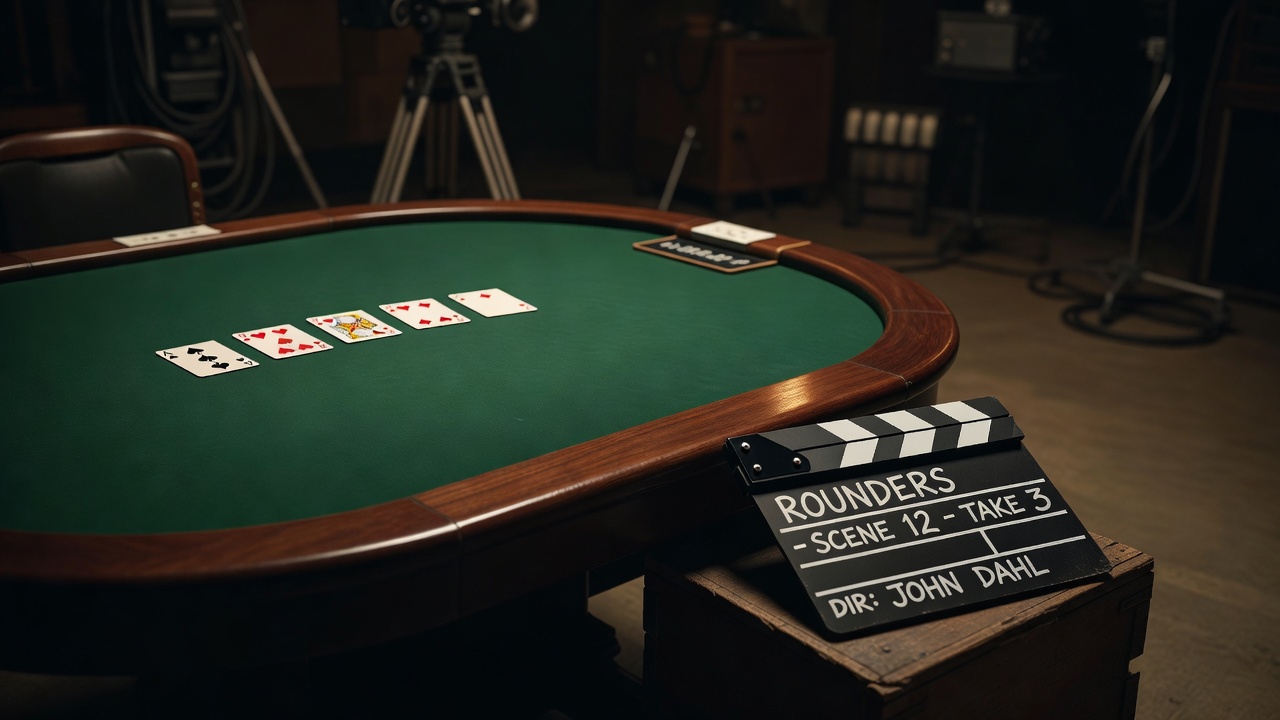
The kid has a baby face and four kings. I am watching him at the Mirage, summer of 1997, and he is losing money on purpose. His name is Matt Damon. He is twenty-six years old. The script in his trailer is called Rounders.
He is not a good player yet. He is a good listener.
The tables he plays at are the soft ones, the five-ten hold 'em games where tourists gather to die. He wants the tells. He wants the cadence. He wants the way a man's hand hovers over his chips when he has nothing and wants to look strong. The script says his character Mike McDermott is a law student who reads souls. Damon has decided the only way to play that is to become the kind of person who sits in a cardroom for a living.
They send him to Johnny Chan. Chan is two-time world champion, owner of the orange he brings to every final table, a man who in 1988 beat Erik Seidel with a nut straight while Seidel sat there with two pair, never blinking. Chan coaches Damon for a week. He tells him two things: don't rush, and stop looking at your cards.
He drops Damon into a Foxwoods tournament against his will. No name on the badge. Shades. A hundred and fifty entrants. Damon finishes in the money. He takes home enough to buy a used car and a story he will tell for the rest of his life.
Edward Norton is in the film too. Norton plays Worm, the addict friend. Norton does not want to learn poker. He wants to learn how to cheat at it. He spends his prep time with mechanics in Los Angeles, hands that can bottom-deal a deck in a motion invisible to you and me, and he comes to set with a deck in his pocket and little half-smiles he has stolen from card sharps who are no longer alive.
What the scene was really about
The director is John Dahl, a man who made The Last Seduction and knew what a dim bar should look like on film. The screenplay is by Brian Koppelman and David Levien, two friends who spent their twenties in the underground poker clubs of New York, the ones above Chinese laundries and behind unmarked doors on Fourteenth Street. They wrote the thing from memory. Every room in Rounders is a room they had lost money in.
John Malkovich plays Teddy KGB. Malkovich is not a poker player. Malkovich is an Oreo. He eats them on camera, slowly, between stacks of chips, the way he imagines a Russian mobster might, and the actors around him do not quite know what to do with it. The Oreo is an improvisation. It becomes the film's most famous image.
I sit in the screening room in 1998 and I watch what they have built. The light is yellow. The chips click like small bones. The money on the table is never explained, the way it is in the real game, because anyone who needs it explained has no business at the table. Mike McDermott loses thirty thousand dollars to KGB in the first fifteen minutes of the film. The room goes quiet. This is a movie about the cost of knowing what you are.
The film opens to a tepid box office. Miramax takes a bath. Critics shrug.
And then something happens. Something I have seen maybe four or five times in my years in this city, a movie that dies at the box office and refuses to stay dead. Rounders shows up on cable. It shows up in dorm rooms. It shows up at four in the morning on hotel televisions where men with bad hair and worse marriages are drinking from the minibar. The men watch Mike McDermott walk out of his apartment with his bankroll sewn into the lining of his jacket, and they think: that.
In 2003, Chris Moneymaker, an accountant from Tennessee, wins the World Series of Poker Main Event after qualifying online for thirty-nine dollars. He has watched Rounders many times. He has quoted it on camera. The television cameras at the Horseshoe catch the Moneymaker boom as it begins. Every player under thirty at that table can trace some part of himself to Mike McDermott.
The turn in the road
Damon himself played the Main Event that year. He busted out before the money. He sat at the rail afterwards and watched Moneymaker win, and a reporter who knew him said later that Damon looked like a man watching his own child graduate.
Poker players will tell you that Rounders is full of small errors. The lingo is not quite right. The hand ranges are loose. Mike's final river check-raise against KGB, with the straight he has made on a board that screams flush, is exactly the kind of move that in the real game would get him stacked by a better player. None of this matters. The film is not about poker. The film is about what a man becomes when he admits what he loves.
Damon told a reporter once that he stopped playing seriously sometime in the early 2000s. He said he was not good enough. He said that among professionals he was a tourist with a famous face, and he could feel them softening the game to keep him at the table, and that was worse than losing. He went back to movies. He made Bourne. He made The Departed. He never quite left poker.
I ran into him at a charity tournament in Los Angeles, years later. He was playing a four-handed pot with the kind of looseness only very good amateurs have. I watched him read a man at the river and fold the winning hand. He smiled at his cards like they were an old friend who had lied to him.
That, I thought, is the whole thing.
That is what Rounders was trying to teach us.
A man who wants to win cannot learn poker. A man who wants to understand himself, though, will sit at the table forever, and he will tip the dealer, and he will go home alone.