
Live Casino on Mobile: What to Expect on a Small Screen
More than 70 percent of live casino volume now happens on mobile devices. The experience is materially different from desktop, and the UX compromises favor the operator in specific, measurable ways.
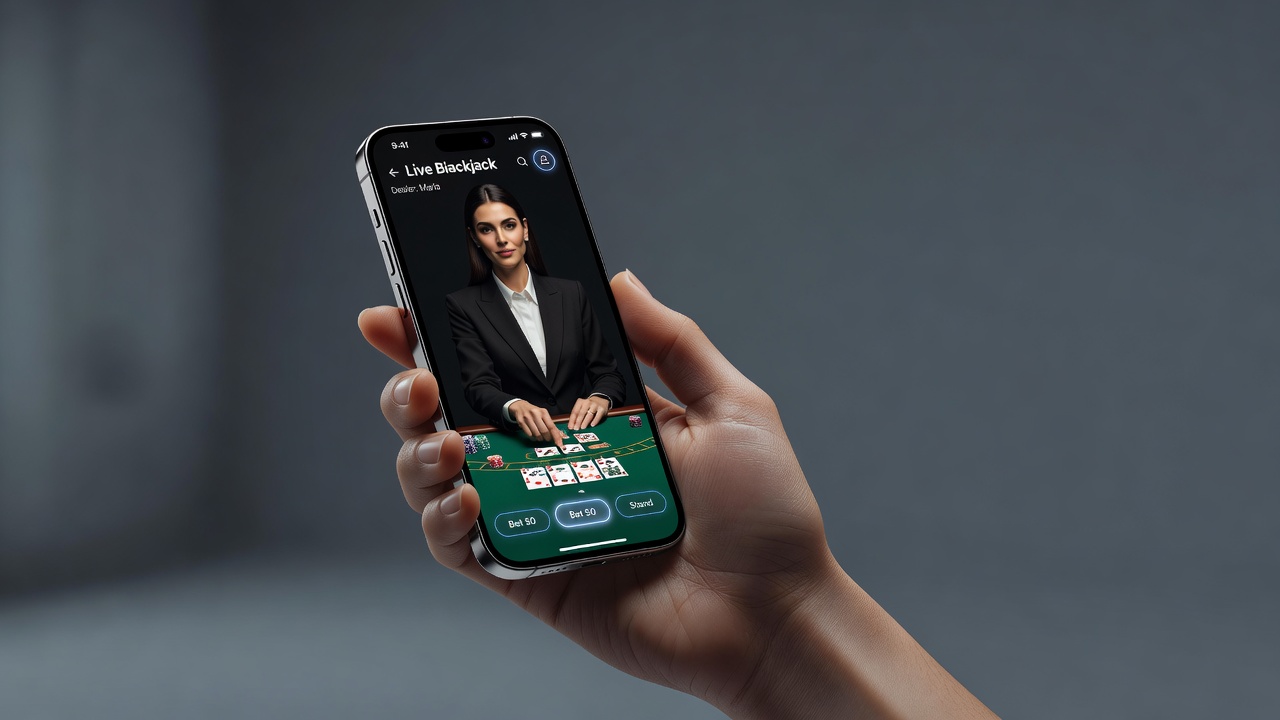
Mobile now accounts for roughly 70 to 80 percent of live casino wagering, depending on the jurisdiction. The product has shifted to a primarily mobile-first design over the past five years, and the UX compromises that come with that shift are worth understanding.
The one-sentence answer
Mobile live casino is the same game as desktop live casino, delivered through a more constrained UI that makes certain bets easier and certain other bets harder. The net effect on player outcomes is measurable in session length and bet composition data.
The core compromise: screen space
Desktop live casino interfaces can show the full dealer video, the game statistics, betting history, chat, and bet controls simultaneously. Mobile interfaces cannot. Operators make specific UX choices about what to surface and what to hide.
Typical mobile prioritization:
- dealer video: maintained, usually top half of screen
- bet controls: simplified, bottom half
- statistics (hot/cold numbers, last 30 results): hidden behind a toggle
- chat: hidden by default
- bet history: hidden by default
This means mobile players typically place bets with less information at hand than desktop players. Whether that information was actually useful (hot/cold numbers are not predictive, for example) is a separate question, but the asymmetry is real.
Bet placement mechanics
On a roulette table, desktop users can click precise split bets, corners, and streets by clicking the specific line on the felt. Mobile users often tap through a multi-step interface: select chip size, tap the general area of the bet, confirm placement.
For simple bets (red/black, odd/even, single numbers), mobile is fine. For complex bets (multiple split bets on a single spin, call bets like "voisins du zero"), mobile is noticeably slower and more error-prone.
The practical consequence: mobile players skew toward simpler bet types. This is visible in the data. Evolution Gaming and other live studios publish roughly consistent bet-type breakdowns showing that mobile users place a higher share of even-money bets and a lower share of complex split and corner bets than desktop users.
Video quality and latency
A modern live casino stream runs at roughly 720p or 1080p on desktop, with typical latency of 1 to 3 seconds behind real-time. On mobile, the stream is adaptive; over a strong 4G or 5G connection, it's comparable to desktop. Over a weak connection, it drops to 480p and latency can grow to 5-10 seconds.
High latency has a real consequence: the betting window closes before the player sees the dealer's "no more bets" call. This doesn't affect game fairness (bets close at the same server-side moment for all players) but it does create a UX problem where your final bet may be rejected for being too late.
A data point: according to connection-quality studies on live casino platforms, roughly 15-20% of mobile sessions experience at least one dropped or rejected bet due to latency issues. This is an operator-independent problem tied to cellular network quality.
Session length on mobile vs desktop
Mobile live casino sessions are typically shorter than desktop sessions in absolute duration (median mobile session around 15-20 minutes vs desktop 25-35 minutes) but more frequent (multiple sessions per day vs single daily sessions on desktop).
In aggregate, total time spent per player per week is often higher on mobile than desktop, because the convenience of short sessions adds up. Operators report that mobile-primary players have higher annual wagering volumes than desktop-primary players.
This is consistent with the broader pattern in mobile-heavy consumer products: devices shorten individual sessions and multiply session frequency. Net engagement usually rises.
The bet size pattern
A subtle pattern in mobile live casino: bet sizes often default to the last bet placed, which can lead to accidental high bets if you tap quickly on a touchscreen.
A player might place a $50 bet once, then in a later session tap the same spot expecting $5, and discover the default is still $50. This happens more on mobile than desktop because the pause between sessions is often shorter on mobile, and the chip-size selector on mobile is more compact and less visible.
Responsible-gambling tool integrations help here. A session bet limit (separate from deposit limit) caps how much you can wager per session regardless of individual bet size. This is offered by most UK-licensed operators but not universally elsewhere.
Mobile-specific safeguards
A few mobile-specific features that affect player experience:
- Biometric login (fingerprint or face ID) speeds access, which is convenient but also removes a 3-5 second pause that might have allowed reconsideration of a session
- Push notifications for active promotions create re-engagement prompts that don't exist on desktop
- Haptic feedback on wins amplifies the emotional response, which studies (e.g., the 2019 paper by Hayer et al. on mobile gambling psychology) suggest increases continued play likelihood
Operators vary in how aggressively they use these features. Regulated jurisdictions are increasingly restricting push notifications for gambling; the UK's 2023 guidance explicitly limits re-engagement nudges.
Concrete example: Evolution Lightning Roulette on mobile
Desktop: you see the dealer, full table layout, chat, history, and current multipliers. Complex "Lucky Number" bets (straight-up bets with potential multipliers) are easy to place with precision.
Mobile: the dealer takes up the top third of the screen. The table layout is compressed into a scrollable grid. Multipliers display as pop-over badges. Betting is mostly single-tap per number. Complex bet combinations (e.g., multiple split bets with different chip values) are doable but require multiple taps per placement.
Net experience: on a slow spin-by-spin basis, mobile and desktop feel similar. Over a longer session, the mobile player tends to place simpler bets and fewer of them per round.
Recommendation for players
A few practical things if you're playing mobile:
- Set a per-session bet limit before starting, not just a deposit limit
- Disable auto-rebet and auto-confirm features if offered
- Use Wi-Fi rather than cellular where possible, to reduce latency
- Disable push notifications for the operator's app
- Play in portrait orientation if the game supports it; landscape fills the screen but makes bet controls harder to tap accurately
The mobile live casino experience has been optimized around two goals: speed to bet and retention of session. Both are commercial goals. Neither is the same as "best for the player."
The summary
Mobile live casino is a real, functional product that delivers the same underlying game as desktop with measurable UX differences. The differences favor simple bets, faster re-engagement, and longer aggregate play. For a player who understands the trade-offs and sets appropriate limits, it works. For a player who treats the mobile app as a casual fill-in, the cumulative exposure can exceed what they'd have accepted on desktop.