
Jackpot Hold'em and Other Progressive Poker Table Games
There is a class of poker-adjacent table games in casinos where you are not playing anyone, you are feeding a pot, and occasionally the pot spits money back. This is the story of one night, one table, one royal flush, and a lot of questions about what we call poker.
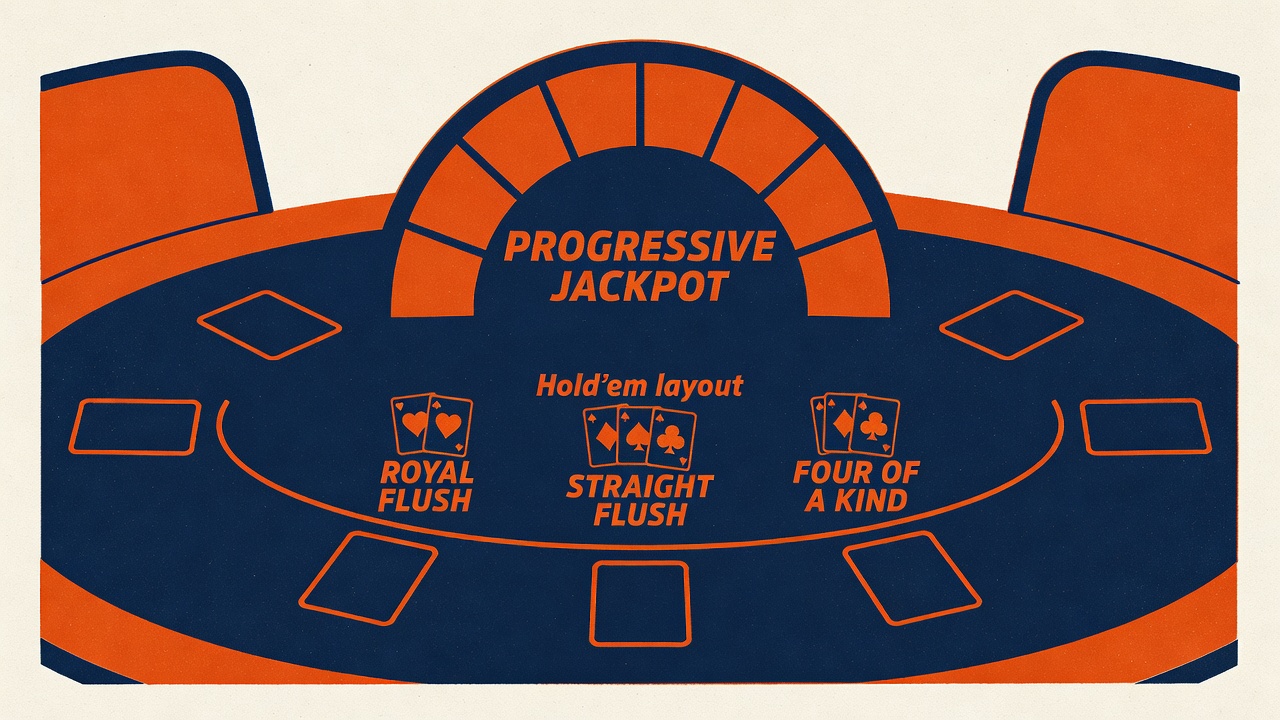
The drinks menu at the Galaxy Macau satellite pit had no prices. That should have told me something. I was there at 11:47 on a Wednesday, jet-lagged in a way that made every light bulb look auratic, and I drifted into a small roped-off area where three tables sat in a soft, commercial half-light, each one running what a purple-vested supervisor, in English marginally better than my Cantonese, called "Jackpot Hold'em." On the side of each table was a progressive meter, the numbers clicking upward in the hundreds of Hong Kong dollars per second, the digital readout climbing toward 800,000 HKD (roughly 100,000 USD) as I watched.
Two things I noticed immediately. First: nobody at these tables was playing against each other. They were all playing against a dealer, like blackjack, and the cards were five-card communal plus two hole cards, like Hold'em. Second: every player had placed a side bet of 10 HKD, a tiny red chip, into a small illuminated slot cut into the felt, and that was the fuel feeding the progressive. A hundred percent of those side bets minus the casino's rake were going into the meter, and the meter never reset unless someone hit the trigger, which, in this variant, was a royal flush in spades using your two hole cards and all three flop cards. Any royal flush paid substantial, but the spade royal was the whole jackpot.
I sat down. I had no intention of sitting down. A man in a gray linen shirt with a small red pin shook my hand with a warmth that did not match the transactional air of the place, explained the rules in about nine seconds, and swiped chips across the felt in that flat-palm way that dealers in Asia have where the gesture feels simultaneously indifferent and infinitely practiced. A hundred HKD per hand, ten on the side bet, one dealer, three of us at the table, and a Hold'em structure I'd known since I was nineteen.
Jackpot Hold'em is a member of a strange and fertile sub-phylum. It lives alongside Caribbean Stud with its progressive side bet, Three Card Poker with its 6-card-bonus, Mississippi Stud, Let It Ride, Pai Gow Poker with the Fortune side bet, Ultimate Texas Hold'em with its trips bonus. The family resemblance is visible once you know what to look for: a poker-shaped game where the structure of bluffing, reading, stealing, and pot control has been surgically removed, and in its place sits a side bet that vacuums a portion of every wager into a growing jackpot pool. The house edge on the base game is modest, sometimes under 3 percent if you play the strategy correctly. The house edge on the side bet is spectacular, often 10 to 30 percent, and the expected return on the jackpot is calculated so that only when the meter gets obscenely large, usually 2 to 4 times the "seed" amount, does the side bet approach positive EV.
The supervisor at my table, standing behind the dealer, read my face and smiled. I had not said anything. He had read me by the arithmetic of my eyes.
What the scene was really about
"Big jackpot tonight," he said. "Almost a million."
"Has it hit recently?"
"Last hit, eight months ago."
Eight months. In a room that probably sees 400 hands an hour across three tables, ten hours a day, with a 1-in-649,740 probability of a royal flush per five-card combination, and a specific-suit constraint that divides that by four again. I did the math on a napkin. The seed was 500,000 HKD. The current meter, 800,000. Still under the break-even point.
I placed the side bet anyway. That is the point of progressives. They are not a rational instrument. They are a story you buy for ten dollars.
The turn in the road
The arc of the night bent the way these arcs always bend. I lost slowly. The base game, once I remembered the simple strategy (fold anything weaker than a pair of 2s pre-flop, call with middle pair and better post-flop, raise with two pair or an open-ended draw), gave back a reasonable percentage of what it took, and the side bet meter crept from 800,000 to 812,000 to 824,000 as everybody in the pit fed it. Nobody at my table hit anything bigger than a flush, which paid 50-to-1 on the side bet. The spade royal did not come. Of course it did not come. You could sit at that table for a year and not see it.
Around 1:30 a.m. a woman in a lavender dress sat down at the next table over. I paid no attention until I heard the purple-vested supervisor make a sound I had never heard a casino employee make. It was not a cheer. It was a small exhale, almost private, as if he had been holding a breath for a long time and the breath had finally been released. I looked over. The dealer at her table was pointing at the board with a kind of ceremonial slowness. Five spades. The woman had two hole cards, both spades, T and J. The flop had come Q, K, A, all spades. A royal flush in spades.
The jackpot was 827,400 HKD. The meter reset to 500,000 with a digital chime. The woman, who looked to be about sixty and had been silent all evening, began to weep without making any noise, the tears moving down her face while her hands stayed flat on the felt.
I left the table a few minutes later. I walked out past a row of slot machines chirping into an empty concourse, past a jade statue of a tiger being polished by a man on a stepladder, past the smell of that particular casino carpet that is always engineered to be just slightly fragrant, like a low-grade memory of hyacinths. Outside, the Cotai strip was still wet from a late rain.
I thought, standing at the taxi rank, about the thing the game is actually selling. Jackpot Hold'em and its cousins are poker in costume only. The skill-adjacent decisions are mostly binary and mostly obvious. The real product is the meter, the idea of the meter, the tiny dream you rent for ten dollars that you will be the one at the table when the spade royal falls. You are not playing cards; you are paying for participation in a lottery whose prize climbs visibly while you watch, and whose design is cunning enough that when the jackpot hits at somebody else's table you will feel not just disappointment but witnessed awe, the way people who buy Powerball tickets feel when a neighbor wins and the neighbor moves to Florida. The game is teaching you to want the feeling of the meter, and the feeling is the product.
I took a cab back toward the peninsula. The driver wanted to talk about football. I let him. I kept thinking, in the back of my head, about that tiny exhale from the supervisor. Eight months of waiting, and now the machine had to be fed again, from zero. The beautiful, patient, hungry thing. I do not know whether the woman in lavender will be back. I know the table will be.