
How VIP Programs Work at Crypto Casinos
An invitation from a Telegram account named Marcus. A handwritten rakeback offer. A weekly cash drop that arrives on Saturday mornings. The VIP program at a crypto casino is a very different animal from its regulated cousin.
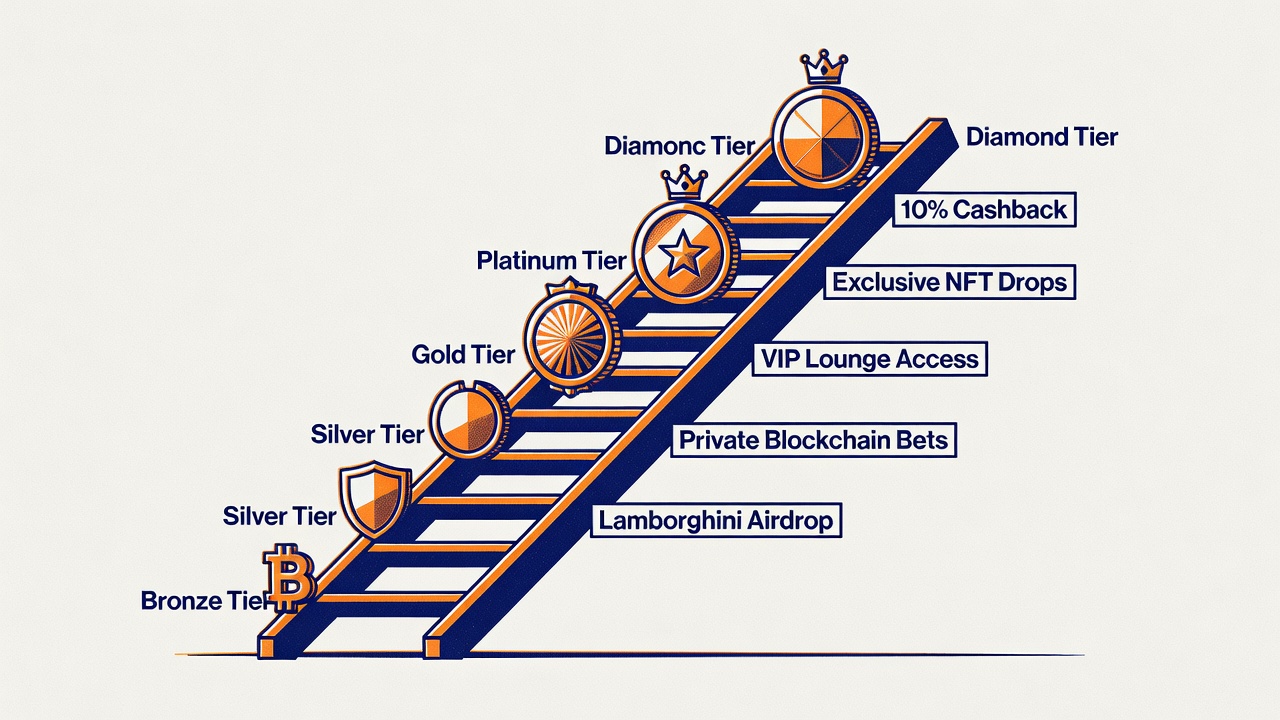
The first message arrived on Telegram at eleven in the evening. The account name was Marcus. The profile photo was a logo, not a face. The message said, politely, that Marcus had noticed our reader's play over the past three weeks, that he was the host of the site's VIP program, and that he would like to discuss a personalized arrangement.
This is how most crypto casino VIP programs begin. Not with a form to fill out. Not with a tier chart on a landing page. With a message, on Telegram or Discord or sometimes WhatsApp, from a human whose job is to keep large depositors depositing.
The reader in question had wagered roughly forty thousand dollars across a four-week period. Not high-roller numbers by land-casino standards, but enough to put him in the top one or two percent of the platform's customer base. The platform, licensed offshore, operated without the advertising restrictions and player-protection framework that governs VIP practices in regulated markets. What Marcus offered, over a series of chats, revealed the structure of a crypto casino VIP program in unusually clear terms.
The first component, and often the largest in practical value, is rakeback. Every wager a player makes generates an implicit house margin, which is the casino's expected profit over the long run on that bet. Rakeback returns a portion of that margin directly to the player's balance, usually on a weekly or monthly schedule. At a crypto casino, rakeback rates vary by wager volume. At the lowest VIP tier, a player might receive three or five percent of their theoretical loss back. At the highest tier, rates can climb to fifteen or even twenty percent. Marcus offered our reader a starting rakeback of seven percent, with a written promise of ten percent after thirty more days of comparable volume.
What the scene was really about
The second component is the weekly or monthly bonus. Unlike the welcome bonus, which is usually a one-time deposit match with wagering requirements, VIP bonuses are often offered as cash, meaning no wagering requirement, sent directly to the player's wallet balance on a recurring schedule. The amount scales with volume. A mid-tier VIP might receive a few hundred dollars a week. A top-tier VIP at a large crypto platform might receive several thousand. The cash drop arrives on a predictable day, usually Saturday morning, which is a deliberate schedule intended to pull the player back into the site for the weekend.
The third component is reload bonuses. These are ongoing deposit matches, typically in the range of twenty to fifty percent of the deposit amount, often with wagering requirements lighter than those attached to the welcome offer. Marcus offered thirty percent reloads up to a daily cap, with a fifteen-times wagering requirement on the bonus amount alone. This is aggressive compared with regulated casinos, where reload bonuses are more commonly in the single-digit percentages and carry higher wagering multipliers.
The fourth component is tournament access. Most large crypto casinos run regular tournaments, with leaderboards that reset weekly or monthly and prize pools denominated in Bitcoin or USDT. VIPs are often entered automatically, or given a multiplier that inflates their score relative to baseline players. Top three finishes at a major crypto operator's weekly slots tournament can pay out five figures.
The fifth component is the host relationship itself. Marcus, in practice, is a concierge. If the reader wanted to request a custom bonus on a bad-luck session, he messaged Marcus. If a withdrawal was delayed, he messaged Marcus. If a new slot launch was scheduled, Marcus told him in advance and often offered an early-access bonus. This is familiar to anyone who has dealt with a land-casino player development host in Las Vegas or Macau. What differs is the medium. Marcus is always, in theory, one tap away.
The turn in the road
The sixth component, which is specific to crypto, is customized deposit and withdrawal pathways. Large VIPs often receive access to faster processing queues, higher withdrawal limits, and occasionally off-chain credit lines. Some offshore platforms will extend short-term credit to known VIPs, denominated in USDT, to be settled at the end of the session or the end of the week. This is a genuinely risky arrangement, from the player's perspective, because it short-circuits the natural pause created by funding a new deposit and has been associated with the kind of chasing behavior that escalates quickly.
The seventh component, and the least visible, is the quiet tolerance of certain player behaviors. Crypto casino VIP programs are often willing to look past thin KYC documentation, unusual geographic footprints, and large, rapid wagering patterns that would trigger account reviews at regulated operators. This tolerance is a feature for some players. It is also the mechanism by which VIP programs can become genuinely dangerous to a segment of customers for whom regulated self-exclusion and deposit-limit tools would otherwise apply. There is no independent regulator who can force a Curacao-licensed operator to honor a self-exclusion request from a player who has lost control.
The reader's four-week relationship with Marcus ended, as these often do, with a break. He took a two-week holiday from the platform. Marcus messaged on day four, on day seven, and on day ten. The day-ten message, notable for its construction, was warm and informal and asked about his son. This is also part of the VIP program. The host remembers.
What these programs tell us, taken together, is that crypto casinos have reproduced the VIP architecture of the land casino almost exactly, with two key differences. The frictions that used to slow the machinery, the need to travel, the need to physically present cash, the presence of a regulator, have been compressed or removed. And the contact, which at a land casino happened over the course of a trip, now happens in the pocket of a player who never needs to look away.