
How to Track Your Poker Results Like a Pro
Most poker players track their results badly or not at all. The gap between their perceived win rate and their actual win rate is usually bigger than they want to know. Here are the claims about tracking, and what the professional practice actually looks like.
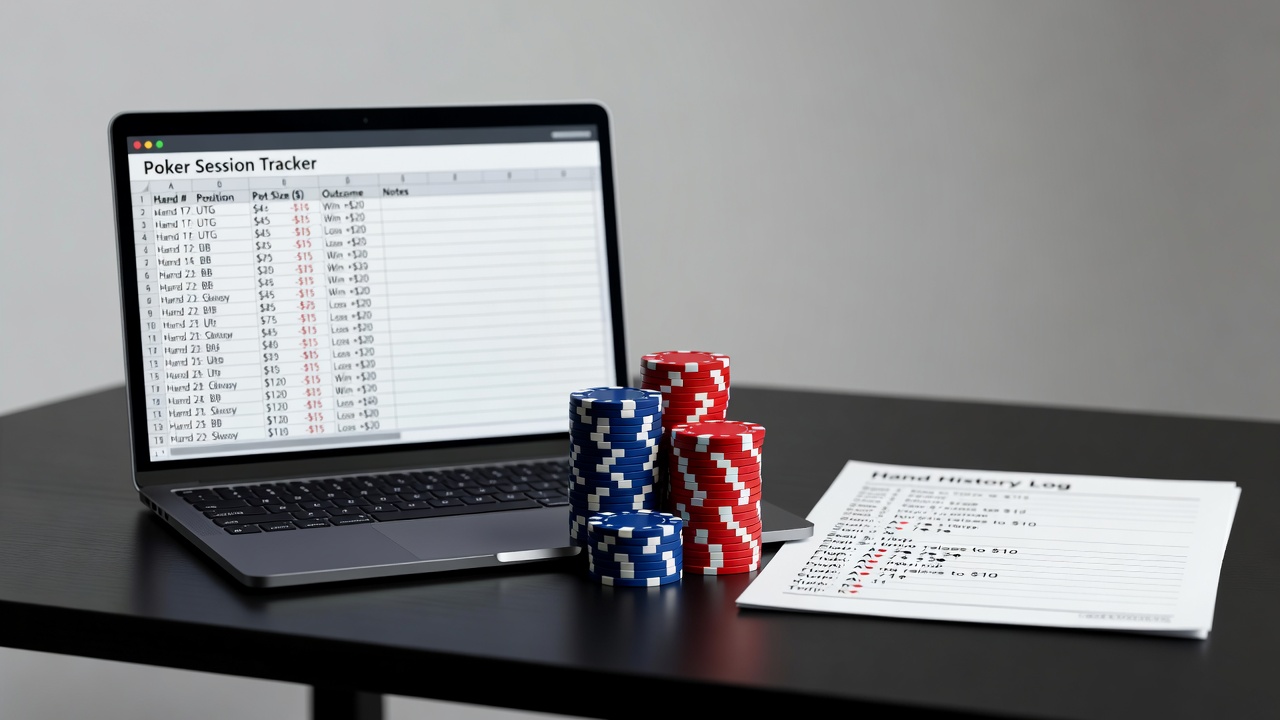
Poker tracking is a statistical discipline wrapped in a games skin. Most recreational players do it badly. Most semi-pros do it reasonably well. Actual pros do it with the rigor of a trading desk, because for them the line between profitable and unprofitable is slim and they cannot afford to mislabel a losing format as a winning one.
Here are the tracking claims that circulate.
Claim 1: Session Totals Are Enough
The claim: Tracking wins and losses by session is all you need. Any deeper tracking is overkill.
Reality: Session-level tracking tells you whether you made or lost money. It does not tell you why. Serious tracking breaks results down by: game type (cash vs tournament vs SNG), stake level (5/10, 10/20, 25/50), position (early, middle, late, blinds), specific opponent type if you can tag them, time of day, session length, and location (online vs live, specific site). The reason for this granularity is that you almost certainly have a subset of games where you are losing money and a subset where you are winning, and the coarse session total averages them into a misleading combined number.
Claim 2: Online Tracking Software Is Sufficient
The claim: PokerTracker, Hold'em Manager, and similar HUD software track everything you need for online play.
Reality: They are great for online cash game tracking but have blindspots. They track every hand, all-in adjusted winnings, bb/100, position stats, and so on. What they do not track well is mental state, session quality (were you tilted, tired, distracted), stakes outside your main game, or live play. A serious player maintains the HUD database as one input plus a separate session log with qualitative notes. Over time, the qualitative log often correlates with the quantitative results in ways that reveal mental-game leaks worth more than technical leaks.
Claim 3: Win Rate Needs a Big Sample to Stabilize
The claim: You need at least 10,000 hands of data before your win rate stabilizes.
Reality: The statistical answer is that a cash game win rate's standard deviation over 10,000 hands is large enough that even a strong winning player might show a small loss over that sample. A more realistic sample for stabilization at low-stakes cash is 100,000 to 200,000 hands. At tournaments, where variance is much higher, you probably need several hundred tournaments before your ROI is meaningfully distinguishable from noise. The 10,000-hand figure is a dangerous half-truth because it encourages players to conclude their win rate too early.
Claim 4: Tracking Kills the Fun
The claim: Logging every session turns a hobby into work. Recreational players should skip it.
Reality: This is mostly true, and I would actually accept it as a valid choice for players who explicitly want poker as pure entertainment. The caveat is that recreational players who skip tracking also lose money they think they are not losing, because memory bias systematically over-remembers wins and under-remembers losses. If you are choosing recreation over optimization, at least acknowledge the blind spot. Track once a quarter to check your bankroll, even if you do not track per-session.
Claim 5: Spreadsheets Are Fine for Live Play
The claim: A Google Sheets with date, site, buy-in, cash-out, and duration is sufficient for live poker tracking.
Reality: Sufficient for basic hourly rate calculation and session-level analysis. Add columns for notes on mental state, notable hands, and post-session regret factor. The regret factor is weirdly useful: rating how satisfied you are with your session quality (independent of win/loss) on a 1 to 5 scale surfaces mental game issues that pure results tracking hides. A player can have a winning session where they played badly and got lucky, and the regret factor catches it.
Claim 6: Bankroll Growth Is the Right KPI
The claim: Whether your bankroll is growing is the metric that matters. Everything else is details.
Reality: Partly. Bankroll growth captures the net result, but it conflates skill with variance. A player who went from $5k to $7k this month might have had a great month of plus-EV play, or might have had a mediocre month where variance was friendly. Distinguishing the two requires looking at your all-in adjusted winnings (for online cash) or your expected-value-adjusted ROI (for tournaments, using ICM equity at all-in spots). Pros watch EV-adjusted results more than raw results, because EV-adjusted numbers are what predict future bankroll trajectory.
Claim 7: Mental Game Logs Are Soft Bullshit
The claim: Tracking emotional state and tilt is self-help fluff that does not affect your win rate.
Reality: It does affect your win rate, measurably. Players who track tilt episodes alongside results consistently find that their worst sessions cluster with specific triggers (bad beats, late night play, life stressors, stake changes). The tracking enables intervention. Unfortunately, the intervention requires effort (taking breaks, reducing session length when tilted, seeking coaching). Most players who log emotional state do not act on the data. Those who do often improve their win rate more from the mental adjustments than from technical study.
Claim 8: You Should Compare Your Results to Published Pros
The claim: Benchmark your win rate against what published professionals post on Twitter or their blogs.
Reality: Published win rates are a selection-biased sample. Players with bad results do not publish. Players with good results sometimes inflate. The range of credible win rates at, say, 2/5 live cash is roughly 5 to 15 bb/hour for serious winning regulars. Public claims of 20+ bb/hour at that level are either exceptional talents, lucky samples, or promotional content from coaching businesses. Compare your results to your own historical baseline. Do not compare to benchmarks you cannot independently verify.
The goal of tracking is not to feel good about your poker. It is to prevent the narrative you tell yourself from diverging too far from the money in your account.