How to Play Plinko: Rows, Risk Levels and Slot Odds
Every Plinko bounce is an even split, so slot odds follow a binomial curve. What rows and risk change, how RTP is set, and how to verify a drop.
Learning how to play Plinko takes a minute: set a stake, pick how many rows of pins the board has and a risk level, then drop a ball that bounces left or right at each row until it settles in a slot at the bottom. That slot's multiplier times your stake is the payout. Where the ball lands is chance, not skill: every bounce is an even split, so the middle slots catch most drops and the edge slots, which carry the largest multipliers, almost never do.
How to play Plinko for beginners
For beginners, the game reduces to three settings and a drop button. None of the settings changes how a single bounce behaves. They change how many bounces there are and what each landing pays.
- Stake. The amount riding on each ball. The payout is the stake times the multiplier printed under the slot the ball reaches.
- Rows. On Stake, players pick between 8 and 16 pins, and the count sets how many game events make up the path. More rows mean more bounces, more slots and rarer edge landings.
- Risk level. This setting swaps the multiplier table printed under the slots. Read the table for the level you chose before dropping, because it is the only thing the setting touches.
- Drop. The ball runs from top to bottom and the round settles when it lands.
The habit worth building early is to look at the multipliers under the middle slots first. That is where most balls finish, so those figures decide most of what the game pays back over many drops.
Why every Plinko bounce is a coin flip
Each peg is an even left-or-right split, and the split is the same at every row. Stake's game-events page says each random float becomes a direction by multiplying each float by 2 and reading the result as left or right.
Because the chance never changes from row to row, the slot a ball reaches follows the binomial distribution. NIST's statistics handbook defines it as the probability of x successes in N trials with a fixed success probability p. In Plinko a success is a bounce to the right, N is the number of rows and p is one half.
The fixed-p condition is what makes the math hold. The handbook stresses that the model requires p fixed for all trials, and the float-times-two mapping is the mechanism that supplies that guarantee in the casino version.
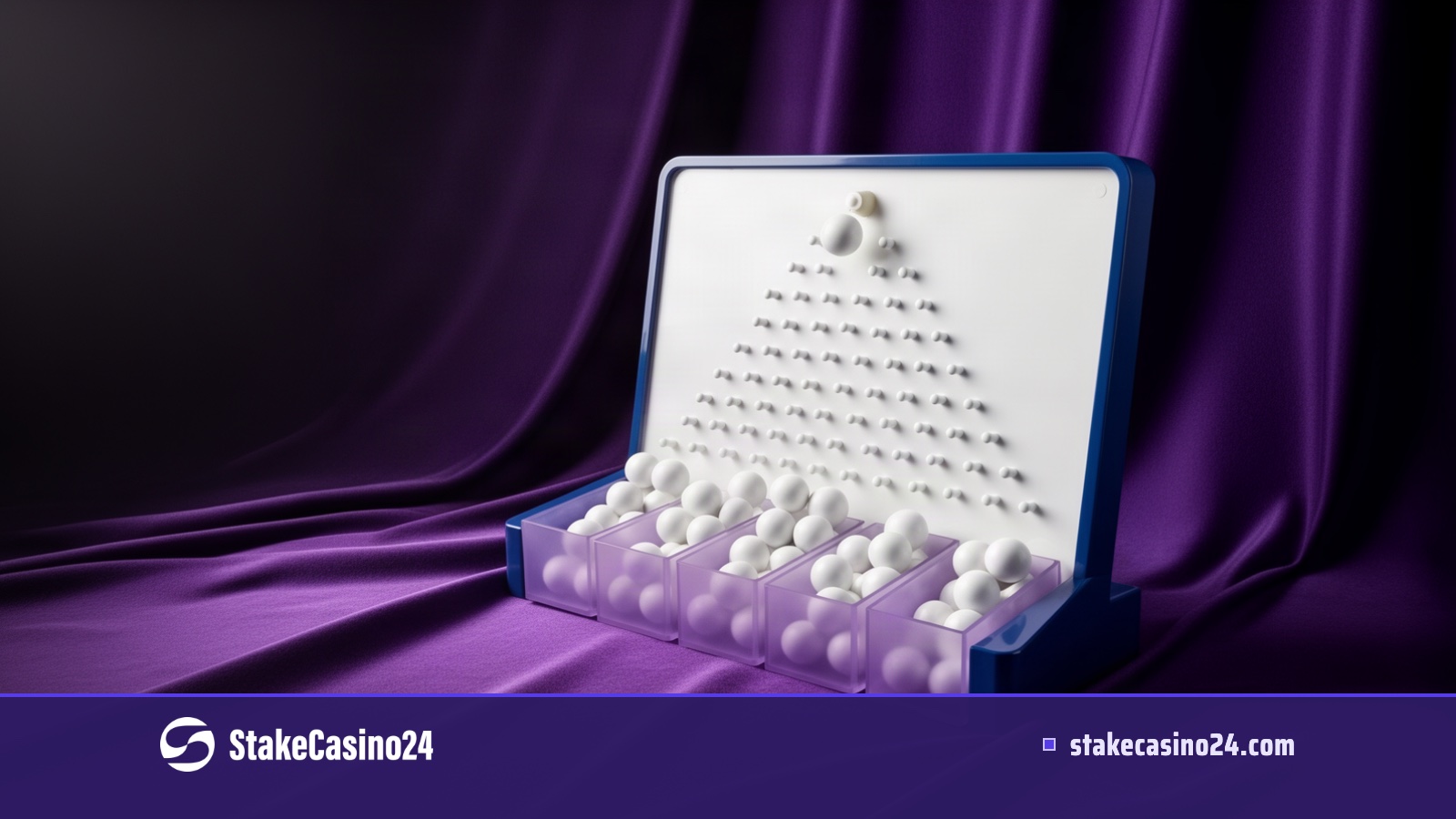
The physical ancestor of the game, the Galton board, shows the resulting shape. Laying Pascal's triangle over the pins counts the paths to each bin, and on that board the row count equals the number of trials. Middle slots are reachable by many mixed sequences of lefts and rights. An edge slot is reachable by exactly one sequence: the ball has to go the same way at every row.
Rows and risk levels: what each setting changes
The three settings act on different parts of the game, and only one of them touches the odds of a slot.
| Setting | What it controls | Effect on slot odds |
|---|---|---|
| Rows (8 to 16 on Stake) | Number of bounces and number of slots | More rows spread drops wider and make edge slots rarer |
| Risk level | The multiplier printed under each slot | None; it changes payouts only |
| Stake | The amount per ball | None |
In Stake's documentation the ball's route comes from the random floats and the chosen pin count. The risk level is not an input to the path, so it cannot move the ball. It reprices the slots.
What the multiplier table means for return to player
Return to player for a given setting is each slot's probability times its multiplier, summed across the bottom row. The binomial odds supply the probabilities and the table on screen supplies the multipliers.
The edges show how lopsided that sum is. Stake's Plinko odds guide puts the chance of landing the biggest win on its 16-row, medium-risk board at 0.0015%. That figure is what the binomial model predicts for an edge slot, since the ball must break the same way at all 16 decisions.
A large top multiplier therefore says little about value. Most of the return sits in the middle of the board, and the multipliers printed there carry most of the weight. To estimate return to player yourself, take every multiplier from the table, weight each by its slot's path count from Pascal's triangle divided by the total number of paths, and add the results. Whatever falls short of the stake is the house edge for that setting.
No timing or pattern improves a drop. Each ball draws fresh floats, so a run of edge hits or misses says nothing about the next one.
How to verify a Plinko drop
Provably fair means you can recompute a result from inputs the casino committed to before you bet. Stake's implementation page lists client seed, server seed, nonce and cursor as the inputs to its random number function, which is built on an HMAC hash.
The server seed is shown only as a hash while you play, a step the page says exists so that the unhashed seed cannot be changed by the operator afterwards. Stake uses 4 bytes per game result, and Plinko needs one result per row, so the deepest board takes 2 cursor increments to cover 16 decisions. Each increment produces a fresh hash output to read from.
Checking a drop means taking the revealed server seed, confirming it hashes to the value shown before the bet, then rerunning the function with your client seed and the bet's nonce and reading each float as left or right. If the recomputed path ends in the slot you were paid for, the result was not altered. Verification proves integrity only: the odds and the house edge still come from the multiplier table.
Questions on this
How do you win at Plinko?
No choice raises the chance of reaching a high-paying slot. Every row is an even left-or-right split set by a random float, so the decisions that matter are your stake, the row count and which multiplier table you accept.
What are the odds of hitting the top Plinko multiplier?
On Stake's 16-row, medium-risk board, its own guide puts the biggest win at 0.0015%. That is the probability of the ball breaking the same way at every row.
Is online Plinko rigged?
On a provably fair implementation you can check rather than trust. The server seed is committed as a hash before you bet, and once the unhashed seed is revealed the full path can be recomputed from the seeds, the nonce and the cursor.
How many rows can you play in Plinko?
Stake lets players choose between 8 and 16 pins. The count sets how many game events make up the path from top to bottom.
Sources and on-chain links
- Stake.com, Provably Fair Implementation, accessed 2026-10-19
- Stake.com, Provably Fair Game Events, accessed 2026-10-19
- NIST, Binomial Distribution (NIST/SEMATECH e-Handbook of Statistical Methods), accessed 2026-10-19
- Wikipedia, Galton board, accessed 2026-10-19
- Stake.com, Plinko Board Probability & Odds, accessed 2026-10-19