
How Bookmakers Set Their Odds: A Look Behind the Scenes
An afternoon at a trading desk in a converted industrial estate north of Manila, watching six screens and a grown man shout at a tennis match in Prague. This is how odds actually get made, up close and mostly unglamorous.
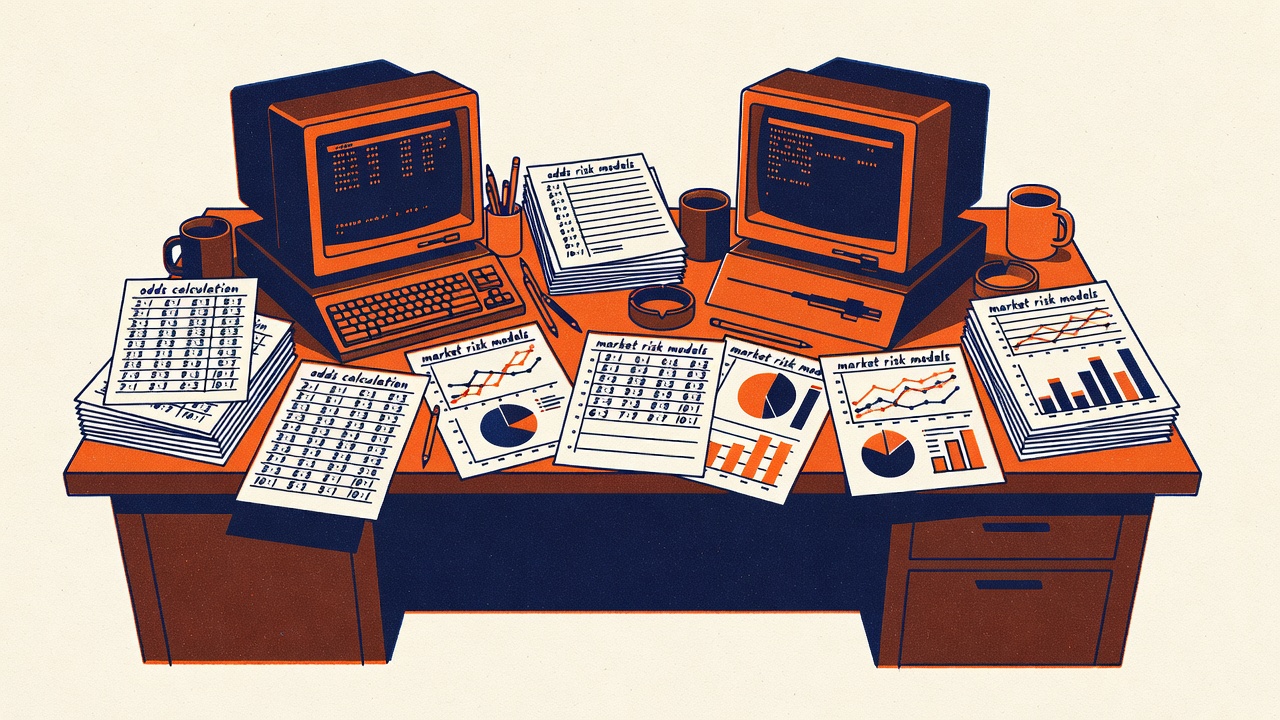
The trading desk I was allowed to sit at, briefly, in the autumn of 2023, was in a fourth-floor office above a shipping company in a business park in Quezon City, the kind of building where the elevator smelled of cooking oil and the receptionist had a small electric fan pointed at a potted orchid. The trading floor itself (they called it a floor, though it was really a room with thirty desks and two whiteboards) was absolutely silent apart from the clicking of keys, the muted commentary of sports feeds on six different television screens hung like religious icons from the ceiling, and the occasional Tagalog expletive from a man in a black polo shirt named Arjay, who was trading a Prague tennis match and had just been shown a break point he had not anticipated.
Arjay did not shout at the match because he had a personal investment in the outcome. He shouted because, on his screen, a line he had set at 1.72 had just been taken by a syndicate in Singapore for the maximum stake four times in six seconds, which meant the syndicate knew something he did not, and his risk exposure on the match had just gone from balanced to ugly in the time it takes to adjust a chair. He moved the line to 1.62 with a keystroke. Then he opened a different screen, checked three other books (Pinnacle, Betfair's exchange, an obscure Asian operator whose feed he had bookmarked), saw they had already moved to 1.60, and exhaled.
This is how odds get made. Not by actuaries at mahogany desks. By men and women in open-plan offices in Manila, Sofia, Malta, Gibraltar, sometimes London or Las Vegas, watching screens that look like the flight deck of a cargo plane, moving lines in response to each other in a great continuous chorus, and occasionally, at the edges of their attention, noticing who is betting what and adjusting accordingly.
The fundamental model is older than the internet. A bookmaker's job is to set a line on a binary or multi-way market such that the total implied probability across all outcomes sums to slightly more than 100 percent, and the difference is the overround, or vig, or juice. On a basic two-way football market the overround might be 105 to 108 percent, meaning the book expects to return, on a perfectly balanced action, 100 and keep 5 to 8 as margin. If all the money lands on one side, the book is on the wrong end of variance. If it lands evenly, the book wins regardless of the result.
What the scene was really about
The interesting question is how the opening line gets set. Arjay's desk had a pricing model running in the background, developed in-house by the company's quants, that ingested roughly forty data feeds for each tennis match: player rankings, surface-specific ELO ratings, recent form, head-to-head history, fatigue indicators derived from travel schedule and match duration in the preceding seven days, injury reports scraped from social media and press conferences, even weather for outdoor matches. The model output a projected probability for each player to win. Call it 58/42. The bookmaker adds an overround by inflating both sides symmetrically (roughly 61/44, adding up to 105) and then converting to decimal odds. That is the opening line.
What happens next is the part the documentaries miss. The opening line is a hypothesis, and the market is the experiment. If the line is too good on one side, sharp money will arrive within minutes. Sharps are syndicates (and a few individuals) with their own models, their own proprietary data, and in the most elite cases, their own information networks. When they hit a line, they hit it hard: big stakes, at the maximum the book will take, repeatedly. This is the signal. A line that survives a minute of sharp action is probably close to fair. A line that gets hammered is wrong, and the book moves.
Public money moves lines too, but differently. If 80 percent of the recreational stake is on a popular team, the book does not automatically shift the line, because the book is happy to have exposure against recreational bias. The book will shift only if the total liability starts to threaten the risk limits the trader is working within.
Arjay explained this to me during a break, eating a sandwich the size of his palm, staring at the TV where Prague had lit up in a post-point celebration. "The public moves the price because of bias. The sharps move the price because of information. We pay attention to the sharps. The public, we let them stay wrong."
The turn in the road
I watched him for six hours. He traded three tennis matches, a Bundesliga second-half, and, toward the evening, shifted to a basketball slate from the Americas. His hands rarely came off the keyboard. He made adjustments in micro-amounts, half-cent, one-cent, usually at moments when nothing visible on the TV had changed. Once I asked what had just happened and he pointed to a Telegram channel open in a sidebar: a rumor that a player had an injury in warm-up. Arjay had seen it eight seconds before the wire services. He had moved the line at 31 percent implied probability before the number could settle elsewhere. Other books followed within a minute.
The arc of the day had a rhythm. In the morning, lines were mostly set by the models. By midday, as European sharps woke up and put orders in, the lines shifted in small quick steps. Evening was when the public piled in, money flowed to the heavy favorites and overs, and the traders watched for irregularities, mispriced correlated bets, anybody trying to arbitrage between two of their own markets. A man two desks down spotted a lay opportunity on a parlay that had been bought too cheap by a player in Vietnam and voided the bet under a clause about "palpable error." The Vietnamese player would receive a refund. The money disappeared from Arjay's liability column. The trading floor did not react. This was routine.
I left the building at 9 p.m. local time. Arjay was still at his desk. On the way out the receptionist was packing up the potted orchid into a cardboard box and the fluorescent light overhead was humming at a frequency that made my teeth ache. In the elevator down, I thought about the scale of what I had just seen: one small office in Manila, responsible for setting prices that players in thirty countries would take or decline, each price the output of a model plus a trader plus a feed of sharp reactions plus whatever rumors had drifted into the Telegram channels that morning. Multiply that office by a few dozen similar offices around the world and you have the global book, a network of nervous systems twitching in real time, pretending to be a perfectly efficient market and almost never being one.
On the sidewalk a tropical rain was starting. The shipping company downstairs was loading a truck. I walked two blocks to a cafe where the coffee was good and thought about the phrase "setting the odds," which is almost always used in the past tense, as if the odds were a thing that someone, once, sat down and established. That is not what happens. The odds are being set, now, continuously, by thousands of people and tens of thousands of pieces of information, in a loop that never closes and never stops. What you see on your betting app is a snapshot of that loop, one frame, already half out of date. If the price feels wrong, it is because the loop has not closed on your bet yet. If it feels right, it is because the loop already closed. That is the real secret of bookmaking, and it does not photograph well.