
Germany's Online Gambling Landscape: A General Overview
Germany's State Treaty on Gambling regulated the online market in 2021. Three years in, the effects on stake sizes, product availability, and channelization are measurable. Here is what the regime actually does.
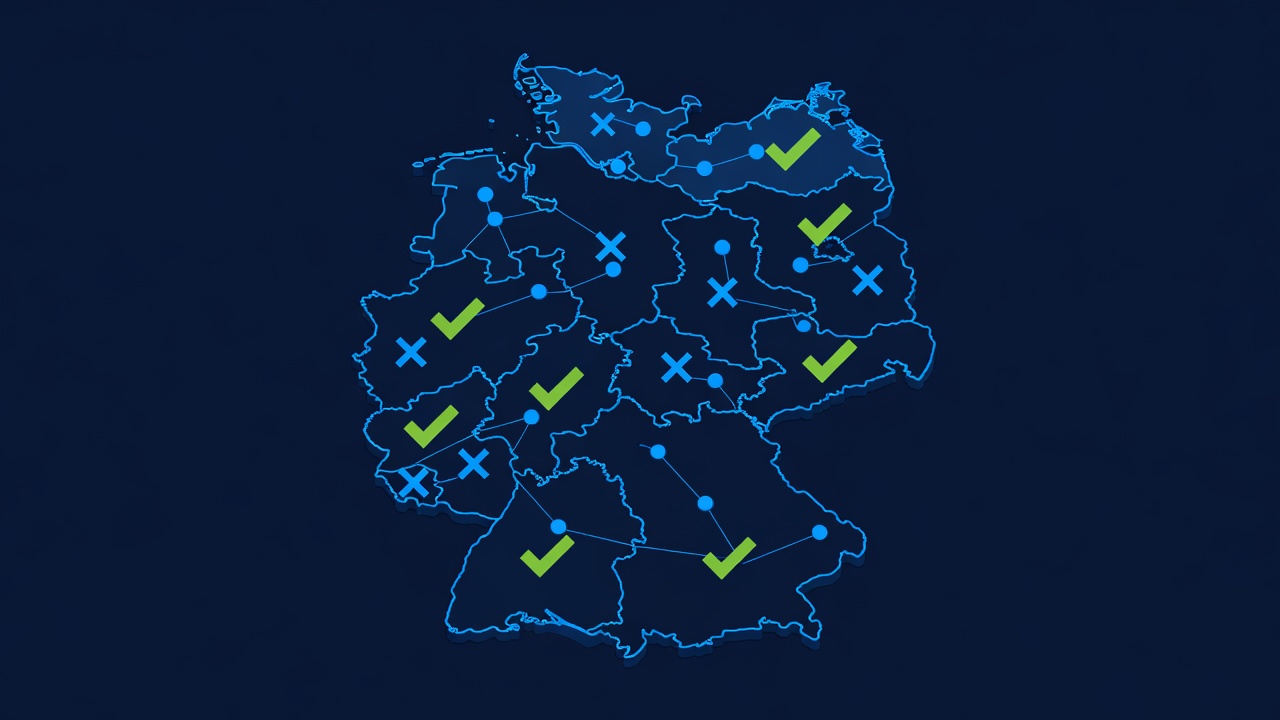
Germany's Interstate Treaty on Gambling, known in German as the Glucksspielstaatsvertrag or GluStV 2021, came into force on July 1, 2021. It replaced a patchwork of state-level regulations with a federal framework regulating online slots, online poker, and sports betting. A centralized regulator, the Gemeinsame Gluecksspielbehoerde der Laender (GGL), sits in Halle and oversees the licensing regime.
From a quantitative perspective the relevant question is: what does the regime restrict, and how do those restrictions change the economics for operators and players?
What is regulated and what is not
Four product categories are explicitly covered:
- Online virtual slots (Virtuelle Automatenspiele).
- Online poker.
- Online sports betting.
- Lottery products.
Online table games like roulette and blackjack, outside of live dealer formats, are explicitly excluded from the federal regime. The individual German states can license online casino games within their own borders, and some, including Schleswig-Holstein and North Rhine-Westphalia, have begun doing so on a state-by-state basis. This creates a split market.
The core restrictions
The slot-specific rules are the most restrictive in the European licensed market.
- A 1 euro maximum stake per spin on licensed online slots.
- A minimum 5 second spin duration. Autoplay is banned.
- No jackpot features on licensed slot titles.
- A federal monthly deposit limit of 1,000 euros across all licensed operators, tracked via a central database called OASIS.
- A cross-operator self-exclusion database. Enter self-exclusion with any licensed operator and you are blocked from every licensed site.
- No simultaneous play across product verticals. A player logged into online slots cannot simultaneously have a sports betting session open at the same operator.
Poker rules are less restrictive but cap tables per player.
Sports betting has a 5 percent turnover tax levied on operator stake volume, passed through to odds by most licensed books.
Stake economics under the 1 euro cap
A 1 euro maximum stake combined with a 5 second minimum spin time creates a firm ceiling on a player's expected hourly loss on licensed slots. At 720 spins per hour maximum and a typical house edge of 4 percent, the maximum expected loss on a licensed German slot session is:
720 spins x 1 euro x 0.04 edge = 28.80 euros per hour.
Compare to the same player at a Maltese-licensed site with 5 euro stakes at 3 seconds per spin and a 4 percent edge:
1,200 spins x 5 euro x 0.04 = 240 euros per hour.
That is an 8x difference in burn rate. From a player-protection standpoint, the German design is doing exactly what it was intended to do.
Channelization
The metric regulators care about is channelization: what fraction of total player spend goes to licensed operators versus unlicensed offshore sites. The German Federal Office of Administration's 2023 report put licensed-market channelization at roughly 50 to 60 percent, depending on product. Sports betting is higher, around 80 percent. Online slots are lower, around 40 to 50 percent, largely because the 1 euro cap pushes higher-stakes players to unlicensed alternatives.
Channelization below 70 percent is generally considered failing by regulatory economists. Germany's regime is tight in design and leaky in practice.
The operator side
Operators face several friction costs in Germany:
- 5.3 percent turnover tax on slot stakes, passed through to RTP. A German-licensed slot runs at roughly 90 to 93 percent RTP versus 96 percent on the same title in Malta or the UK.
- IP-level licensing, meaning separate tech stacks and separate bank arrangements for the German market.
- Mandatory real-time reporting to the GGL of every transaction.
- Restrictive advertising rules, including a ban on sports sponsorships that prominently feature operator logos.
The net result: many international operators have elected to serve the German market through separate, stripped-down brands or to skip the market entirely.
For the individual player
For a German player using licensed sites, the practical implications are:
- Slot RTPs will be noticeably lower than at non-German-licensed operators.
- Monthly deposits are capped at 1,000 euros across all licensed sites combined.
- A single self-exclusion ends all licensed-market access nationwide.
- Live casino tables (roulette, blackjack) are only available on a state-specific licensing basis.
- Verification and KYC is tighter than in most EU markets, via the OASIS database.
Germany built the most protective online gambling regime in Europe and, predictably, saw a large share of volume leak to offshore sites that offer none of the protections.
A concrete example
A player depositing 500 euros in a month at a German-licensed operator, playing slots at 1 euro per spin with a 92 percent RTP, will turn over roughly 6,250 euros if they play through their deposit 12.5 times before busting. Expected loss is 500 euros, which is the deposit. Session length: around 9 hours at the 5 second spin cap. The same 500 euros at a Maltese-licensed operator with 96 percent RTP and 5 euro stakes turns over in about 2,500 euros of wagered stake and roughly 100 minutes before bust.
The German regime trades faster session exposure for lower RTP. Whether that trade improves player outcomes is an empirical question the channelization data is slowly answering.