
Craps: From Hazard to America's Favorite Dice Game
Craps is the loudest table in the casino, and for a reason. My take: it is also the closest thing to a genuine ritual surviving in American gambling, and if you have never stood shoulder to shoulder at a pass line with twelve strangers, you have not really been to a casino.
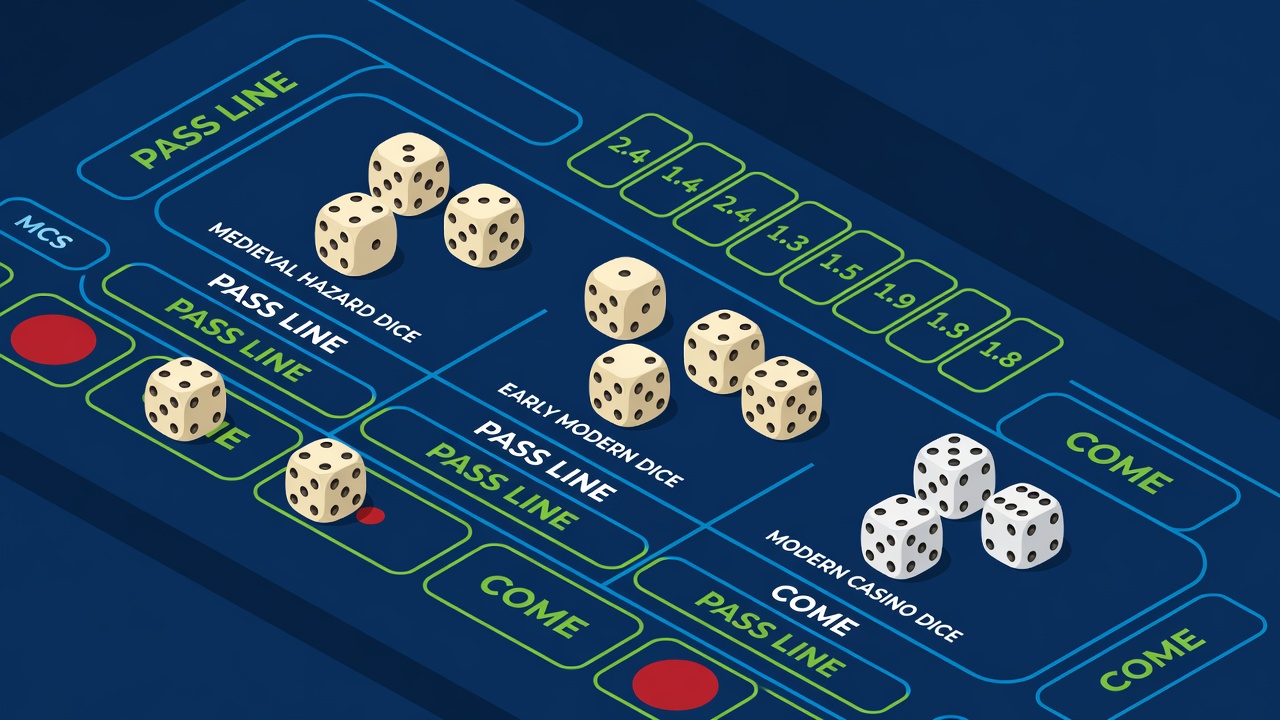
The thesis, up front: craps is the last communal game in the American casino, and its survival is the single most interesting thing happening on a modern gaming floor. Everything else is headphones and individual screens. Craps is still a congregation.
Second paragraph, in case the thesis needs support: a craps table is the only place in a modern casino where twelve strangers will cheer for the same outcome at the same time, where the noise of a single hand (a hot shooter running thirty minutes of rolls without a seven) can be heard from the other end of the floor, and where the ritual structure of the game (the shooter, the stickman, the boxman, the specific vocabulary of the rolls) still functions as a live social performance. This is not nostalgia. This is a product advantage that nobody is taking seriously.
The history is relevant because the craps table is a direct descendant of a game called Hazard, which is mentioned in Chaucer's Canterbury Tales (the Pardoner's Tale, late 14th century) and which was played across Europe for several hundred years before being brought to North America by French colonists in New Orleans in the early 1800s. A man named Bernard Xavier Philippe de Marigny de Mandeville, a French-Creole aristocrat and gambler, is usually credited with simplifying Hazard into something closer to what we now recognize as craps. The simplification made the game portable, more mathematically symmetric, and easier to learn, which turned out to matter enormously for its eventual spread.
From New Orleans the game moved up the Mississippi on the riverboats, became a staple of frontier gambling halls in the late 19th century, was adapted again by a Philadelphia dice maker named John H. Winn around 1907 (who introduced the "don't pass" bet, balancing the book and making the table more appealing to casinos), and entered the modern era on the green felt of the Vegas Strip in the 1940s, where it coexisted with blackjack and roulette as the three core table games that defined casino architecture for the next sixty years.
Why this matters
By the 1970s and 80s, craps was everywhere. Every casino floor had at least three or four tables. The pit boss hierarchy around craps was its own small world. The dice themselves (casino dice are precision-machined, transparent, with sharp edges, and retired after eight hours of use) were a fetish object. The vocabulary of the game (snake eyes, boxcars, yo-leven, hard ways, come bets, don't come, field, big six, big eight) became part of American English in ways that only baseball and boxing could match.
And then, in the late 2000s and 2010s, craps began to shrink on casino floors.
The reasons were structural and not about the game itself. Craps tables have the worst revenue per square foot of any major casino product. Slot machines, by comparison, are enormously efficient: each unit generates revenue without staff, without supervision, without cheering crowds that clog walking lanes. A single craps table requires four employees on a shift (stickman, two dealers, boxman), takes up roughly fifteen feet of floor space including standing room, and has a house edge that is competitive but not high. The math of the casino floor pushed craps into corners.
Meanwhile, the arrival of electronic table games (stadium gaming, digital craps machines where players bet using touchscreens around a shared dice or a random number generator) offered a hybrid: some of the communal feel without the labor cost. The Boyd Gaming and Station Casino properties in Vegas rolled out digital craps aggressively. Some players love it. Most of the old-timers hate it, because the ritual does not survive the transition. You cannot high-five the stranger next to you when the shooter hits your nine if the shooter is a pixel on a screen.
Here is where I plant the flag. The survival of craps depends on the casino industry realizing that what they are selling is not a dice game. They are selling a small communal ritual that happens to produce revenue. The economics say: replace it with slots, replace it with electronic tables, replace it with whatever extracts more dollars per square foot. The marketing says, or should say: this is the last room in the casino where the product is the group, not the individual.
The counterargument
I have stood at craps tables in a dozen cities. The one I remember most clearly was in a Harrah's in Bossier City, Louisiana, at 1:40 a.m. on a Saturday, where a shooter named, improbably, Darnell, was thirty-seven minutes into a run that had not yet produced a seven. The table was full, twelve players, plus five or six of us standing in the second row watching. Every roll that came out as a point (not a seven) was greeted with a small collective cheer that built as the run continued. Chips piled on the felt. The stickman's patter got faster. A woman in a green sweater hit a hard eight on the forty-second roll and shouted in a way that was neither happy nor sad, just enormously present, and for that one minute the dollar-per-square-foot of the space we were all standing in was probably higher than any slot bank in the building.
Darnell sevened out forty-eight minutes in. Everyone congratulated him. He tipped the dealers. He walked away. A new shooter picked up the dice. The table reset.
The counterargument to my thesis, steelmanned: maybe craps is a dying ritual because younger players do not want communal gambling. Maybe the headphones-on, algorithmically-recommended, one-screen-one-player model is what the next generation actually wants, and craps is just a holdover from a world where Americans socialized differently. This is possible. I cannot fully disprove it. The craps demographic skews older, and the learning curve is steeper than most slots. If the generational preference is truly individual, then craps may slowly die, not because it is a bad product but because the culture that sustained it is gone.
But I do not think that is what is happening. I think the communal appetite is still there (look at Twitch streaming, look at sports-book shared betting, look at the revival of in-person poker rooms) and craps is just badly marketed to anyone under forty. Put a craps table next to a craft cocktail bar in a well-lit modern room and watch twenty-somethings crowd around it once someone shows them how to play. The communal pull is not generational. It is human.
The casinos that figure this out will keep the craps tables. The ones that do not will replace them with another slot bank, and the floor will get quieter, and something specific to the American gambling experience will have been lost, not because it was unprofitable but because it was slightly less profitable than something else. That is how rituals die. Not by being killed. By being calculated against.