
Casino 1995: How Scorsese Captured the Mob-Era Las Vegas
Martin Scorsese's Casino was released November 22, 1995. The film is a lightly fictionalized account of the Stardust skim, based on Nicholas Pileggi's reporting. A look at where the documentary record and the film align, and where they diverge.
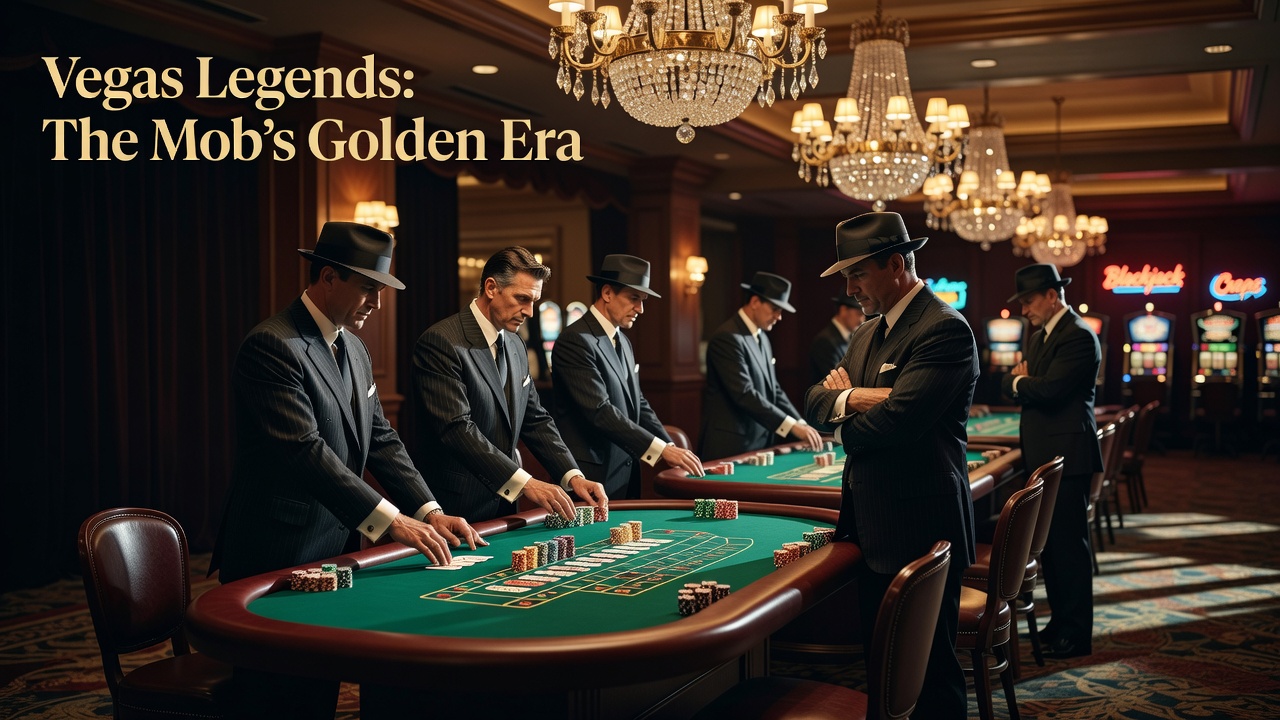
The source material for Casino is a book by Nicholas Pileggi, published by Simon and Schuster in 1995 under the title Casino: Love and Honor in Las Vegas. Pileggi spent six years interviewing Frank Rosenthal, his ex-wife Geri McGee, Anthony Spilotro's associates, FBI agents, and Stardust employees. The book is built on transcribed testimony and contemporary news reporting from the Las Vegas Sun and the Las Vegas Review-Journal.
Martin Scorsese's film, released on November 22, 1995, compressed that material into 178 minutes with a screenplay by Pileggi and Scorsese. The central characters are renamed. Frank Rosenthal becomes Sam Rothstein. Anthony Spilotro becomes Nicky Santoro. Geri McGee becomes Ginger. The Stardust Hotel and Casino becomes the Tangiers. The skim itself, and the eventual federal case that ended it, map closely to the real events.
The Stardust skim, 1974 to 1983
The Stardust was owned on paper by Argent Corporation, controlled by Allen Glick, a San Diego businessman. The real control sat with the Chicago Outfit, the Kansas City family, the Milwaukee family, and the Cleveland family, which had jointly financed Glick's purchase through loans from the Teamsters Central States Pension Fund. Frank Rosenthal ran the casino floor. He held the title of entertainment director, then food and beverage director, then public relations director, because the Nevada Gaming Control Board repeatedly denied him a gaming license owing to his 1961 North Carolina indictment for bribing a college basketball player.
The skim operated at the count room level. Cash pulled from the slot machines and the tables was weighed before being counted; a portion was diverted before it reached the counting table. Estimates from the eventual federal trial placed the total skim between 1974 and 1979 at roughly 15 million dollars, though some internal Outfit communications intercepted by the FBI suggested a higher figure.
Couriers carried cash to Kansas City, Milwaukee, Chicago, and Cleveland. The shares were split by pre-arranged percentage. When Tony Spilotro set up his own burglary crew in Las Vegas, known as the Hole in the Wall Gang for its method of entry through exterior walls, he began drawing heat from the FBI that threatened the skim itself. The Outfit's displeasure with Spilotro is central to the film and is well documented in the testimony of Frank Cullotta, who entered the federal witness protection program in 1982.
Where the film sticks to the record
Scorsese's depiction of the count room skim, including the use of scales rather than counts as the trigger, tracks the grand jury testimony filed in the 1983 case United States v. Civella et al. in the Western District of Missouri. Nick Civella, the Kansas City boss, was indicted alongside Carl DeLuna, Carl Civella, and eleven others. FBI surveillance tapes recorded at the Villa Capri restaurant in Kansas City captured Nick Civella discussing skim percentages with DeLuna; those tapes were played in open court.
The film's depiction of the beating of Tony Dogs, the ice pick sequence, is drawn from Cullotta's account of a 1979 interrogation of a burglary associate. The car bomb assassination attempt on Rosenthal on October 4, 1982, outside Tony Roma's restaurant on East Sahara Avenue in Las Vegas, is depicted nearly frame-for-frame from contemporary police photographs. Rosenthal survived because the 1981 Cadillac Eldorado had a metal plate under the driver's seat as a factory defect against warping, which absorbed the force of the blast.
The killing of Tony and Michael Spilotro, depicted in the film as a cornfield beating in Indiana, occurred on June 14, 1986. The bodies were found on June 23 in an Enos, Indiana cornfield. The actual murders took place in a basement in Bensenville, Illinois, according to the 2007 testimony of Nicholas Calabrese in the Family Secrets trial in Chicago. The cornfield location was where the bodies were buried, not where the men died. Scorsese combined the two for cinematic reasons.
Where the film diverges from the record
Geri McGee's death is portrayed as an overdose in a Los Angeles motel. The actual event occurred on November 9, 1982, at the Beverly Sunset Motel on Sunset Boulevard. Coroner findings listed the cause as an accidental overdose of Valium, cocaine, and Jack Daniels whiskey. The film's depiction is accurate in outline but compresses the preceding months of her relationship with Lenny Marmor, the Los Angeles boyfriend who predated her marriage to Rosenthal.
The film suggests that Rosenthal was forced out of Las Vegas. In fact, after the Nevada Gaming Control Board formally placed him in the Black Book in 1988, banning him from all casinos in the state, Rosenthal moved to Boca Raton, Florida, and then to California. He died of a heart attack on October 13, 2008 at 79. He never returned to Las Vegas as a resident.
The film compresses multiple federal cases into one narrative thread. The Kansas City skim case resulted in convictions in 1986. The related Chicago case, centered on Joseph Aiuppa and Joseph Lombardo, produced convictions in the same year. Rosenthal himself was never convicted of a federal crime. He was subpoenaed, questioned, and placed in the Black Book, but the skim indictment against him was dropped.
What the film got right about the city
One detail worth noting for the record. The Tangiers interior was shot on location at the Riviera Hotel and Casino, which closed in 2015 and was demolished in 2016. The count room scenes were filmed in the actual former count room of the Landmark Hotel, which had been shuttered since 1990 and demolished in 1995, four days after Casino's release. Scorsese filmed there with permission from the county, which held title to the property after its foreclosure.
The city the film depicts is a city that was, by 1995, already disappearing. The corporate era had begun with the public listing of Resorts International in 1974, expanded through Hilton's Nevada entry, and accelerated with Steve Wynn's purchase of the Golden Nugget in 1973 and the opening of the Mirage in 1989. By the time Casino premiered, the Tangiers-style operation was a historical artifact.
What it tells us
Scorsese and Pileggi produced a film that functions as a record. The names were changed, the timeline compressed, the geography of certain murders altered. The essential mechanism, a cash skim funded through a pension fund loan, protected by political reach, ended by federal wiretaps, survived the translation from court transcript to screen largely intact. For a researcher working from primary sources, the film is surprisingly usable as a secondary reference, with known places where it departs from the record.