
Cash Game vs Tournament Poker: Which Pays Better Long-Term
I spent a decade chasing one format and then the other. The difference is not only the money. It is what each format does to the rhythm of your life. Here is what I learned, late.
There is a 2/5 no-limit cash table in a Midwest card room where I used to sit four nights a week. The dealer was named Rachel. She had worked that table since before the game spread to fifty US states. She knew my hands better than my wife did. She would slide the button past me and say 'good luck, honey' in a way that meant nothing and also meant something.
I played cash because I thought it was the sober choice. Tournaments were for people who wanted to wake up at 2 a.m. with a trophy and a hotel bill, who needed the applause. I told myself this for years. I was wrong about most of it.
The first three weeks of the first year I tried to make a living from poker, I played cash exclusively. My roll was fourteen thousand dollars. My job was data analysis at a logistics firm where I had been passed over for a promotion. I took unpaid leave for three months, told my wife it was a sabbatical, and went to sit with Rachel. I remember the color of the chips. I remember the way the room smelled when the buffet opened at six. I do not remember, specifically, the first time I lost four buy-ins in a session. There were too many of them.
Cash, if you can actually play it, is a monthly annuity. You sit down, you wait for a spot, you make three hundred dollars in five hours, you go home. Over a year, if your win rate is five big blinds per hundred hands and you clock twelve hundred hours, that is a reasonable living in most of the middle of the country. The variance within a week is real but the variance across a year is manageable. The problem, for me, was not the variance. The problem was the time.
What the scene was really about
I was sitting in a chair under fluorescent light for more hours per week than most of the people I had left behind at the logistics firm. My back hurt. My wife stopped asking about my schedule. I lost track of my daughter's piano teacher's name. Cash is a job. It pays for the life you are too busy living to enjoy.
Tournaments, when I started playing them, felt like the opposite. I was chasing something. The whole room was chasing something. The pacing of a tournament is its own drug: you arrive in the afternoon, the stakes grow through the day, by midnight everyone left in the room has spent twelve hours in the same state of elevated attention. The money, if it came, came in irregular spikes. A min-cash paid about the same as a bad cash session. A deep run, once or twice a year, paid for a vacation.
I made my first real money in tournaments in March of my second year. Fourth place in a regional event, nine thousand after the taxes. I came home. My daughter was asleep. I put the money on the kitchen table and poured a drink and sat there looking at it until the sun came up. I felt like I had arrived somewhere. I had not. I had arrived at the bar where the next plane boards.
Here is what I did not understand at the time, and what I had to sit out of the game for four years to see clearly. Tournament variance is not a bug. It is the product. The whole economic structure of a tournament is designed to pay a tiny minority of entrants enormously and everyone else zero or close to it. If you are a good tournament player, your expected return might be twenty percent above your buy-ins. Your actual return, in any given three-month window, can be minus eighty percent or plus three hundred. The volatility is not a side effect. It is the thing you are paying to experience.
The turn in the road
Cash players report that they grind. Tournament players report that they chase. Both groups are describing the same economic activity with different emotional textures. I know because I did both. I also know that the chase was what unhooked me.
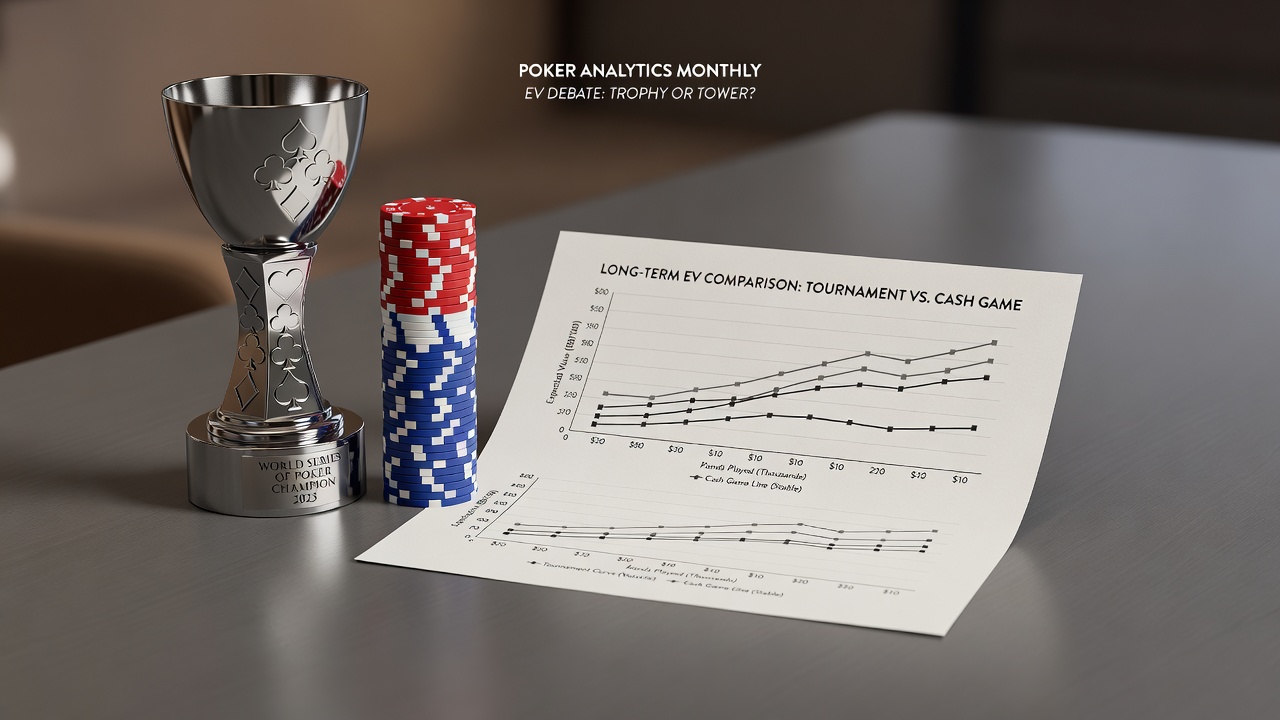
In the numbers, cash pays more reliably per hour for a given skill edge. The hourly standard deviation is lower. The bankroll required to play the stake is smaller. Over a career of, say, twenty years at steady mid-stakes cash, a skilled player will outearn a comparably-skilled tournament player in total dollars, net of travel, hotel, and the cost of lifestyle inflation that tournament success tends to produce.
In the living, the two feel nothing alike. Cash is a discipline. Tournaments are a narrative. The discipline lasts. The narrative does not, but it pulls at you harder in the moments when you are inside it, and the problem with the pull was that I kept answering. I would book a cash session, then register a satellite on the way, then play the satellite instead, then play the main event it fed, then wake up Tuesday owing Rachel an explanation I did not have.
I moved home four years ago. I see a counselor twice a month. I do not play any more. But people ask me, still, which one I would tell a young player to chase, if they had to pick.
I tell them cash. Not because cash is safer, exactly, but because cash does not teach you to want the spike. Tournaments do. The spike is what ruined me, and it was beautiful, and it was not worth what it cost.