
Bally, IGT, and the Companies That Built the Slot Industry
The slot machine industry is, in effect, the creation of half a dozen companies whose decisions over a century have shaped what the gambling floor looks and feels like. A considered look at Bally, IGT, Scientific Games, Aristocrat, and the others whose corporate manoeuvres produced the modern slot economy.
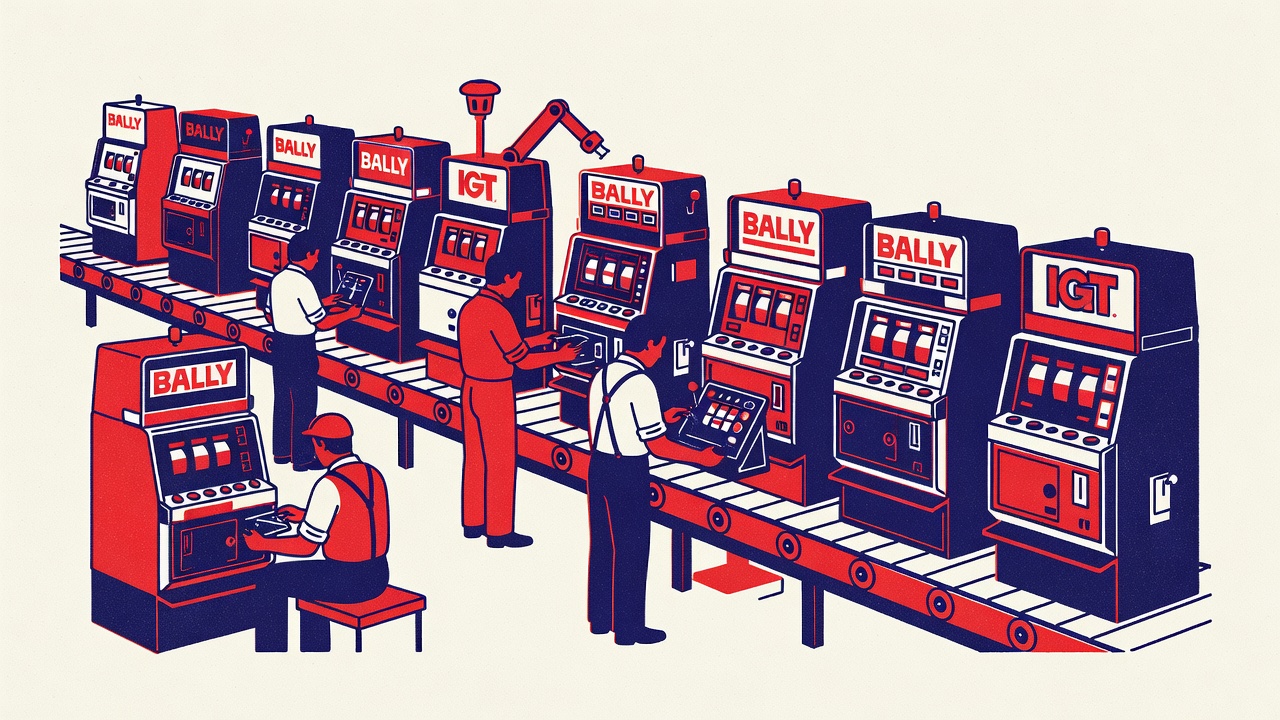
The slot machine, in its current form, is not a folk invention of unnamed tinkerers. It is, rather, the cumulative product of a small number of commercial enterprises whose strategic decisions have determined what the world's casino floors look and feel like, and what the world's online gambling interfaces inherit from that physical template.
The corporate history is, in one sense, a conventional tale of American and Australian industrial consolidation. In another sense, it is the story of how a mechanical curiosity became, through a sequence of patents, acquisitions, and technological leaps, one of the more globally pervasive forms of consumer engagement the twentieth century devised. What follows is an examination of how the principal companies built the machinery of modern slot gambling, with the particular attention to the question of why they, rather than any of the alternatives, came to dominate.
The pre-industrial slot
The mechanical slot machine's origin is generally dated to Charles Fey's Liberty Bell, patented in San Francisco in 1895. Fey's three-reel device with its diamond, heart, spade, horseshoe, and Liberty Bell symbols set the essential mechanical template for the next sixty years. Fey operated as an independent maker, refusing to sell his patents to the larger machinery firms that approached him. His business remained family-run, and by the 1920s Fey's dominance had eroded as competitors reverse-engineered his designs.
The industry's first serious consolidation came with the rise of Mills Novelty Company, based in Chicago, which through the 1910s and 1920s became the leading manufacturer of coin-operated gambling devices in the United States. Mills's Operator Bell and later Mills High Top machines furnished the majority of illegal and semi-legal slot machines in American speakeasies, smoke shops, and, by the 1930s, legal Nevada casinos.
Bally: the mid-century consolidator
Bally Manufacturing Corporation, founded in Chicago in 1932 by Raymond Moloney, began as a pinball manufacturer. Its 1936 Rock-Ola competitor machines established its position in the coin-operated amusement market. Bally entered the slot business properly in 1963 when it introduced Money Honey, the first fully electromechanical slot machine. Money Honey retained the visual three-reel template but replaced the spring-based mechanics with electrical switching, which permitted larger payouts, a hopper capable of paying out winnings automatically rather than requiring attendant intervention, and, critically, the introduction of multi-coin wagering.
Money Honey transformed the economics of the casino floor. A slot machine that could accept multiple coins per spin, pay larger hopper-dispensed jackpots, and operate continuously with minimal staff attention was a much more productive device than the mechanical predecessors. Bally became, through the 1960s and early 1970s, the dominant slot manufacturer in Nevada and beyond. By 1975, Bally held approximately 90 percent of the US slot market by unit sales.
IGT: the video revolution
International Game Technology, known universally as IGT, was founded in 1975 by William Redd under the name A-1 Supply and renamed shortly after. Redd had acquired the patents for Fortune Coin's video poker machine, invented by Dale Electronics, and began manufacturing video poker terminals for the Nevada market in the late 1970s.
Video slots followed in the 1980s. The video format permitted features that mechanical reels could not accommodate: multiple pay lines, bonus rounds, and, most consequentially, virtual reels whose symbol weighting could be configured independently of the visible reel presentation. Virtual reels, sometimes called virtual reel mapping, allow a three-reel display of, say, twenty-two physical stops to correspond to a virtual reel of, say, sixty-four or more weighted stops. This decouples the visible probability from the actual probability, which permits the near-miss effect that has since become a contentious feature of slot design.
By the mid-1990s, IGT had displaced Bally as the market leader. The 1996 launch of Wheel of Fortune, licensed from the television game show, marked IGT's ascent to dominance. Wheel of Fortune machines were, for several years, the highest-earning slots per day on most US casino floors.
Aristocrat: the Australian export
Aristocrat Leisure, based in Sydney, Australia, has been manufacturing slot machines since 1953. For several decades, the company was largely confined to the Australian and South Pacific markets, in part because US regulators were slow to certify non-American manufacturers for Nevada and other jurisdictions.
Aristocrat's global expansion accelerated from the mid-1990s. The Lightning Link and Buffalo game families, introduced respectively in 2014 and 2006, became genuinely global slot brands, installed in casinos across North America, Europe, and Asia. Aristocrat's 2021 acquisition of the Playtech business segment known as Plitch, and its parallel investment in the online slot software market, has positioned the company as a leading supplier to both land-based and online operators.
Aristocrat's market share in the United States, as of 2023, was reported to be second only to IGT and comparable to Scientific Games in certain regional markets.
Scientific Games: the consolidator's consolidator
Scientific Games Corporation, known for many years simply as Scientific Games, began its life as a lottery ticket printer in 1973. Its transformation into a major slot manufacturer came through a series of acquisitions in the 2010s: WMS Industries in 2013, Bally Technologies in 2014, and, through those acquisitions, the slot portfolios that had once belonged to Williams, Midway, and others.
The Bally acquisition, incidentally, is where the Bally brand passed from independent operation into the Scientific Games portfolio. The Bally name continued to appear on machines manufactured under Scientific Games ownership, maintaining a brand recognition that the buyer had purchased along with the underlying assets.
In 2022, Scientific Games was rebranded as Light & Wonder, reflecting the company's strategic pivot toward integrated gaming experiences rather than pure manufacturing. The transition also involved the sale of the lottery business, which had been the firm's original business, to private equity.
The online transition
The migration of slot manufacturing into online software has been the defining industry story of the 2000s and 2010s. Several of the companies that dominate online slot supply emerged independently of the land-based manufacturers.
Microgaming, founded in 1994 on the Isle of Man, was the first significant online slot developer. Its title portfolio, built over three decades, has included Mega Moolah, Thunderstruck, Immortal Romance, and hundreds of others. Games Global, spun out of Microgaming in 2022, now holds and licenses the Microgaming-origin content.
NetEnt, founded in Sweden in 1996, built a portfolio of slots whose mathematical and visual quality was considered a step above the industry average for much of the 2000s and 2010s. NetEnt was acquired by Evolution Gaming in 2020, bringing the Swedish online slot business under the same corporate umbrella as the dominant live-dealer casino operation.
Pragmatic Play, founded in 2015 in Malta, has grown rapidly to become one of the largest online slot suppliers by game volume. Its slot portfolio, emphasising aggressive volatility and bonus-buy features, has been controversial but commercially successful.
Play'n GO, Evoplay, Relax Gaming, Hacksaw Gaming, and Nolimit City represent the current generation of online slot developers whose design language, heavily influenced by the older land-based manufacturers, has in turn begun to influence the content choices of Aristocrat, IGT, and Light & Wonder in their own online offerings.
The design lineage
The visual and interactive template of a modern online slot, whether from Pragmatic Play, Play'n GO, or one of the established land-based manufacturers, is recognisably descended from the Bally electromechanical era via the IGT video slot era via the online software era.
The three-reel symbol template survives, transmuted, in the five-reel video slot. The multi-line pay structure that IGT introduced in the 1980s survives as the 243-ways and 1,024-ways mechanics of modern titles. The bonus round concept, which IGT and Bally developed in parallel in the 1990s, is now the central engagement mechanism of nearly every released slot. The virtual reel mapping that allowed near-miss effects in the 1980s survives as the regulated-but-real volatility design of the present day.
Each design choice was, in its time, a commercial decision by a specific company, made for a specific competitive reason, and preserved because it worked. The industry did not evolve; it accumulated.
The concentrated present
The slot industry, as of 2024, is highly consolidated. A handful of publicly traded firms, Light & Wonder, IGT, Aristocrat, and a second tier including Evolution, Games Global, and Pragmatic Play, account for the majority of global slot revenue in both land-based and online channels. Regulatory barriers to entry have risen, certification costs have risen, and the scale required to operate across jurisdictions has likewise risen.
Small independent slot developers still exist and occasionally produce titles that attract genuine followings, but the economics favour the large suppliers. The design sensibility that emerges from the concentrated industry is consequently a rather narrow band, with innovations occurring largely at the margins of bonus mechanics and volatility tuning rather than in the fundamental structure of the game.
The slot industry is a century-old artefact of corporate decisions. Every colour, sound, and volatility curve on the modern gaming floor descends from a specific commercial choice by a specific company in a specific decade.
That the industry now produces billions of dollars in annual revenue globally is, in one sense, a tribute to the accumulated ingenuity of Bally, IGT, Aristocrat, and their competitors. In another sense, it is a reminder that the shape of mass entertainment in the twenty-first century is determined by a small number of firms whose decisions are rarely visible to the customers they serve. Knowing the history does not change the house edge. It does, however, change what one sees when one looks at the flashing cabinet.