
Baccarat Banker vs Player Bet: Which Has the Better Expected Value?
Banker or Player? It is the classic baccarat question and the answer is actually really specific. Here is the real math, the real edges, and the stuff most guides completely miss.
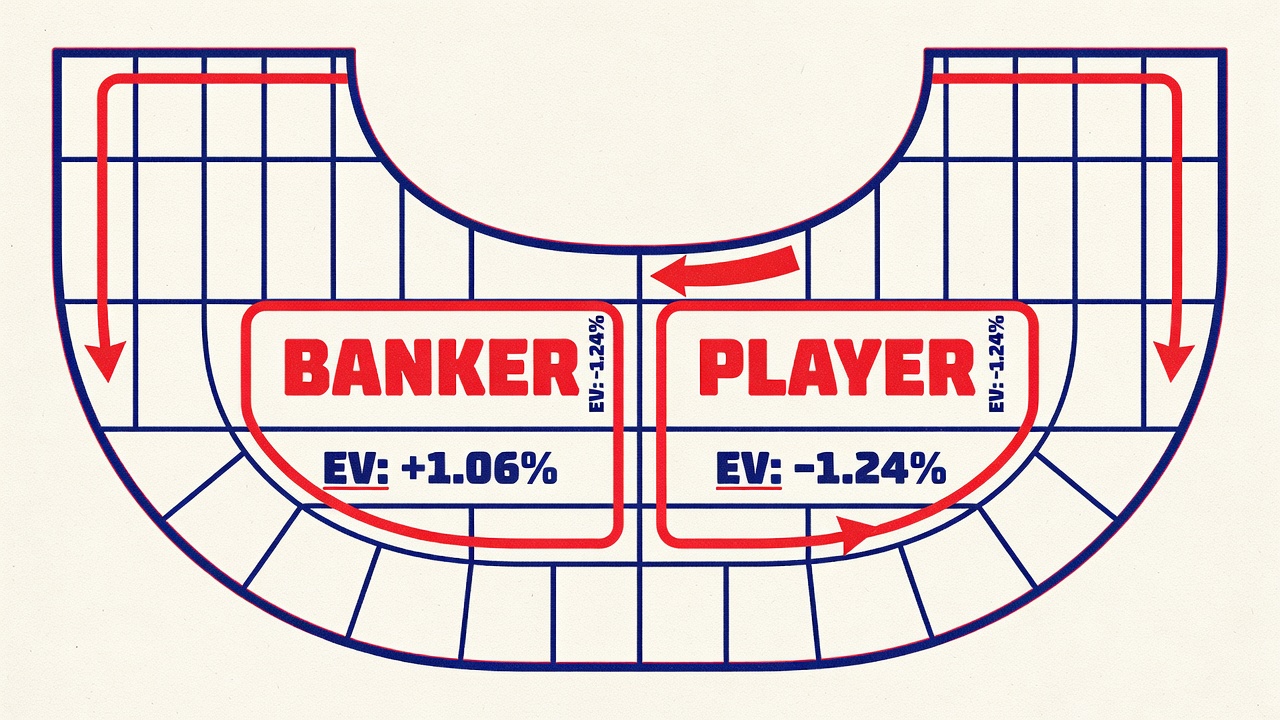
Banker or Player. The eternal baccarat question. Let me walk through the actual list of what you need to know, because the simple answer is wrong in like four different ways.
Here are the points, in order.
1. Banker Wins More Often
The Banker bet wins about 45.86 percent of hands. The Player bet wins about 44.62 percent. Ties happen roughly 9.52 percent of the time.
If you ignore ties and just compare winning bets, Banker wins roughly 51 percent of decisions to Player's 49 percent. That is a small but real statistical advantage built into the rules of the game. Specifically, the Banker draws a third card conditionally based on Player's third card, which lets the Banker react to information the Player cannot.
2. The Commission on Banker Is Not a Gimmick
When you win a Banker bet, the casino takes 5 percent commission. This is not marketing. It is the house protecting itself against the structural advantage Banker has.
Without commission, Banker would have a player-positive edge. Every baccarat table in the world would print money for disciplined Banker bettors. The 5 percent commission is precisely calibrated to pull Banker back into a small house edge, because the casino knows the math.
3. Banker Edge Is About 1.06 Percent
After commission, the house edge on the Banker bet is approximately 1.06 percent. This is one of the lowest house edges in any casino game.
For comparison, European roulette is 2.7 percent, American roulette is 5.26 percent, and most slots run 3 to 8 percent. Baccarat Banker is cheaper to play than almost anything else on the floor.
4. Player Edge Is About 1.24 Percent
The Player bet has a 1.24 percent house edge. No commission, slightly lower win rate.
It is a perfectly reasonable bet. It is just not as good as Banker. If you were going to pick one and play it forever, math says Banker.
5. The Tie Bet Is a Trap
The Tie pays 8 to 1 at most tables. The actual probability of a tie is 9.52 percent, which means fair odds would be closer to 9.5 to 1.
The house edge on the Tie bet is 14.4 percent. That is worse than almost every slot machine. Some tables pay 9 to 1, which brings the edge to 4.85 percent, still bad but survivable.
Do not make the Tie bet. Ever. This is one of the clearest math lessons in the pit.
6. No-Commission Baccarat Is Still a House Game
Some tables offer "commission-free" Banker. The catch is that Banker winning with a total of 6 only pays half, instead of the full 1 to 1.
The house edge on no-commission Banker with the 6-pays-half rule is about 1.46 percent. Worse than commission baccarat. The "free commission" framing is marketing, and the house is using a different mechanism to get the same edge back.
7. Patterns, Streaks, and Roadmaps Do Not Work
Baccarat tables display shoe history in elaborate Chinese-style grids. Bead plate, big road, small road, cockroach pig, you name it. Players use them to spot patterns.
These do nothing. Each hand is independent given the cards left in the shoe, and card removal effects in baccarat are vanishingly small. The roadmaps are a UI feature that gives players the illusion of decodable structure. There is no structure.
If there was, the casinos would remove the displays.
8. Card Counting Baccarat Is Technically Possible
There are confirmed historical cases of advantage play in baccarat, especially around the third-card drawing rules. Edward Thorp's team in the 1960s identified edges in end-of-shoe situations under certain rules variations.
In practice, the edges are so thin that even professional card counters rarely bother. The bet-sizing required to profit from a 0.1 percent advantage is too steep for most bankrolls. Baccarat counting is possible. It is also mostly not worth doing.
9. The Banker Streak Myth
Banker hits are distributed across the shoe. Sometimes you get 12 Banker wins in a row. Sometimes you get 8 Player wins in a row. Humans see streaks and assume they are meaningful.
Because Banker wins slightly more often, the average streak length for Banker is slightly longer than Player. This is real. Chasing the streak by pressing bets after a run is not a strategy, it is variance-amplified gambling. The math does not care whether the last five were Banker.
10. The Actual Answer
Bet Banker. Accept the 5 percent commission. Skip the Tie. Do not chase streaks. Ignore the roadmaps.
You will still lose in the long run, but slower than at almost any other table in the casino. That is the actual, unsexy answer.