
21: The Movie vs the True MIT Blackjack Team Story
The 2008 film 21 Hollywood-ised the MIT Blackjack Team into an Asian-American-free, romance-driven thriller. Here is what actually happened, measured against what ended up on screen.
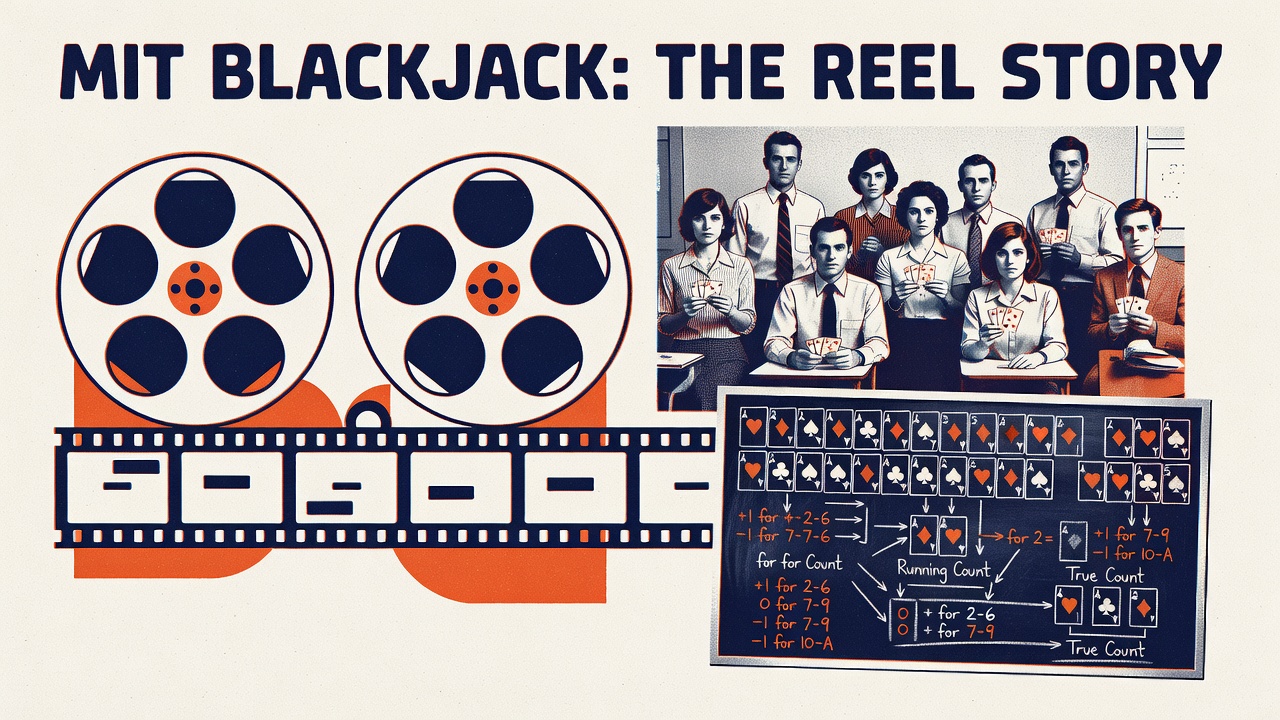
The movie came out on 28 March 2008. The team it was based on had been counting cards against Las Vegas casinos for over twenty years by that point.
This is a close look at what the film got right, what it got wrong, and what it invented, measured against the documented history of the MIT Blackjack Team. The source material for the film was Ben Mezrich's 2002 book Bringing Down the House, which itself was a fictionalised account of the team's late-1990s operation.
The team, as it actually was
The MIT Blackjack Team, in its longest-running form, operated from roughly 1979 until the early 2000s. It was not a single team. It was a series of overlapping teams with shared core members and evolving corporate structures. The original team was organised by Bill Kaplan, a Harvard MBA and experienced counter, along with J.P. Massar and John Chang, two MIT students who had been running an informal counting operation.
The team's peak years were from 1992 through roughly 1997. During that period, they ran a professional operation with investors, detailed hand-counting curricula, managed bankrolls running into millions of dollars, and a structured approach to what they called the "big player" system.
The big player system
This is the mechanic the movie actually did portray, more or less accurately. Counters would sit at multiple tables throughout a casino flat-betting small amounts, tracking the true count. When a table hit a count favourable to the player, the spotter signalled a big player to come sit down. The big player, who had not been counting, would drop large bets on the already-positive count, scoop the edge, and leave when the count cooled.
The spotter-controller-big player architecture insulated each role. Spotters were hard to catch because they bet small. Big players were hard to catch because they did not appear to be counting, only winning at the right tables. The division of labour multiplied the team's effective edge and complicated surveillance's job of identifying a pattern.
The real principals
The film composites and renames the real team members. The character of Ben Campbell, played by Jim Sturgess, is a fictionalised version of Jeff Ma, a Chinese-American MIT graduate who was one of the team's most effective big players from the early to mid-1990s. The film cast Sturgess, a white British actor, in the role. The casting was widely criticised at the time and has remained a point of discussion about Hollywood whitewashing.
The character of Micky Rosa, played by Kevin Spacey, is a composite of Bill Kaplan, J.P. Massar, and John Chang. The real Kaplan was in his late thirties and early forties during the team's peak. He had a Harvard MBA, not the charisma-villain persona of the Spacey portrayal. John Chang, Jeff Ma, Mike Aponte, and Semyon Dukach were all active core members. The film reduces this roster to a pair of composites.
The love interest Jill Taylor, played by Kate Bosworth, is invented. The real team had female members, including Katie Lilienkamp, but the romance arc of the film is pure Hollywood.
What the movie got right
- The big player system and its signalling.
- The use of verbal codes to communicate the count ("the gorilla is hungry" style phrases, which the real team did use in various forms).
- The eventual pressure from casino surveillance and the Griffin Investigations agency that tracked counters across properties.
- The scale of the winnings. The team did earn millions over its active years.
- The idea that MIT students, many of them engineers and mathematicians, could out-math the house.
What the movie got wrong
- The team members were not mostly white. They were predominantly Asian-American, with members drawn from the broader MIT community. The casting erased this.
- Micky Rosa's character betrayal arc, where he turns on the team for his own profit, is fictional. No equivalent betrayal is documented.
- The casino violence subplot, where counters are taken to back rooms and beaten, did not reflect the real 1990s Vegas. Backoffs in that era were aggressive but generally verbal. Physical violence against detected counters was mostly a 1970s phenomenon.
- The film compresses a multi-year operation into what appears to be a single school year. The real work involved months of training, bankroll building, and careful trip planning over many years.
- The card counting itself is oversimplified. Real team members spent 100 hours or more learning the Hi-Lo count, true count conversion, index plays, and side-counts before they were cleared to play team money.
What the movie invented entirely
- The romance. No documented real-life equivalent.
- The Vegas back-room beatings as depicted. Did not happen in that form.
- The singular villain figure of Cole Williams, played by Laurence Fishburne. Griffin Investigations was real, but there was no single nemesis like this character.
- The climactic Vegas heist-style final trip. The real team wound down over years, not in a single last job.
The real ending
The team did not end in a dramatic showdown. It ended through attrition. Casino surveillance improved. Griffin Investigations circulated photo databases of suspected counters across properties. By 2000, the cost of staying undetected started outweighing the edge for the big players who had spent years on the circuit.
The final iterations of the team, under names like Strategic Investments, dissolved in the early 2000s. Bill Kaplan has since co-founded an online poker business. John Chang is a professional gambler and educator. Jeff Ma founded a sports analytics company in Boston and now works in technology. Mike Aponte co-founded a blackjack training business.
What the movie did for card counting
The film made card counting briefly famous again. Casinos responded by accelerating the deployment of continuous shuffling machines and reducing deck penetration. Hi-Lo became the most commonly taught beginner count because of the increased interest, and a generation of counters cut their teeth in the aftermath of the film's popularity.
Whether that was net good or bad for active counters is debatable. More interest meant more dilettantes at the tables making the pit's job of spotting real counters harder, in a sense. But it also meant tighter countermeasures industry-wide.
The movie was fiction built on a true foundation. The real story was slower, more careful, and far less white than the film suggested.
Read Bringing Down the House if you want the halfway version. Read Ed Thorp's Beat the Dealer if you want the origin of the math. Read Ben Mezrich's follow-up Busting Vegas for a slightly different slice of the same community. The film is entertainment. The history is better.